
When scale-out AI training workloads transfer massive datasets between GPU memory spaces across nodes, traditional TCP/IP stacks introduce high latency and significant host CPU overhead. How does Remote Direct Memory Access (RDMA) resolve this performance bottleneck?
Select an answer to reveal the explanation.
Short Explanation and Infographic
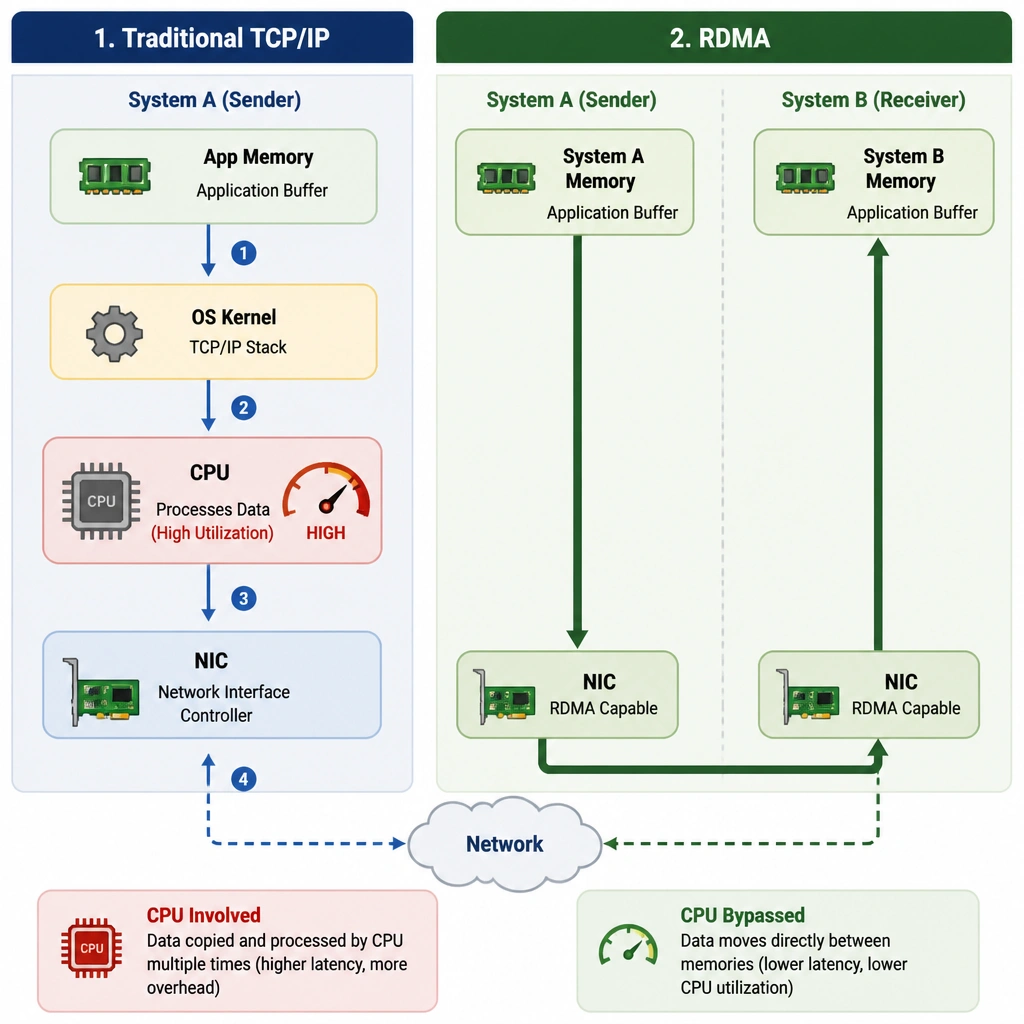
Here's the deal: with traditional TCP networking, when data arrives at the network card, it has to be copied to the kernel space, then the host CPU gets interrupted, and finally it gets copied to the application space. If you're pushing hundreds of gigabits of AI data, your CPU is going to scream under that load! Think of RDMA like a VIP pass. It lets the network interface card (NIC) write data directly into the remote system's memory without asking the operating system kernel or host CPU for permission. That means near-zero latency and almost zero CPU usage, letting your CPUs and GPUs focus on the actual math instead of moving bytes. Got it? Sweet.
Full explanation below image
Full Explanation
Remote Direct Memory Access (RDMA) is a networking technology that enables computers in a cluster to transfer data directly between their respective memory spaces (RAM or GPU VRAM) without involving the operating system kernel or the host CPU on either system. In traditional TCP/IP networking, data transfer requires multiple memory copies (from application buffer to kernel socket buffer, then to network adapter) and triggers frequent CPU interrupts, which limits throughput and increases latency. RDMA bypasses the host operating system stack entirely by offloading the transport protocol to the network interface card (NIC) hardware (such as InfiniBand or RDMA over Converged Ethernet (RoCE)). This direct transfer capability yields extremely high throughput and ultra-low latency while maintaining near-zero CPU utilization.
Let's look at why the other options are incorrect: Option A is incorrect because RDMA's primary focus is performance and latency reduction. It does not natively provide built-in hardware-layer encryption; security is typically handled by separate protocol layers or network configurations. Option C is incorrect because RDMA requires hardware support on both the host network adapters (RNICs) and the network switch fabric (supporting either InfiniBand or lossless Ethernet features like Priority Flow Control for RoCE). It cannot run over legacy, unconfigured Ethernet switches. Option D is incorrect because RDMA does not compress data in system RAM before sending it, nor does it use traditional TCP ports. Instead, it moves uncompressed memory blocks directly across the network using hardware-level transport mechanics.