
In a high-performance AI cluster running the Slurm workload manager, a large training job requiring 64 GPUs is queued and waiting for enough nodes to free up. While it waits, Slurm identifies smaller, short-duration jobs in the queue and runs them on the currently idle nodes, ensuring they complete before the large job's scheduled start time. What is this optimization technique called?
Select an answer to reveal the explanation.
Short Explanation and Infographic
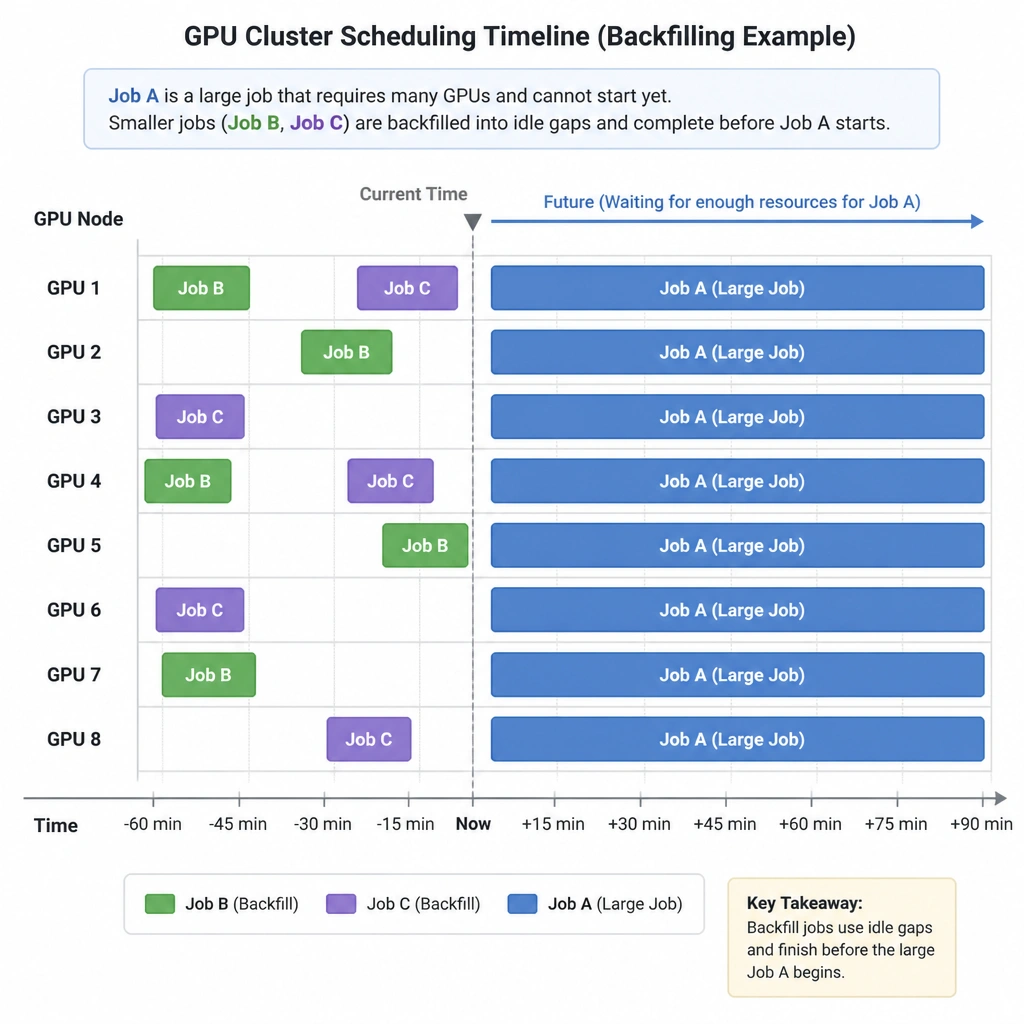
Imagine you're waiting at a restaurant for a big table of ten to open up. The hostess isn't going to let that empty table of two sit idle for an hour while they wait for your party to assemble—she's going to seat a couple who can eat and leave before your friends arrive. That's exactly how Slurm's backfill scheduling works! If a massive training job is waiting for 64 GPUs to free up, Slurm looks at the queue, finds smaller jobs that only need a couple of GPUs for a quick 10-minute run, and slips them in. The key is that they must finish before the big job is ready to start. It keeps cluster utilization high instead of letting expensive nodes sit around doing nothing!
Full explanation below image
Full Explanation
Backfill scheduling is an advanced scheduling optimization used by Slurm and other high-performance computing (HPC) workload managers to maximize cluster utilization and minimize job queue wait times. In a standard priority-based queue, if the top-priority job cannot run because it is waiting for sufficient resources (like a large multi-node GPU allocation) to become available, the scheduler reserves those resources as they free up. Normally, this would cause the cluster's utilization to drop as nodes sit idle waiting for the entire allocation to compile. Backfill scheduling solves this by scanning the queue for lower-priority, smaller, or shorter jobs and launching them on the idle resources, provided that their estimated runtimes guarantee they will complete before the high-priority job's expected start time.
Let's look at why the other options are incorrect: Option A is incorrect because Fair-share scheduling is a mechanism used to calculate job priorities based on how much resource a user or group has historically consumed relative to their allocation. It does not handle the dynamic scheduling of short jobs in idle slots. Option C is incorrect because preemptive rescheduling involves suspending or terminating lower-priority jobs to free up resources immediately for higher-priority jobs. Backfill scheduling does not terminate any jobs; it only runs jobs that are guaranteed not to delay the high-priority job. Option D is incorrect because strict priority-based queuing processes jobs strictly in order of their priority, meaning that if the highest-priority job is blocked waiting for resources, no other jobs are allowed to start, leaving many nodes idle.