
An enterprise data science team is deploying the NVIDIA Merlin framework to optimize their end-to-end recommendation systems. Which of the following are considered core component libraries that make up the central NVIDIA Merlin framework? (Select three)
Select all correct answers, then click Submit.
Short Explanation and Infographic
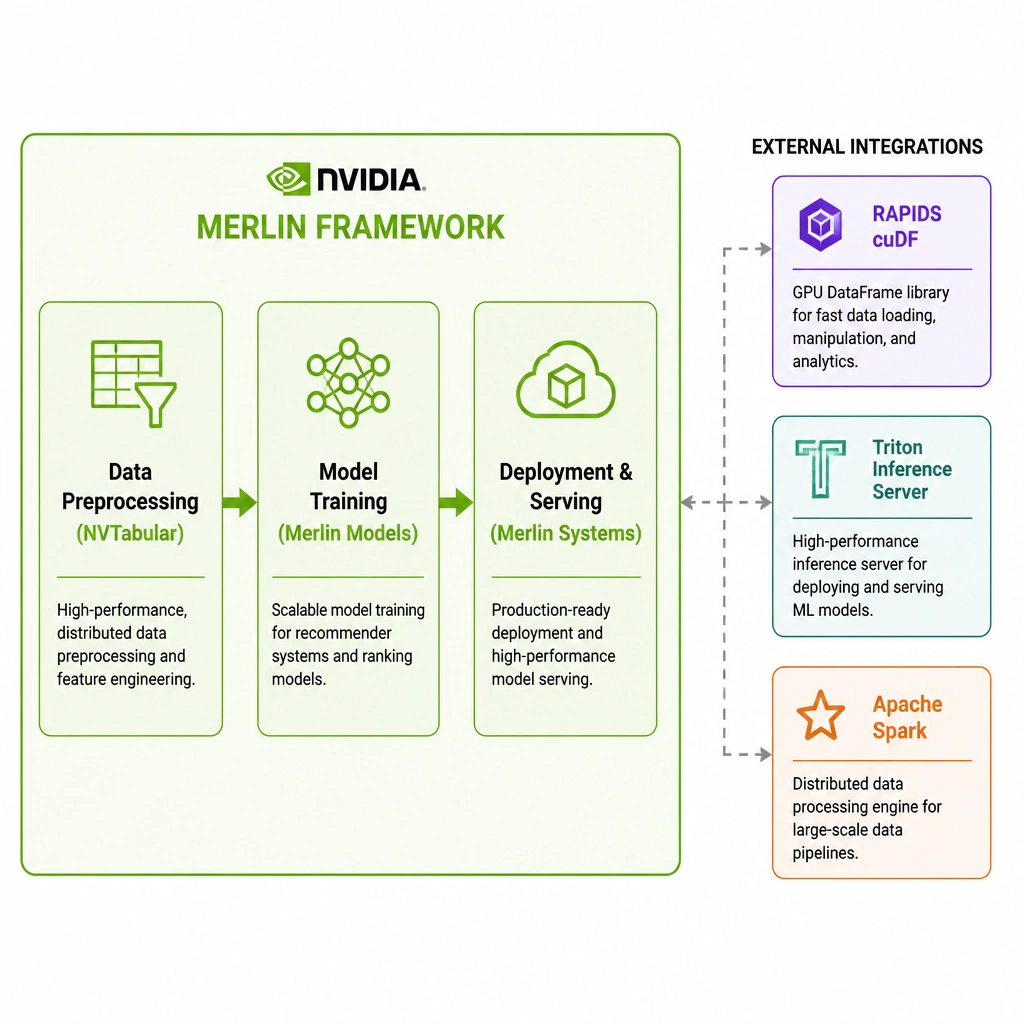
Here's the deal: building recommendation systems is incredibly tough because you have to handle massive datasets of user clicks, train complex models, and serve recommendations in milliseconds. To make this easier, NVIDIA built the Merlin framework. It is structured around three core libraries that handle each phase of the pipeline. First, you use NVTabular (Option C) to handle data preprocessing and feature engineering on the GPU. Next, you use Merlin Models (Option D) to quickly train and evaluate common recommender architectures. Finally, you use Merlin Systems (Option A) to deploy that model and hook it up to your production pipeline. While you might use Triton (Option E) or RAPIDS cuDF (Option B) alongside Merlin, they are separate tools, not core libraries of the Merlin framework itself. And Apache Spark (Option F) is a general CPU-based big data framework, definitely not part of Merlin. Keep these three core libraries straight for the exam!
Full explanation below image
Full Explanation
NVIDIA Merlin is an open-source, GPU-accelerated framework designed to build, train, and deploy high-performance recommendation systems at scale. Recommender systems require processing huge tables of user interactions, and Merlin addresses this by offering a specialized ecosystem composed of three core libraries:
1. NVTabular (Option C): A GPU-accelerated data preprocessing and feature engineering library designed to quickly manipulate large-scale tabular datasets (handling billions of rows) and prepare them for training. 2. Merlin Models (Option D): A library containing pre-built, optimized recommender system architectures (such as DLRM, DCN, and DeepFM). It simplifies model definition, training, and evaluation on GPUs. 3. Merlin Systems (Option A): A library that bridges the gap between training and production deployment. It orchestrates the retrieval, filtering, and ranking steps required to serve recommendations in live environments.
Let's review the incorrect options: - RAPIDS cuDF (Option B) is a GPU-accelerated dataframe library. While NVTabular utilizes cuDF under the hood to perform GPU-accelerated operations, cuDF is a separate component of the RAPIDS suite, not a core Merlin library. - Triton Inference Server (Option E) is NVIDIA's general-purpose model serving platform. While Merlin Systems frequently exports pipelines to Triton, Triton itself is a standalone product. - Apache Spark (Option F) is an open-source distributed cluster-computing framework, not a component of the NVIDIA Merlin framework.
Understanding the specific role of each library is key to designing end-to-end recommender systems.