
A cluster administrator is configuring a Kubernetes-based scheduling policy for a multi-tenant GPU cluster. Several users are submitting distributed training jobs that require multiple GPUs to run concurrently. Which scheduling mechanism ensures that a job's request for multiple GPUs is either fully satisfied all at once or held in queue, preventing resources from sitting idle while waiting for the remainder of the allocation?
Select an answer to reveal the explanation.
Short Explanation and Infographic
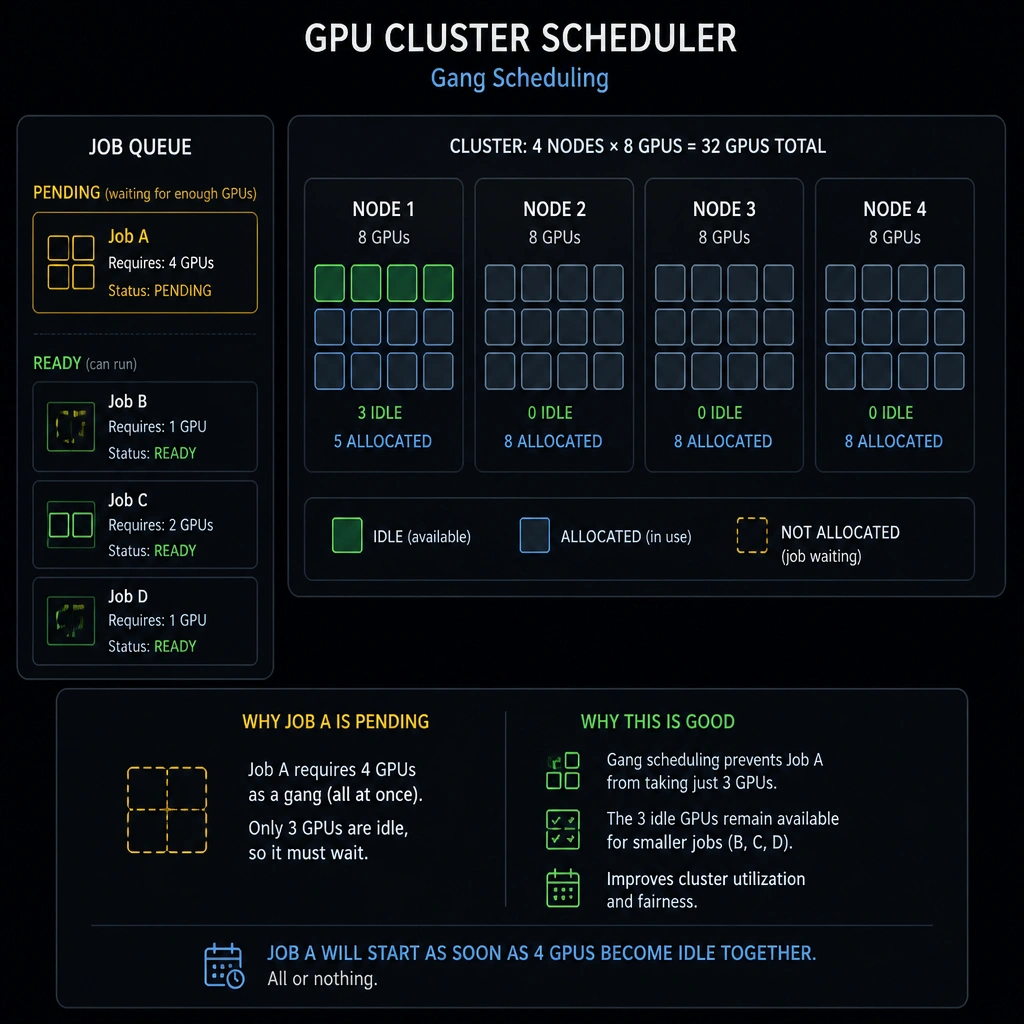
Think of this like going to a popular restaurant with a group of four friends. The host says, 'I have two chairs open right now. Do you want to sit down?' If you take those two seats, you're sitting there doing nothing while your other two friends wait outside. Plus, those seats are wasted because another group of two people could have used them. In GPU clusters, this is called resource fragmentation. A distributed AI job needs all of its GPUs to start running at the exact same time. If a scheduler gives a job four GPUs when it actually needs eight, those four GPUs will just sit there idling and wasting money while waiting for the others. Gang scheduling solves this. It's an all-or-nothing deal: the scheduler will hold the job in the queue until all the requested GPUs are available to start simultaneously. That keeps your cluster running efficiently. Got it? Sweet!
Full explanation below image
Full Explanation
In high-performance AI clusters, distributed training jobs require multiple GPUs to execute tasks synchronously and exchange gradients (using collective communication). Because these tasks are tightly coupled, the job cannot make progress unless all its constituent tasks are running.
The correct scheduling technique to handle this is Gang scheduling (also known as co-scheduling). Gang scheduling is an algorithm that schedules a set of closely related, parallel tasks to run on multiple resources simultaneously. In a GPU cluster, it ensures that a distributed job is only allocated resources when the entire required set of GPUs can be provisioned at the same time. If the cluster cannot satisfy the full resource request, the entire job remains in the queue. This prevents 'deadlocks' and resource fragmentation, where a job holds onto a subset of GPUs while idling, blocking other workloads from utilizing those resources.
Let's analyze why other scheduling methods fail in this scenario: - First-Come, First-Served (FCFS) allocates resources in order of arrival. If a large job arrives and only a few GPUs are free, FCFS might assign those free GPUs to the job, which then sits idle waiting for the rest of the cluster to clear, causing a head-of-line bottleneck. - Round-Robin distributes tasks evenly across resources sequentially, which does not guarantee that a specific group of parallel tasks will be scheduled together in a coordinated block. - Priority-based preemption terminates lower-priority jobs to free up resources. While it handles job urgency, it does not inherently guarantee atomic, all-or-nothing allocation of multi-GPU resources unless paired with gang scheduling logic.