
An enterprise machine learning team experiences highly erratic workloads, with massive training runs occurring for a few days every month followed by weeks of near-idle resource usage. What is the primary benefit of utilizing public cloud GPU resources instead of building out a dedicated on-premises GPU cluster for this scenario?
Select an answer to reveal the explanation.
Short Explanation and Infographic
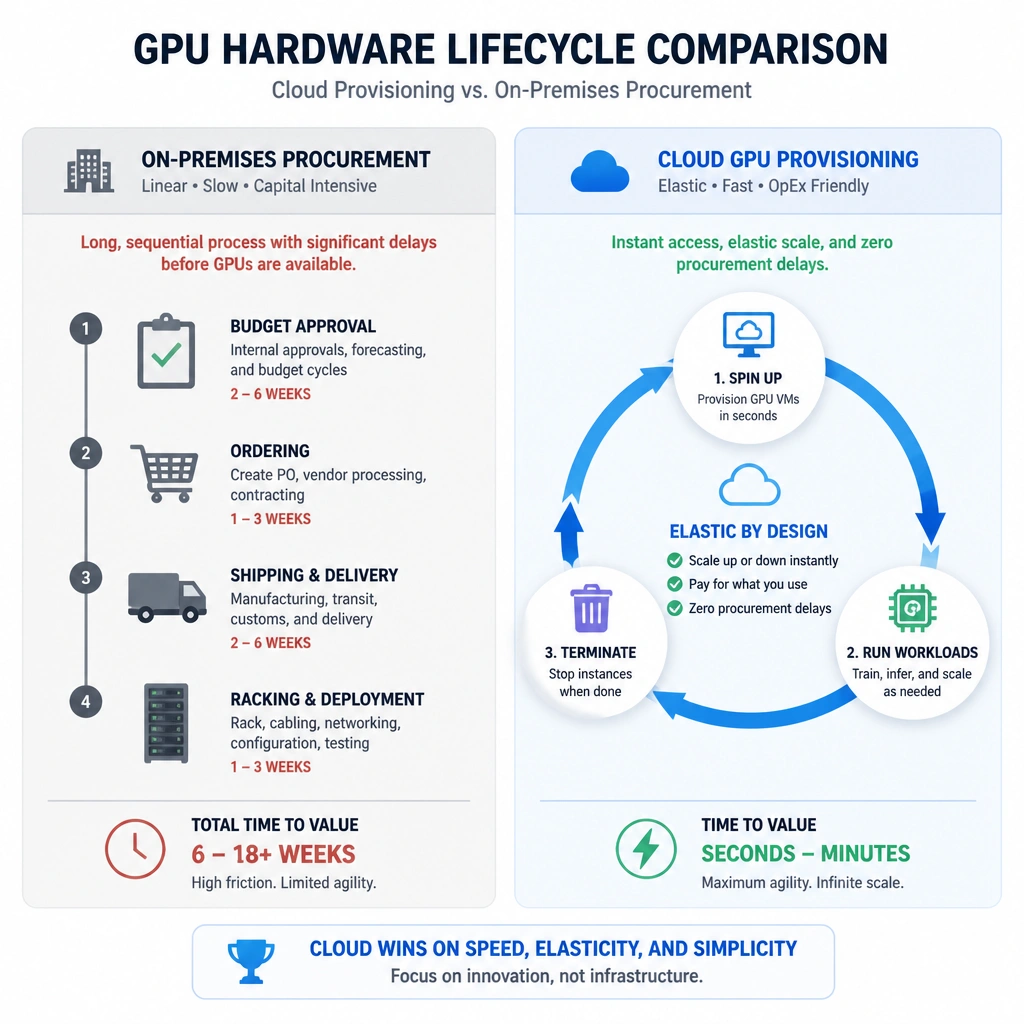
Here's the deal: if your boss walks in and says we need to spin up 64 H100 GPUs for a massive training run by tomorrow, what happens if you're on-premises? You're going to be waiting months for budget approval, vendor shipping, and datacenter rack deployment. Not cool, right? Public cloud GPU infrastructure completely changes the game here. The cool thing is that you can scale up a massive cluster in minutes to handle those huge, erratic training runs, and then tear them right back down so you aren't paying for idle silicon. Got it? Sweet. Remember, it's all about avoiding procurement lag and scaling dynamically.
Full explanation below image
Full Explanation
The key advantage of cloud-based GPU infrastructure for fluctuating workloads is elasticity—specifically, the capability to scale compute resources up or down on demand without the long lead times associated with physical hardware acquisition. In a traditional on-premises model, accommodating a sudden spike in AI/ML workloads requires purchasing, installing, and configuring physical GPU servers. This hardware procurement process can take weeks or months, creating a severe bottleneck for agile development. By contrast, cloud GPU providers maintain large pools of resources that can be provisioned almost instantly via API calls or management consoles, allowing organizations to respond rapidly to changing business needs.
Let's look at why the other options are incorrect: Option A is incorrect because on-premises deployments often deliver superior latency and raw performance compared to cloud environments. On-premises setups avoid the hypervisor overhead, virtualization layers, and network latency inherent in multi-tenant cloud environments. Option B is incorrect because hosting data on public cloud infrastructure introduces complex regulatory, privacy, and compliance challenges. Many highly regulated industries (like healthcare and finance) prefer on-premises infrastructure specifically to guarantee data sovereignty and maintain absolute control over security boundaries. Option D is incorrect because cloud resources are not always the cheapest option. While cloud is cost-effective for variable or short-term workloads due to its pay-as-you-go billing, a steady-state, 24/7/365 high-utilization workload is often far less expensive when run on-premises over the hardware's lifespan.