
In a Slurm-managed AI cluster, a massive multi-node training job is waiting in the queue for a block of 64 GPUs to become free. While the scheduler is waiting for those resources to accumulate, which scheduling mechanism allows smaller, shorter-running jobs to run on the currently idle nodes without delaying the start time of the big job?
Select an answer to reveal the explanation.
Short Explanation and Infographic
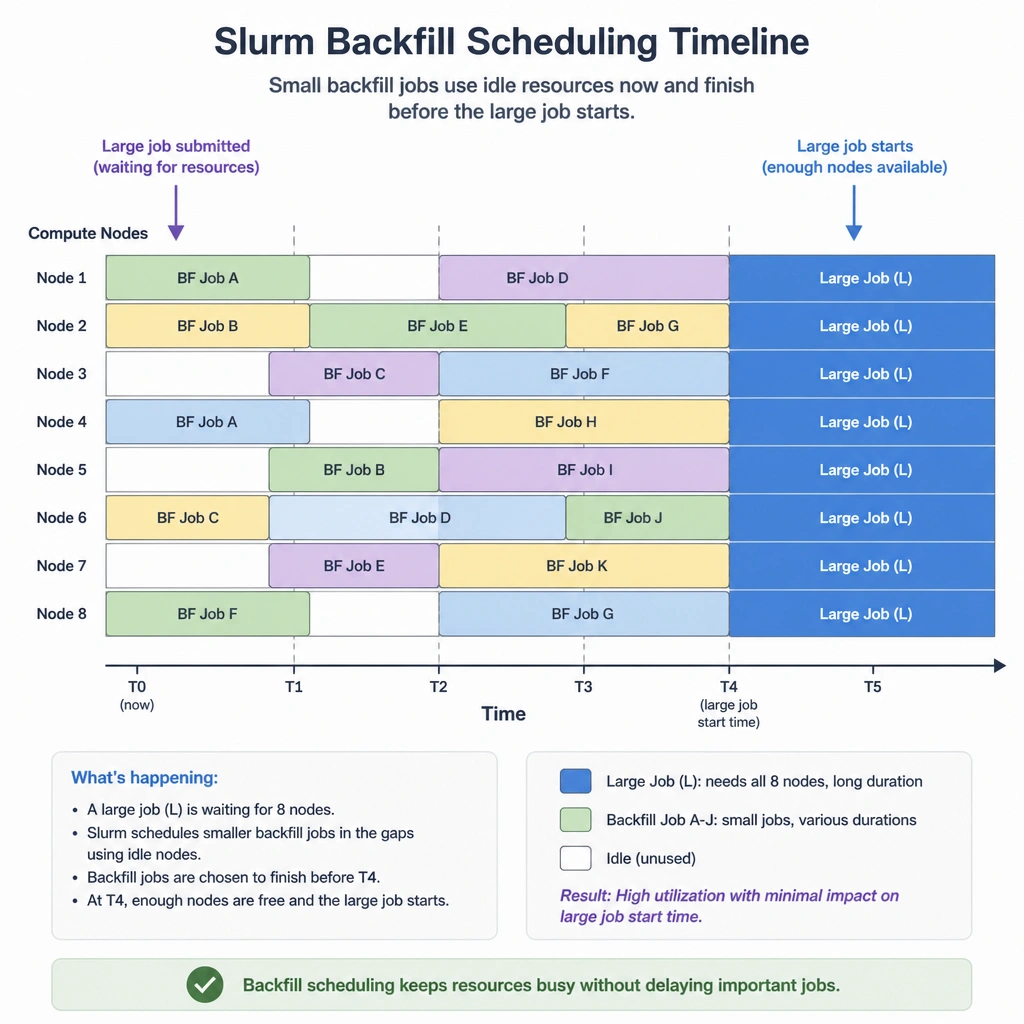
Let's say a developer submits a massive job that needs 64 GPUs to start. The scheduler has to hold those GPUs as they become free until it has enough to start the job. But in the meantime, you've got idle nodes just sitting there doing nothing. Talk about a waste of resources! This is where backfill scheduling steps in. It lets smaller, quick jobs sneak into those empty slots and run, as long as they promise to finish before the big job is scheduled to start. The key is that it doesn't delay the big guy. To make this work, your users must specify accurate runtime limits for their jobs. Otherwise, the scheduler has to guess, and that never ends well. Remember: backfilling fills the gaps and keeps your cluster utilization high!
Full explanation below image
Full Explanation
Slurm (Simple Linux Utility for Resource Management) uses advanced scheduling algorithms to maximize cluster utilization and ensure fairness. - Why Option D is correct: Backfill scheduling is a resource allocation technique that allows smaller, lower-priority jobs to start before higher-priority jobs that are blocked waiting for resources. Normally, if a high-priority job is waiting, the scheduler reserves resources as they become free, leaving some nodes idle. Backfill scheduling scans the queue for smaller jobs that can run and complete on those idle nodes before the reserved resources are fully assembled for the high-priority job. This requires users to specify accurate job time limits (--time or -t) so the scheduler can calculate start and end times precisely. - Why Option A is incorrect: FIFO (First-In, First-Out) scheduling executes jobs strictly in the order they are received. If the job at the head of the queue is blocked, all subsequent jobs must wait, regardless of size or duration, leading to poor cluster utilization. - Why Option B is incorrect: Gang scheduling is a time-slicing method where multiple jobs are scheduled to run concurrently on the same resources by swapping them in and out of execution, which is not designed to utilize idle reservation windows. - Why Option C is incorrect: Fair-share scheduling is a prioritization mechanism that calculates a job's priority based on the historical resource consumption of the user or group, rather than dynamically placing jobs to fill idle resource windows. Memory Aid: Backfill scheduling is like filling a jar. You put the big rocks (large jobs) in first, and then you pour sand (small jobs) to fill the remaining gaps without moving the big rocks.