
You are setting up an Out-of-Band Management (OOBM) network for a multi-tenant AI cluster. Which of the following operational challenges does OOBM help solve in this high-density environment? (Select all that apply)
Select all correct answers, then click Submit.
Short Explanation and Infographic
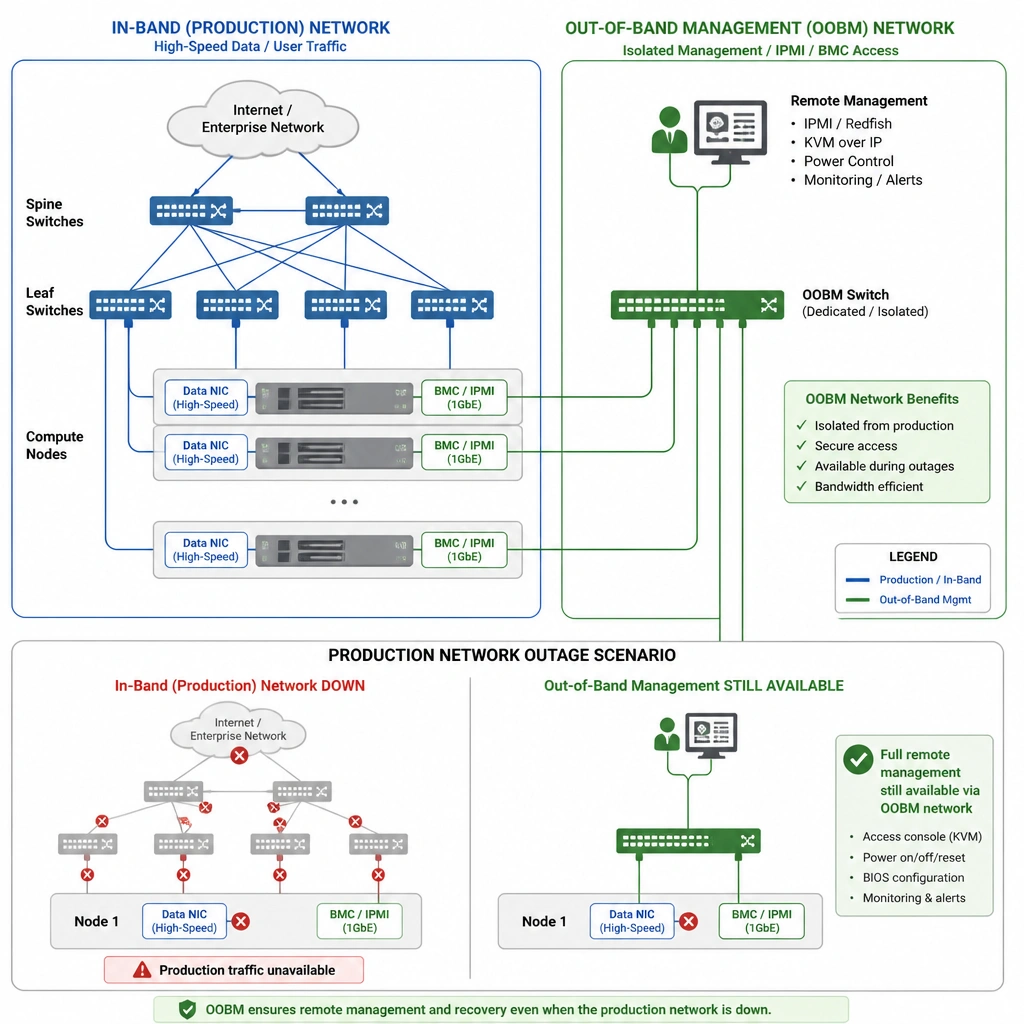
Imagine your production network goes down, and you can't reach your AI servers. If you don't have Out-of-Band Management (OOBM), you're driving to the data center in the middle of the night just to push a power button. Not fun! OOBM gives you a dedicated back-door pathway to your hardware. You can reboot servers, update the BIOS, and monitor power usage even when the primary network is completely toast. It's an infrastructure lifesaver for remote sites and high-density data centers. Just keep in mind: OOBM has absolutely nothing to do with running or optimizing your AI models. It's all about keeping the physical hardware reachable and manageable. Trust me on this, configure it before you need it!
Full explanation below image
Full Explanation
Out-of-Band Management (OOBM) uses dedicated physical or logical channels to manage network devices and servers independently of the primary production network.
- Why Option C is correct: If the primary network fabric experiences a crash or routing loop, in-band access is lost. OOBM provides a separate management plane (often connected to a BMC/IPMI port) that allows administrators to access the command-line console, view logs, and perform power operations to restore service. - Why Option D is correct: High-density AI racks consume massive amounts of power. OOBM networks interface with smart PDUs and BMCs to track power consumption and thermal metrics in real-time, helping prevent thermal runaway or overloaded circuits. - Why Option E is correct: Low-level maintenance, such as OS installation, firmware upgrades, and BIOS configurations, cannot be done safely or at all via the standard network. OOBM provides a secure, dedicated path for these administrative actions. - Why Option F is correct: Deploying and maintaining hundreds or thousands of nodes across edge locations requires automation. Schedulers and management consoles use OOBM interfaces to push configurations and automate the provisioning process. - Why Options A & B are incorrect: OOBM functions at the hardware management plane (Layer 1/2 of management). It does not interact with the operating system's software execution layer, ML libraries, or model architectures, and therefore cannot optimize algorithms or accelerate inference speeds.
Memory Aid: OOBM is the management back-door. If it deals with power, BIOS, crash recovery, or hardware monitoring, OOBM solves it. If it deals with AI software, it doesn't.