
You are deploying the NVIDIA Unified Fabric Manager (UFM) to monitor and manage an InfiniBand network. What is the primary role of the UFM Host Agent software that you install directly on the individual GPU compute nodes?
Select an answer to reveal the explanation.
Short Explanation and Infographic
In an InfiniBand environment, the Unified Fabric Manager (UFM) is the brain of your network. But UFM needs eyes and ears on the ground—specifically, right inside your compute servers. That's the UFM Host Agent. When you install this agent on a node, it gathers critical host data like CPU specs, memory, and IP info, and sends it back to the central manager. Even better, it lets you push remote firmware updates to the Host Channel Adapter (HCA) and manage the OFED software stack without logging into each machine manually. The other jobs, like routing tables and congestion control, are handled by the switches and the central UFM controller, not this host-level agent. Keep that straight, and you'll do great on this topic!
Full explanation below image
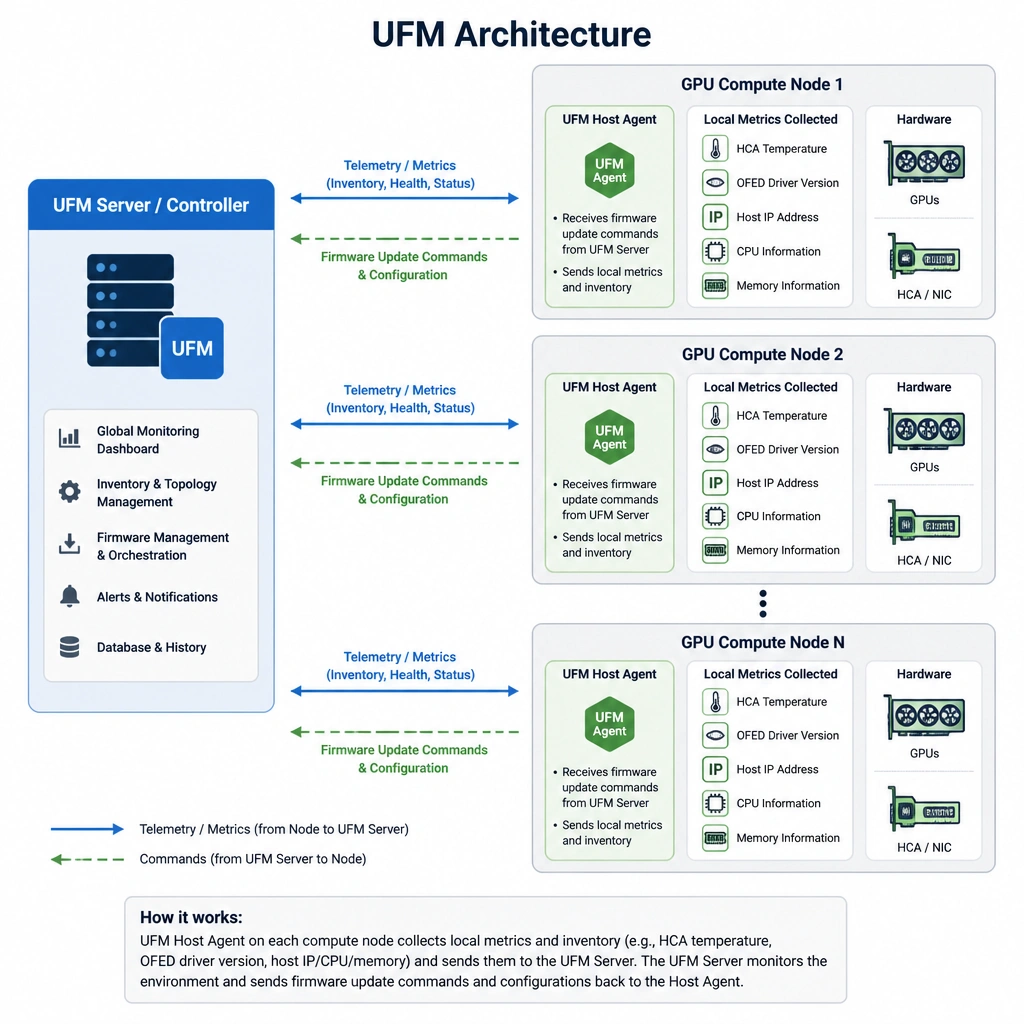
Full Explanation
NVIDIA Unified Fabric Manager (UFM) manages and monitors InfiniBand fabrics in scale-out AI environments. It consists of central controllers and host-level agents. - Why Option B is correct: The UFM Host Agent is a lightweight daemon that runs on each compute node (host). It has direct access to the host's hardware and operating system. Its primary functions include discovering host parameters (such as CPU type, RAM capacity, and IP addresses), reporting HCA (Host Channel Adapter) status and health metrics, and facilitating remote updates. Administrators can use the central UFM platform to push HCA firmware updates and Mellanox Open Fabrics Enterprise Distribution (OFED) driver installations directly to the host via this agent. - Why Option A is incorrect: InfiniBand-to-Ethernet bridging is a hardware-level gateway function performed by specialized hardware gateways or switches (such as NVIDIA Skyway), not a software agent running on a compute node. - Why Option C is incorrect: Fabric-wide topology discovery and switch routing table management are performed by the Subnet Manager (SM) running on the InfiniBand switches or as part of the central UFM Enterprise controller. - Why Option D is incorrect: Adaptive routing and congestion control are low-level fabric mechanisms executed by switch ASICs and managed by the Subnet Manager, not by a host-level software agent. Memory Aid: The Host Agent is the local assistant on the server. It handles local host issues (like local driver versions and local HCA firmware), while the switches handle network-level routing and traffic.