
As machine learning architectures and practices progress into 2025, which of the following represent significant trends and technological drivers shaping the industry? (Select all that apply.)
Select all correct answers, then click Submit.
Short Explanation and Infographic
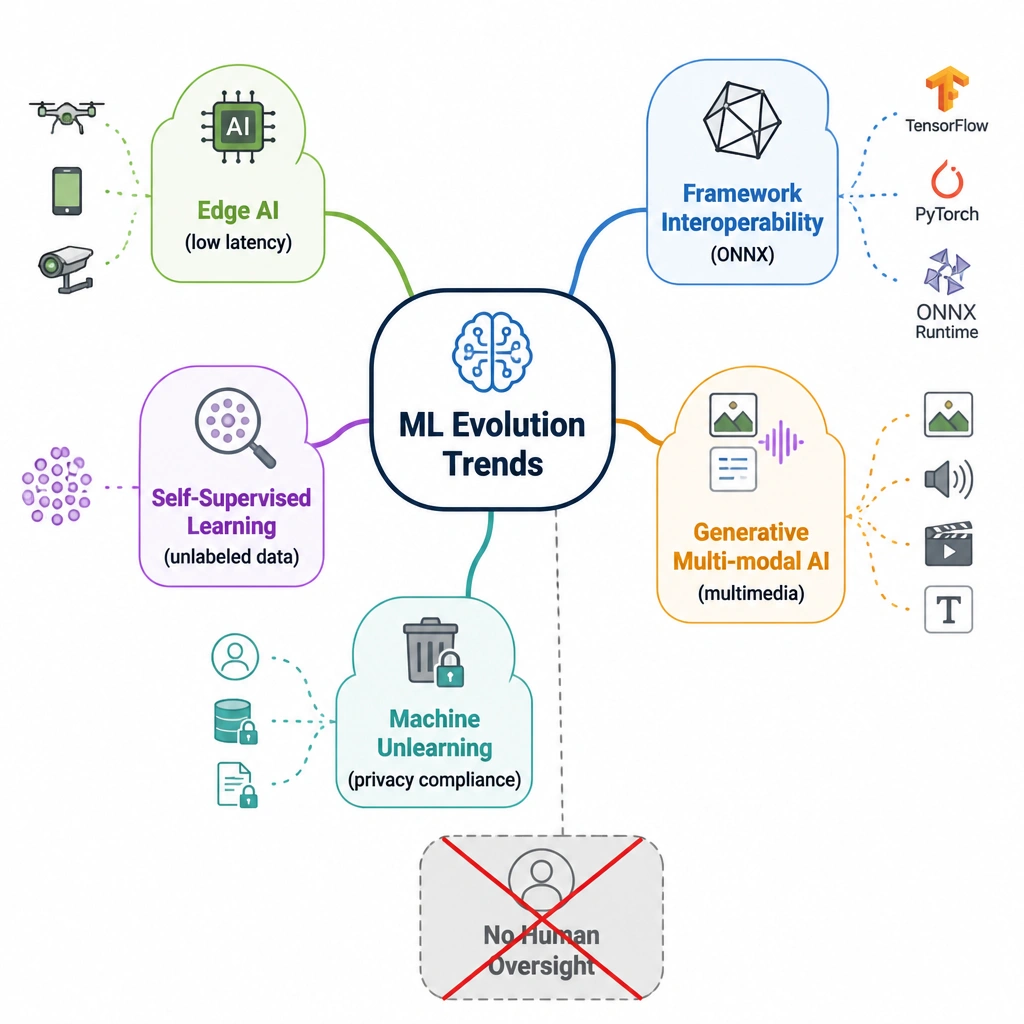
Okay, let's take a look at where machine learning is heading in 2025. It's moving fast! We're seeing Edge AI pushing intelligence right to the device to kill latency. We're also seeing systems play nice with each other using cross-framework compilers. Plus, self-supervised learning is huge because labeling data by hand is slow and expensive. And of course, generative AI is tackling complex video and audio. Oh, and don't forget 'machine unlearning'—which is all about selectively deleting data to keep regulators happy. But here's the trap: we are not replacing human oversight. In fact, keeping humans in the loop is more important than ever to keep these models on the rails. So watch out for that option on the exam!
Full explanation below image
Full Explanation
The machine learning landscape is maturing to address real-world deployment challenges, framework diversity, data scarcity, and privacy regulations.
- Why Option A is correct: Deploying ML models directly to edge devices (Edge AI) reduces latency, saves network bandwidth, and keeps data localized, which is essential for real-time applications like autonomous driving. - Why Option C is correct: Interoperability frameworks, such as ONNX (Open Neural Network Exchange), and compilers like Apache TVM allow developers to train a model in PyTorch and deploy it on specialized hardware without rewritten code, streamlining the deployment pipeline. - Why Option D is correct: Labeling petabytes of data is a massive bottleneck. Self-supervised learning allows models to learn representations from unlabeled data, vastly expanding the training pool. - Why Option E is correct: Generative AI is transitioning from simple text generation to high-fidelity, multi-modal outputs including video, 3D assets, and multi-track audio. - Why Option F is correct: Regulations like GDPR grant users the 'right to be forgotten.' Machine unlearning allows organizations to remove specific user data from a trained model's weights without retraining the entire model from scratch. - Why Option B is incorrect: The industry trend is moving toward more robust human-in-the-loop (HITL) governance, ethical AI, and alignment mechanisms (like RLHF) to prevent bias and hallucination, not the complete removal of human oversight.
Memory Aid: Modern ML is about being fast (edge), flexible (interoperability), self-starting (self-supervised), multi-talented (multimedia), and legally compliant (unlearning), while keeping humans in charge.