
Modern data center operators are seeing rack power densities skyrocket from historical averages of 3–5 kW per rack to 30–50 kW or more. What is the main factor driving this dramatic shift toward high-density computing environments?
Select an answer to reveal the explanation.
Short Explanation and Infographic
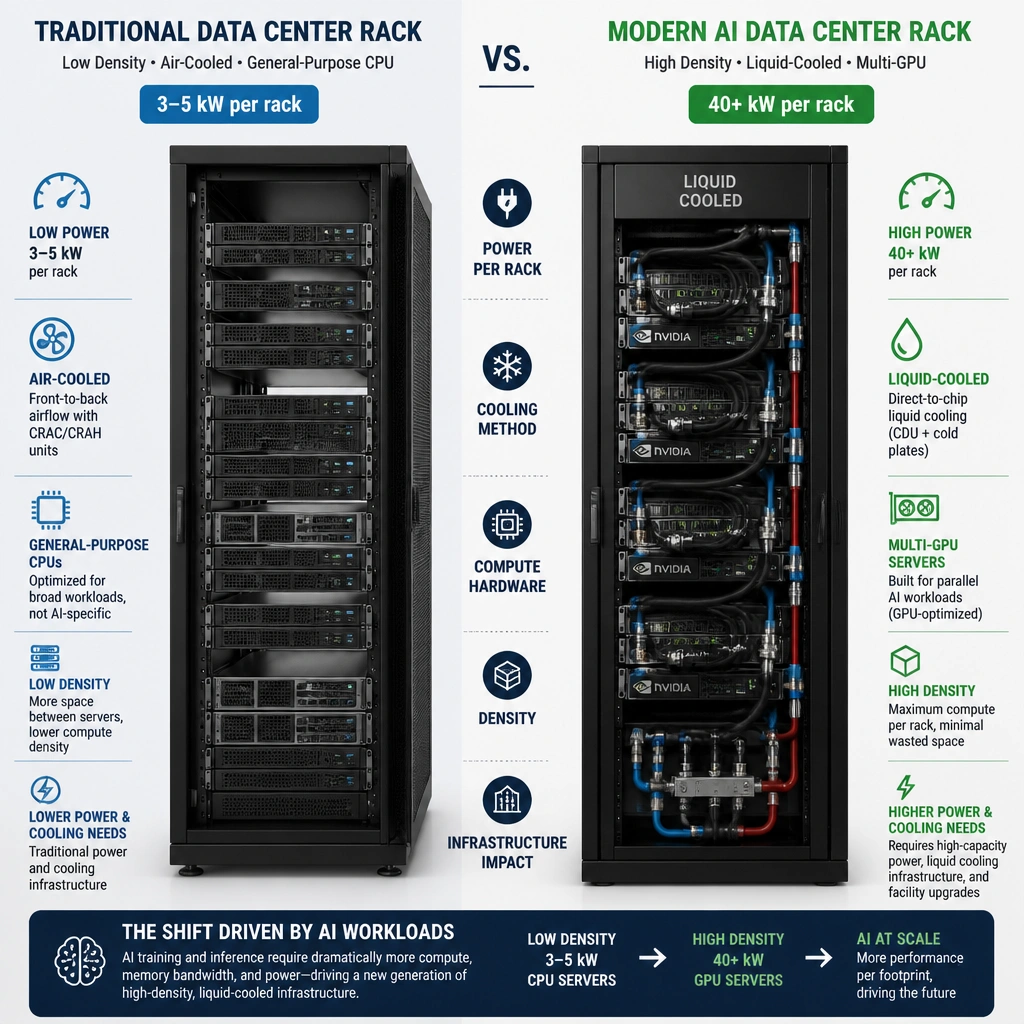
Here's the deal: traditional data centers were built for racks drawing around 4 to 5 kilowatts. But now? We're talking 40, 50, or even 100 kilowatts per rack! What's driving this massive power spike? It's the sheer explosion of AI, machine learning, and high-performance computing. These workloads run on dense arrays of GPUs that draw a ton of juice and generate massive heat. You can't just spread them out over miles of floor space because they need to be packed tight to keep physical network latency low. So, the data center has to get dense. The other choices—like storage consolidation or security mandates—just don't require this level of extreme power and cooling density. Keep this in mind: AI workloads are the absolute engine behind high-density power demands today.
Full explanation below image
Full Explanation
The computing landscape has shifted from general-purpose CPU-based hosting to specialized accelerator-based infrastructure. - Why Option C is correct: Deep learning and high-performance computing (HPC) workloads require massive parallel processing power. To deliver this, modern servers house multiple high-performance GPUs (like NVIDIA DGX systems which contain 8 GPUs per system). A single modern GPU server can easily draw 10.2 kW of power. Placing several of these servers in a standard rack drives rack density to 30–50 kW or more. Furthermore, these clusters require low-latency, high-bandwidth interconnects (like InfiniBand), which physically limits how far apart the servers can be placed, forcing high-density consolidation. - Why Option A is incorrect: While network and storage technologies have evolved, storage arrays and standard network switches do not require the extreme power and specialized liquid cooling solutions associated with high-density GPU racks. - Why Option B is incorrect: While data centers strive for energy efficiency, regulations generally push for lower Power Usage Effectiveness (PUE) rather than forcing high power density into smaller footprints, which actually complicates heat dissipation. - Why Option D is incorrect: Compliance and security regulations may dictate network segregation or physical security cages, but they do not drive the high electrical and cooling demands of high-density computing. Memory Aid: AI equals GPUs. GPUs are power-hungry and need high-speed interlinks, which forces them close together. That is the definition of high-density computing.