
When architecting an AI data center, you decide to mix older Ampere-generation GPUs with newer Hopper-generation GPUs in the same cluster. What is a primary challenge that the workload scheduler (such as Slurm or Kubernetes with Volcano) must solve in this heterogeneous hardware environment?
Select an answer to reveal the explanation.
Short Explanation and Infographic
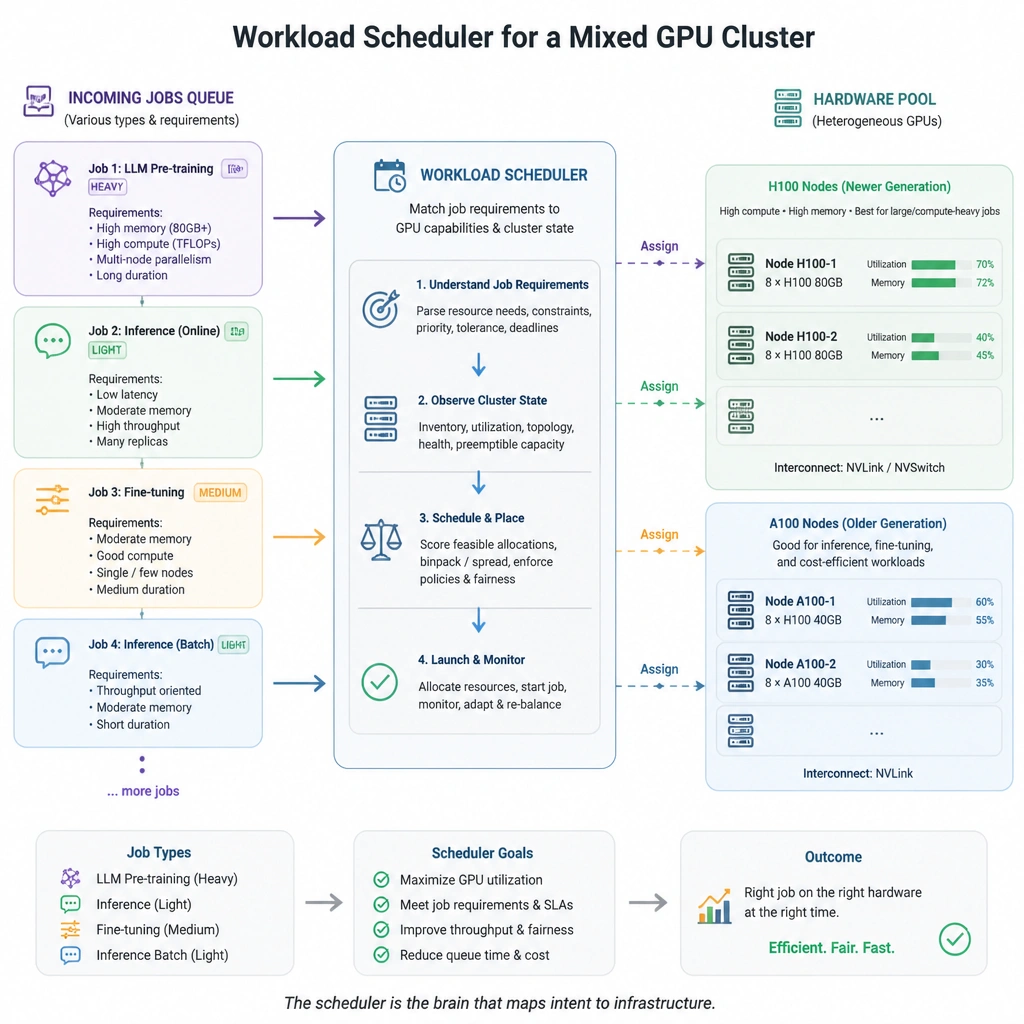
Let's say you've got a cluster that's a bit of a mixed bag—some older Ampere A100s sitting next to shiny new Hopper H100s. Your developers are submitting training jobs, and this is where things get tricky. A workload scheduler has to be smart enough to know which GPU is which. If it treats them all the same, you're going to have massive bottlenecks where fast GPUs are stuck waiting on slow ones. The scheduler's big challenge here is managing these different GPU generations and their varying performance specs to make sure resources are allocated optimally. The other options, like updating model weights or encrypting data, are handled by the ML framework or the network fabric, not the job scheduler. Got it? Sweet. Let's keep rolling.
Full explanation below image
Full Explanation
Heterogeneous GPU clusters contain accelerators from different generations (e.g., A100, H100) or with different memory capacities (e.g., 40GB vs. 80GB models). - Why Option C is correct: A job scheduler's main responsibility is resource allocation. In a heterogeneous cluster, different workloads have different hardware requirements. A basic scheduling algorithm might treat all GPUs as identical units, leading to inefficient resource utilization. For instance, putting a highly parallel, high-bandwidth training job on older GPUs while a simple inference script occupies a newer GPU is highly suboptimal. Advanced schedulers must perform hardware-aware scheduling, assigning the right tasks to the right hardware generation to avoid bottlenecks and maximize throughput. - Why Option A is incorrect: Updating AI model weights during training (backpropagation) is an application-level function handled by deep learning frameworks like PyTorch or TensorFlow, not the infrastructure job scheduler. - Why Option B is incorrect: Interoperability or conversion between frameworks (e.g., using ONNX) is a developer-level compilation task and is not managed by the infrastructure scheduler during execution. - Why Option D is incorrect: Data encryption in transit is handled by communication libraries (like NCCL with secure sockets) or hardware-level network components (such as IPSec/MACsec on switches and NICs), not by the workload scheduler. Memory Aid: The scheduler is the traffic cop of the cluster. Its job is to direct traffic to the right lanes (different GPU models) based on capacity and speed, not to drive the cars or paint the roads.