
When building a large-scale AI or high-performance computing (HPC) cluster, InfiniBand is frequently selected over standard Ethernet. Which of the following features and architectural traits explain why InfiniBand is suited for these demanding environments? (Select all that apply)
Select all correct answers, then click Submit.
Short Explanation and Infographic
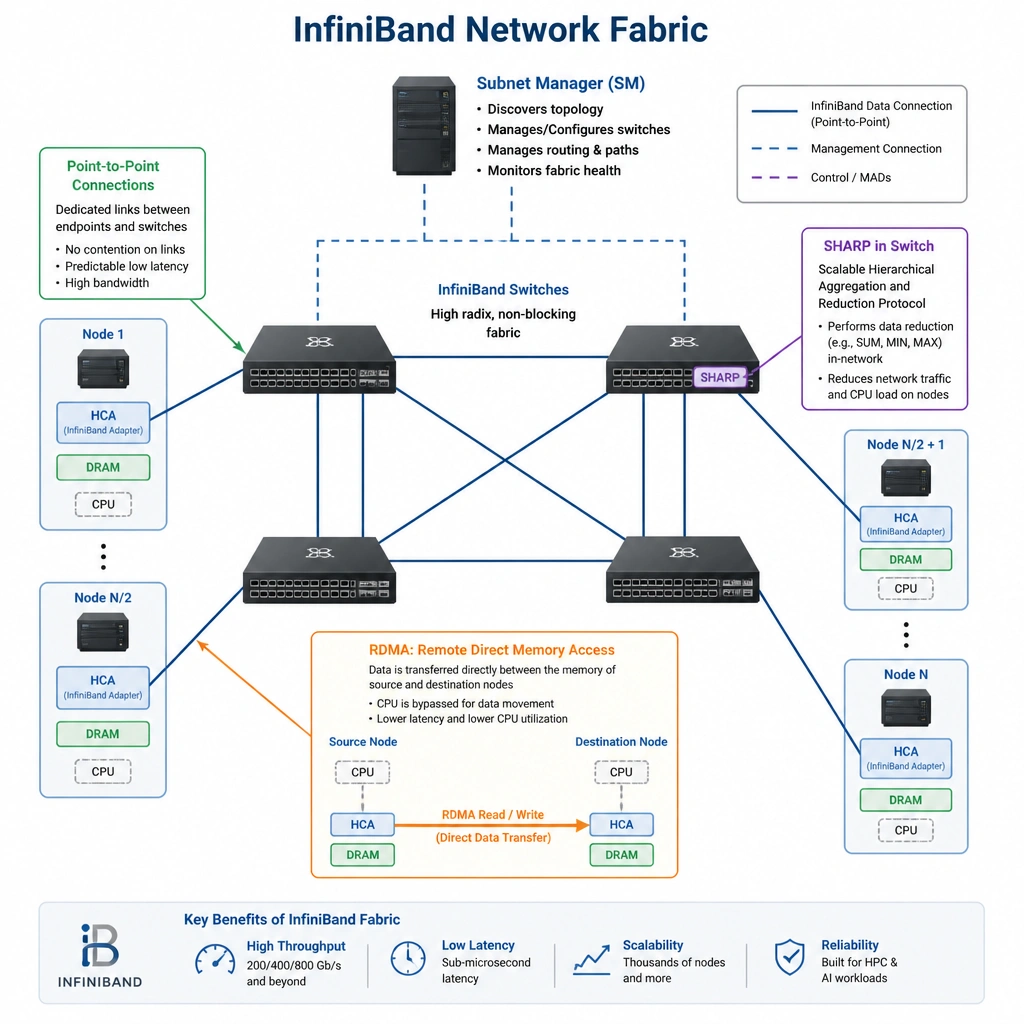
Think of standard Ethernet like a busy highway system with stoplights, roundabouts, and traffic cops. It's built to be flexible, but it's not built for raw speed and minimal latency. InfiniBand, on the other hand, is like a dedicated high-speed rail line built from the ground up for supercomputers. Instead of a shared bus where systems have to take turns talking (which would crash performance instantly), InfiniBand uses a switched fabric architecture. Every link is a dedicated, point-to-point connection. It natively supports RDMA so servers can exchange data directly without nagging their CPUs. A centralized Subnet Manager configures everything automatically. And the throughput is insane, scaling all the way from old SDR (10 Gbps) to the latest NDR at 800 Gbps! Plus, it has SHARP — which lets the network switches perform mathematical calculations on the data while it's moving through the fabric. That's a huge time-saver during AI model training.
Full explanation below image
Full Explanation
InfiniBand is a high-speed, low-latency communication link used primarily in supercomputing, enterprise data centers, and AI training clusters. Unlike Ethernet, which was originally designed for general-purpose LAN environments, InfiniBand was engineered specifically for high-throughput, low-latency inter-processor communication.
The key architectural features that make InfiniBand highly effective include: 1. Switched Fabric Topology: InfiniBand uses a switched fabric architecture with dedicated point-to-point connections. This eliminates the collisions and bandwidth sharing associated with bus-based topologies, providing high scalability and fault tolerance. 2. Native RDMA Support: RDMA is baked directly into the InfiniBand protocol, allowing nodes to write directly to another node's memory without passing the data through the operating system kernel or utilizing host CPU cycles. 3. Subnet Manager (SM): InfiniBand networks are managed by a Subnet Manager, which is software (or firmware on a switch) responsible for discovering the network topology, assigning local identifiers (LIDs), configuring routing tables, and monitoring network health. 4. Scalable Data Rates: The technology has evolved through multiple generations, supporting data rates from Single Data Rate (SDR at 10 Gbps) through Double Data Rate (DDR), Quad Data Rate (QDR), Fourteen Data Rate (FDR), Enhanced Data Rate (EDR), High Data Rate (HDR), up to Next Data Rate (NDR at 800 Gbps). 5. Traffic Optimization (QoS & SHARP): InfiniBand supports strict Quality of Service policies and hardware offloads like NVIDIA SHARP. SHARP executes collective communication algorithms (like AllReduce) directly inside the switch hardware, preventing redundant data transfers across the network.
Let's see why option A is incorrect: - Shared Bus Topology (Option A) is incorrect because InfiniBand uses a switched fabric design. Shared bus systems do not scale to high-performance clustering due to contention and collisions.