
How does NVIDIA GPUDirect Storage (GDS) optimize the performance of data-intensive deep learning applications during training?
Select an answer to reveal the explanation.
Short Explanation and Infographic
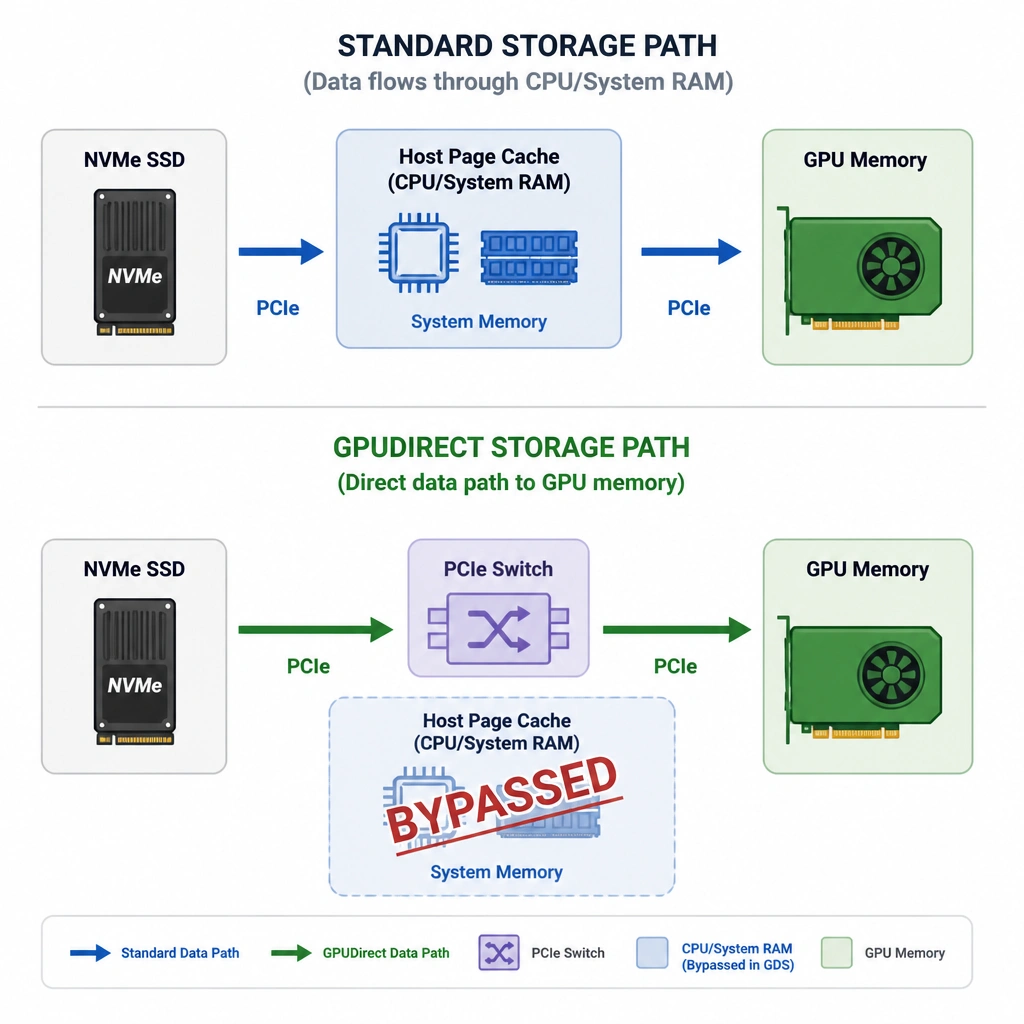
Think of a traditional storage read like this: your GPU needs some image data from an NVMe drive. The drive reads it, copies it into host system memory (creating a "bounce buffer" managed by the CPU), and then the CPU copies it again over to the GPU's memory. That means the host CPU and system memory are acting as a middleman, slowing everything down. Your CPU is busy doing memory copies instead of actual work! NVIDIA solved this with GPUDirect Storage (GDS). GDS acts like a VIP express lane. It establishes a direct DMA path between NVMe storage and the GPU's High Bandwidth Memory (HBM). No CPU involvement, no bounce buffers. It drops latency through the floor and maximizes your throughput. Just remember: it's not virtualizing storage as RAM, compressing data, or acting as an API wrapper — it's all about that direct hardware path.
Full explanation below image
Full Explanation
In deep learning workloads, feeding data to the GPUs fast enough to keep them fully utilized is a major challenge. In standard storage architectures, data must be read from storage devices (such as NVMe drives), loaded into system memory (DRAM) using CPU cycles, and then transferred from system memory to GPU memory via the PCIe bus. This "bounce buffer" mechanism relies heavily on the host CPU, creating a performance bottleneck as network and storage speeds increase. NVIDIA GPUDirect Storage (GDS) resolves this bottleneck by enabling a direct memory access (DMA) path between local or remote storage (like NVMe or NVMe-oF) and GPU memory (HBM). Key benefits of GDS include: 1. CPU Bypass: Data transfers bypass the host CPU entirely, freeing up CPU cores to focus on other tasks like data preprocessing. 2. Elimination of Bounce Buffers: By avoiding the intermediate copy to host DRAM, GPUDirect Storage reduces latency and significantly increases overall data throughput. 3. Lower System Overhead: Reduces congestion on the PCIe bus and system memory controller.
Let's evaluate the incorrect options: - Compression (Option A) is not a feature of GPUDirect Storage; GDS focuses strictly on routing data directly, not processing or compressing the data payload. - Memory Virtualization (Option C) describes unified memory or storage class memory integration, but GDS does not present disk storage as an extension of the physical GPU memory pool. - API Wrapper (Option D) is incorrect because GPUDirect Storage is a low-level system technology involving drivers and hardware pathways, rather than a high-level software abstraction API for frameworks.