
When discussing modern data science, terms like AI, Machine Learning, Generative AI, and LLMs are often thrown around. What is the correct nested hierarchical relationship among these four concepts?
Select an answer to reveal the explanation.
Short Explanation and Infographic
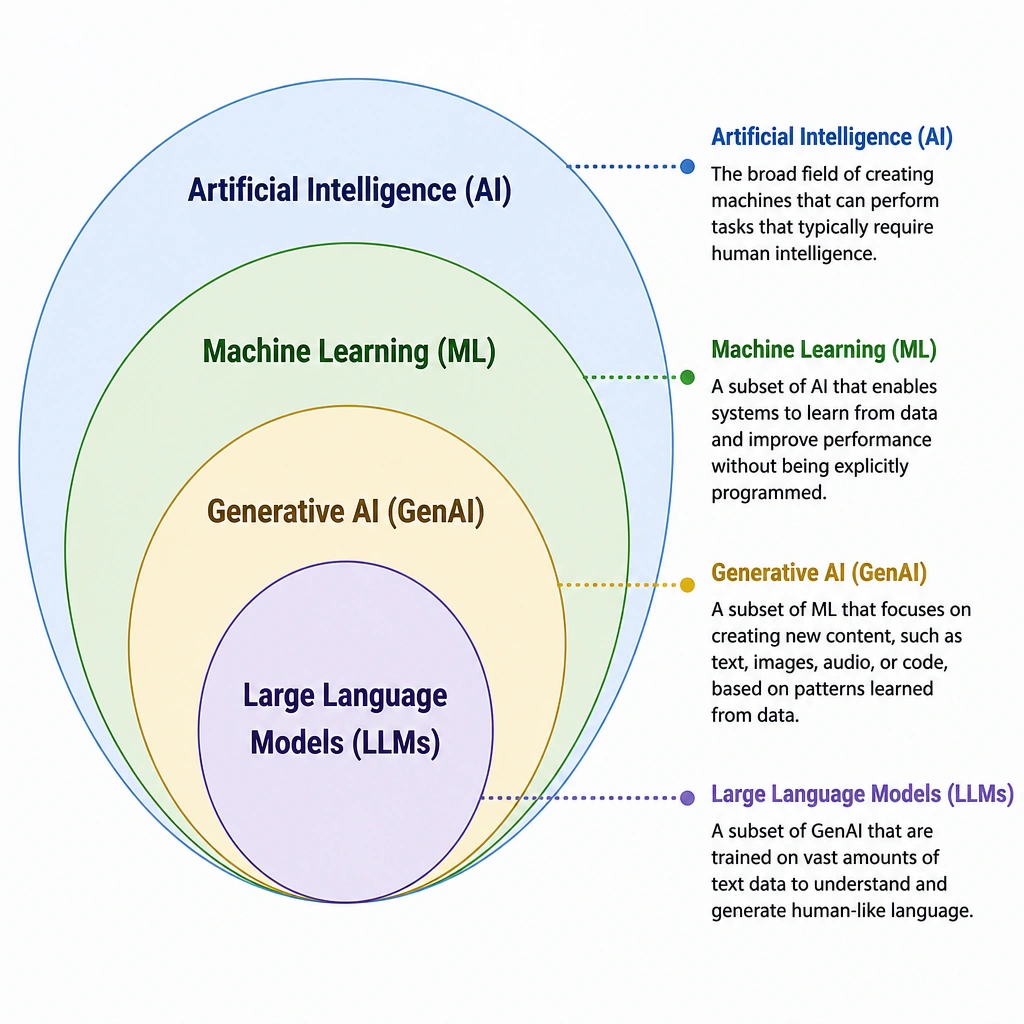
Think of this like nested Russian nesting dolls. The biggest doll on the outside is Artificial Intelligence (AI) — that's the whole field of making machines mimic human behavior, which includes old-school rule-based systems from decades ago. Pop that open, and you find Machine Learning (ML). Here, we aren't writing rules; we're feeding the system data and letting it learn patterns. Inside ML, you'll find a specialized area called Generative AI (GenAI). This is all about creating new content — like text, images, or audio — instead of just predicting numbers or labeling photos. And if you open up GenAI, you find Large Language Models (LLMs) right in the center. LLMs are a specific type of generative model trained on massive amounts of text. Don't let the buzzwords confuse you on the exam — it's a straight-down nested chain from AI to ML to GenAI to LLMs.
Full explanation below image
Full Explanation
Understanding the taxonomy of Artificial Intelligence is critical for framing how different technologies interact. These terms are not interchangeable or parallel; they form a clear hierarchical structure of subsets: 1. Artificial Intelligence (AI): The broadest classification. It encompasses any technique, system, or software that enables computers to mimic human intelligence, reasoning, or decision-making. This includes rule-based expert systems, search algorithms, and machine learning. 2. Machine Learning (ML): A major subset of AI. Instead of using hard-coded logic, ML models use statistical algorithms to train on datasets, improving their performance on a task over time as they ingest more data. 3. Generative AI (GenAI): A subset of Machine Learning. While traditional ML models are typically analytical or discriminative (used to classify data, detect anomalies, or make predictions), Generative AI models are designed to generate new, original content (such as text, images, audio, or code) that resembles their training data. 4. Large Language Models (LLMs): A highly specialized subset of Generative AI. These are neural networks (typically utilizing the Transformer architecture) trained on massive corpuses of text to understand, process, and generate human language.
Let's analyze why other choices are incorrect: - Option A is incorrect because Machine Learning is not the outermost category; it is a subset of AI. Additionally, LLMs are a subset of GenAI, not an independent branch. - Option B reverses the hierarchy completely; AI is the broadest, and LLMs/GenAI are narrow subsets, not the other way around. - Option D is incorrect because these fields are deeply nested and overlapping, not separate and distinct disciplines.