
When designing a data center space to support high-density AI server racks consuming 35 to 45 kW of power per cabinet, what thermal and environmental challenges must be addressed?
Select an answer to reveal the explanation.
Short Explanation and Infographic
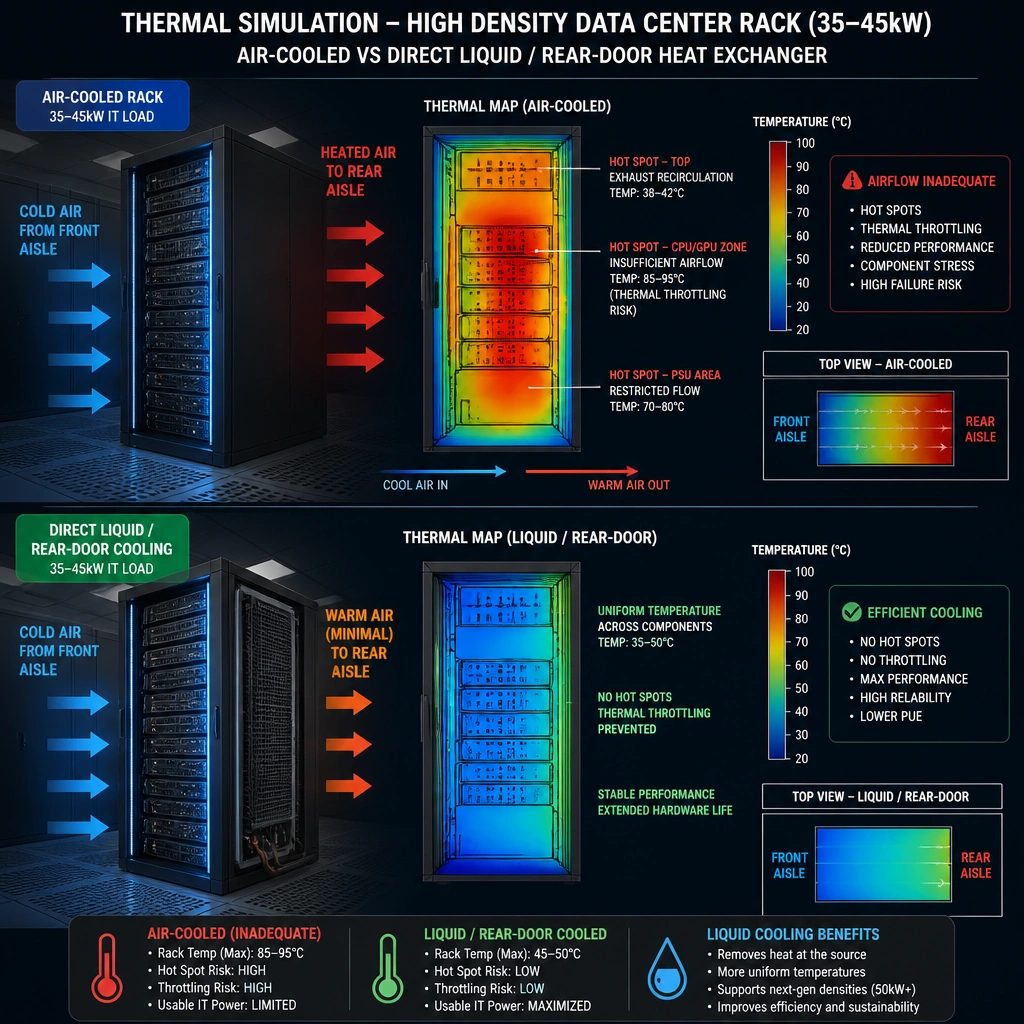
Imagine putting ten high-end space heaters in a tiny closet and turning them all on high. That's basically what a 40kW AI rack is like. AI servers packed with modern GPUs draw an insane amount of power, and almost all that electricity is converted straight into heat. If that heat doesn't get pulled away fast, your GPUs will heat up and start thermal throttling — which means they slow themselves down to prevent melting. In other words, you just bought millions of dollars in hardware that is running at half-speed because it's too hot! You've got to focus on serious heat management, making sure you have perfect airflow distribution, and often switching from standard air cooling to liquid-to-chip or rear-door heat exchangers to keep these systems cool. Yes, power and cabling are important, but when we're specifically talking about high-density cabinet design, heat is the monster we have to tame.
Full explanation below image
Full Explanation
Traditional data center cabinets typically consume between 5 kW and 10 kW of power. However, modern AI clusters featuring high-density servers (such as NVIDIA DGX systems) can easily push rack power requirements to 35 kW, 45 kW, or even higher. Because nearly 100% of the electrical energy consumed by a server is converted into heat, these high-density cabinets present severe thermal management challenges. When deploying these racks, data center designers must address: 1. Heat Management and Dissipation: Traditional hot/cold aisle containment systems using air cooling struggle to remove heat from cabinets consuming over 30 kW. Without advanced cooling methods, temperatures within the cabinet will spike rapidly. 2. Thermal Throttling Prevention: Modern GPUs have safety features that automatically lower their clock speeds when they exceed safety thresholds (often around 80-85°C). Thermal throttling dramatically reduces compute performance, causing expensive training jobs to run slowly. 3. Airflow Distribution: Standard raised-floor cooling often cannot supply enough volume of cold air to high-density racks, creating localized hot spots. Specialized engineering (such as CFD analysis, containment, or liquid cooling systems like direct-to-chip liquid cooling or rear-door heat exchangers) is necessary.
Let's look at why other options are incorrect: - Power Redundancy and Distribution (Option A) are critical electrical infrastructure challenges, but they represent power delivery concerns, not the cooling/thermal challenges specified in the question. - Software and Compatibility (Option C) are logical software stack and component compatibility issues, completely unrelated to data center physical facilities or thermal management. - Network Latency and Cabling (Option D) are networking engineering challenges rather than thermal or cooling issues.