
NVIDIA Merlin is an open-source application framework designed to build high-performance recommender systems at scale. Which four of the following components are core parts of the NVIDIA Merlin ecosystem? (Select four)
Select all correct answers, then click Submit.
Short Explanation and Infographic
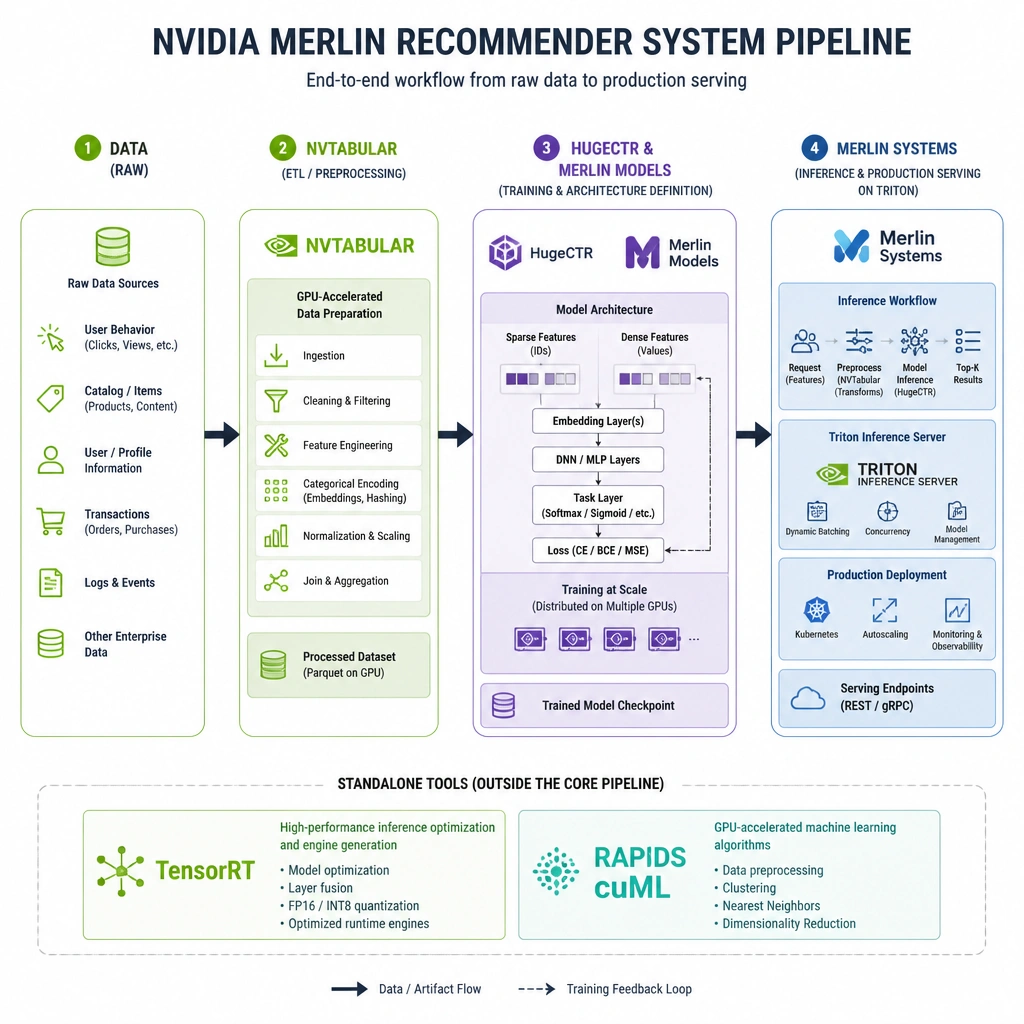
Okay, let's dive in. Recommender systems are the unsung heroes of the internet. Think of Netflix, Amazon, or YouTube—their recommendation engines drive almost all of their user engagement. But recommender systems are notoriously difficult to build because they have to process massive datasets with billions of rows in real-time. That's why NVIDIA built the Merlin framework. To pass the exam, you need to know the four core pillars of the Merlin family: 1. NVTabular (Option C): This is your preprocessing champion. It accelerates the ETL (Extract, Transform, Load) phase on GPUs, which is crucial because data prep is usually the slowest part of the pipeline. 2. HugeCTR (Option B): When it's time to train, HugeCTR takes over. It's a highly optimized, distributed training engine designed specifically for recommender systems with massive embedding tables. 3. Merlin Models (Option E): This library gives you pre-built, high-quality architectures so you don't have to code recommendation models from scratch. 4. Merlin Systems (Option F): This ties everything together for production deployment, making it easy to serve your models using Triton. Now, don't fall for the distractors. TensorRT (Option A) and RAPIDS cuML (Option D) are awesome NVIDIA tools, but they are general-purpose. TensorRT optimizes all kinds of deep learning models, and cuML is for traditional ML algorithms. They aren't core components of the Merlin recommender ecosystem. Keep those four Merlin components straight!
Full explanation below image
Full Explanation
NVIDIA Merlin is an end-to-end, GPU-accelerated framework designed to streamline the development of recommender systems, from data preprocessing to training and production deployment. Recommender systems present unique challenges, such as handling massive, sparse embedding tables and strict latency constraints. The Merlin framework addresses these challenges through four core integrated components:
1. NVTabular (Option C): A GPU-accelerated feature engineering and preprocessing library. It addresses the data preparation bottleneck by utilizing GPU execution to accelerate operations like normalization, bucketizing, and categorical encoding. 2. HugeCTR (Option B): A dedicated, highly optimized recommender framework that supports distributed model training. It features native GPU-accelerated hash tables to handle large-scale embedding tables that exceed the memory capacity of a single GPU. 3. Merlin Models (Option E): A high-level library that provides standardized, pre-implemented recommender system architectures (e.g., DLRM, DeepFM, Two-Tower), allowing developers to build and evaluate models quickly. 4. Merlin Systems (Option F): A deployment framework that helps construct and export complete recommendation pipelines (including feature retrieval, candidate generation, filtering, and ranking) to Triton Inference Server.
Let's review the incorrect options: - TensorRT (Option A) is NVIDIA's general-purpose deep learning inference optimizer and runtime. While Merlin Systems may utilize TensorRT under the hood for specific model executions, TensorRT itself is a standalone utility, not a core component of the Merlin recommender suite. - RAPIDS cuML (Option D) is a suite of libraries for accelerating traditional machine learning algorithms (such as K-Means, XGBoost, and Support Vector Machines) on GPUs. It is part of the RAPIDS data science ecosystem, not the Merlin recommender framework.
Understanding the specific role of each Merlin component is key to architecting end-to-end recommender pipelines.