
Recent industry reports show a massive spike in corporate AI adoption, with organizational usage climbing from 55% to 78%. Which three factors have been the primary drivers behind this rapid surge in enterprise AI adoption? (Choose three.)
Select all correct answers, then click Submit.
Short Explanation and Infographic
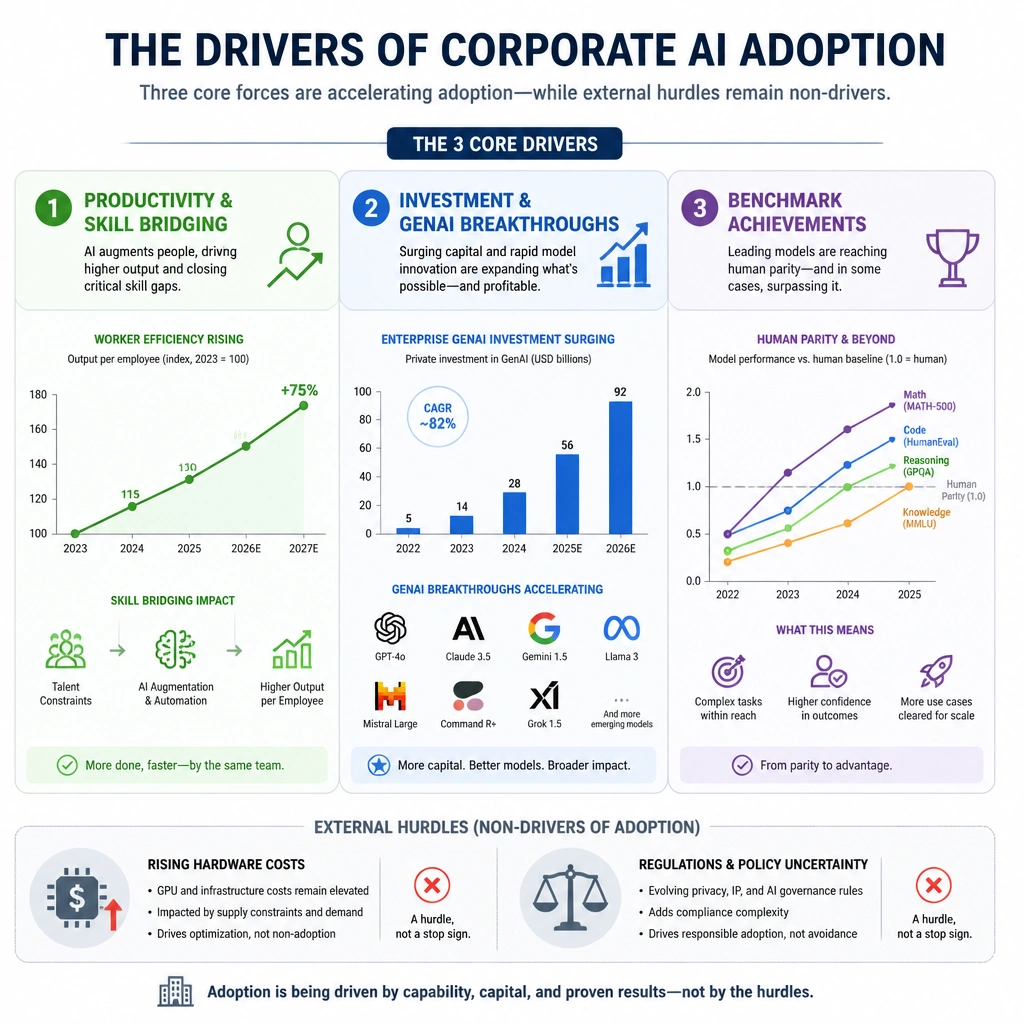
Check this out: AI adoption isn't just hype anymore—it's a massive shift in how businesses operate, jumping from 55% to 78% in a single year. But why is this happening right now? First up, it's about productivity and bridging skill gaps (Option B). When your developers use AI assistants, they write code faster. When your support teams use AI, they resolve tickets quicker. It helps junior staff perform like seasoned pros, which is huge when there's a talent shortage. Second, the tech itself has taken a massive leap forward. We've seen dramatic improvements in AI performance benchmarks (Option E). Models are smarter, faster, and make fewer mistakes, making businesses comfortable putting them in front of customers. Finally, you can't ignore the generative AI boom and investment momentum (Option D). Since ChatGPT hit the scene, billions of dollars have flooded the market, fueling rapid innovation. Let's talk about the traps here. Has GPU hardware gotten cheaper (Option C)? Absolutely not! If you've tried to buy H100s or A100s lately, you know the prices are sky-high and wait times are long. Regulatory restrictions (Option A) actually slow down adoption rather than drive it. And traditional market saturation (Option F) isn't what's pushing companies into AI; they are adopting AI because the value is real and immediate. Keep these three drivers in mind!
Full explanation below image
Full Explanation
The surge in enterprise AI adoption (rising from 55% to 78% according to recent global surveys) is driven by tangible business value, technological leaps, and capital access. The three primary catalysts include:
1. Proven productivity gains and skill gap reduction (Option B): Organizations deploying AI tools see immediate improvements in operational efficiency. Generative AI allows non-technical employees to perform complex tasks (such as writing code, generating reports, or automating customer support) that previously required specialized training, effectively mitigating the global talent shortage. 2. Generative AI advancements and investment momentum (Option D): The rapid evolution of large language models (LLMs) and diffusion models has unlocked new use cases. This technological unlock has driven massive capital inflows—with tens of billions of dollars in private and venture capital investments—accelerating commercialization and product deployment. 3. Improvements in AI performance benchmarks (Option E): AI models have reached or exceeded human parity on various benchmarks (such as reading comprehension, image recognition, and mathematical reasoning). These standardized benchmark improvements give enterprises the confidence that AI solutions are reliable enough for production environments.
Analyzing the incorrect options: - Option A is incorrect because regulatory restrictions generally introduce compliance hurdles and slow down adoption rather than driving it. - Option C is incorrect because hardware costs for high-end AI training and inference (such as NVIDIA H100/H200 GPUs) have remained exceptionally high due to supply constraints and high demand. - Option F is incorrect because the pivot to AI is driven by the transformative potential of the technology itself, rather than a reactive escape from saturation in traditional software sectors.
Understanding these market dynamics is crucial for aligning AI infrastructure investments with actual corporate strategy.