
When you deploy high-performance AI clusters and need to transfer huge amounts of training data between nodes, why is Remote Direct Memory Access (RDMA) preferred over standard TCP/IP protocols?
Select an answer to reveal the explanation.
Short Explanation and Infographic
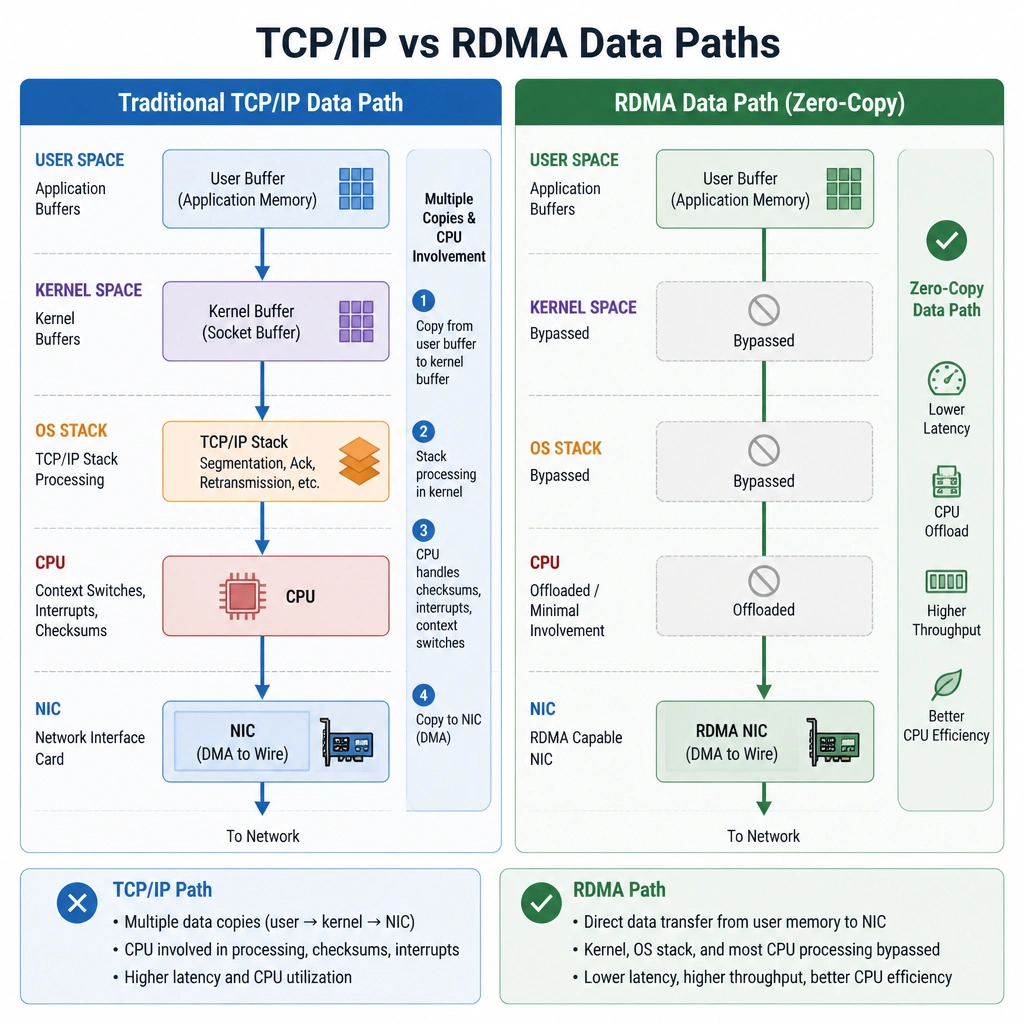
Think of TCP like sending a package through a massive corporate mailroom. Every packet has to be opened, inspected, stamped by the OS kernel, copied from one memory buffer to another, and finally handed to the application. Your host CPU is doing all that heavy lifting. In a massive AI cluster, that CPU overhead will choke your training run. RDMA is like having a direct teleportation pad between the memory of Server A and Server B. It completely bypasses the OS kernel and the CPU, offloading the work directly to the Host Channel Adapter (HCA). The result? We get screaming-fast single-thread throughput of around 40 Gbps, sub-2 microsecond latency, and virtually no CPU load. That's a huge deal when you're scaling out clusters!
Full explanation below image
Full Explanation
In high-performance computing (HPC) and AI workloads, data transfers between nodes can easily become a bottleneck if they rely on traditional TCP/IP stacks. The TCP protocol requires the host CPU to handle packet processing, encapsulation, and memory copying (from kernel space to user space). This process consumes significant CPU cycles and introduces latency, which limits the network's efficiency and overall system throughput. Remote Direct Memory Access (RDMA) addresses these limitations by bypassing the operating system's networking stack entirely. The network interface card (NIC), or Host Channel Adapter (HCA) in InfiniBand networks, executes the protocol processing directly in hardware. Data is transferred directly from the memory of one system to the memory area of another system without invoking either operating system's kernel or CPU. This hardware offloading yields distinct performance advantages: 1. Near-Zero CPU Overhead: Because the HCA performs the data transfers directly, host CPU utilization remains close to zero, freeing up valuable processing power for the actual AI training or inference tasks. 2. High Single-Thread Throughput: RDMA can achieve single-thread throughput of approximately 40 Gbps, whereas TCP is often limited by CPU thread performance. 3. Ultra-Low Latency: RDMA reduces latency to the 1-2 microsecond range, compared to tens of microseconds for typical TCP setups.
Incorrect Distractors: - Option A is incorrect because RDMA does not rely on CPU vector registers or perform compression to achieve its speed; its primary mechanism is hardware bypass of the CPU. - Option B is incorrect because RDMA is designed for high performance and low latency, not hardware-based encryption. In fact, standard RDMA does not encrypt data, and it is vastly faster than TCP. - Option D is incorrect because RDMA does not use software-defined routing policies to reduce jitter while matching TCP's resource usage; it bypasses software routing completely to eliminate CPU overhead.