
What is the primary operational benefit of implementing dynamic GPU resource allocation within a containerized AI development cluster?
Select an answer to reveal the explanation.
Short Explanation and Infographic
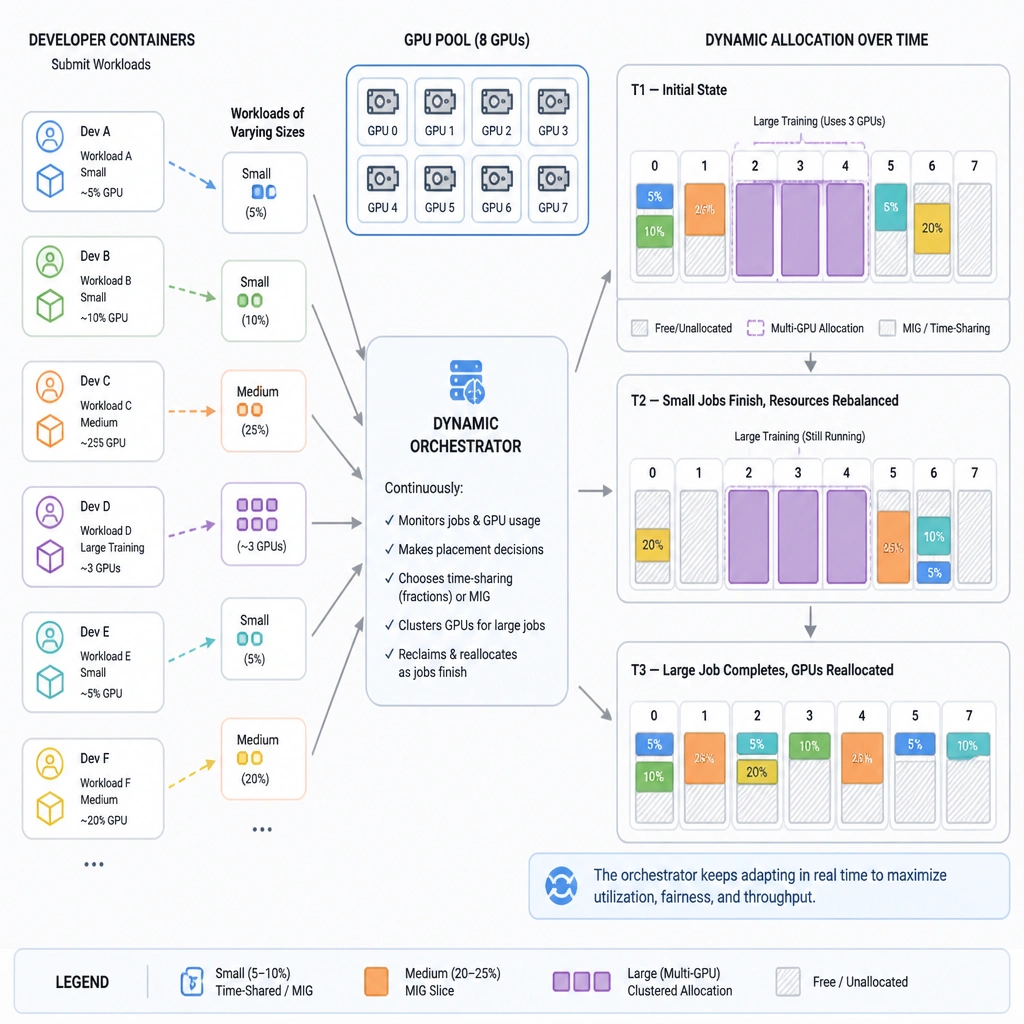
Here's the deal: GPUs are expensive. Really expensive. If you've got a cluster where GPUs are locked down to specific containers that are sitting idle half the day, your boss is going to walk in wanting to know why we're burning budget with nothing to show for it. Dynamic resource allocation is the solution. Think of it like a smart ride-sharing service. Instead of assigning a dedicated car to every single employee who might only use it for ten minutes a day, you share the fleet. In an AI cluster, dynamic allocation allows multiple containers to share the same physical GPU when their workloads are light. When a container suddenly needs more horsepower for a heavy training run, the system automatically scales up its GPU resources. Once the job is done, it scales them right back down. Let's look at the other options to make sure you don't get tripped up. Option A talks about forcing GPUs to run at maximum capacity all the time. That's a great way to melt your cooling system and skyrocket your electric bill, but it's not resource allocation. Option B describes static slicing, which is the exact opposite of dynamic. And Option D? Restricting containers to a single GPU would completely ruin your ability to run multi-GPU training jobs like LLMs. Keep it dynamic, keep it shared, and keep your cluster running efficiently!
Full explanation below image
Full Explanation
Dynamic GPU resource allocation is an advanced resource scheduling paradigm that optimizes the utilization of GPU hardware in shared cluster environments. Traditionally, GPU allocation in container orchestrators was static: a container requested a GPU, and that GPU was exclusively mapped to the container for its entire lifecycle, regardless of whether the GPU was actively executing kernels or sitting idle.
Dynamic resource allocation addresses this inefficiency by decoupling the physical GPU from the container lifecycle. Its primary benefits include: 1. Fractional GPU Sharing: Enabling multiple containerized applications (such as lightweight inference tasks or development workspaces) to safely share a single physical GPU through technologies like NVIDIA Multi-Instance GPU (MIG) or time-sharing. 2. Elastic Scaling: Automatically provisioning and attaching GPU resources to containers when compute demands spike, and reclaiming those resources once workloads decrease.
Let's review the incorrect options: - Option A is incorrect because forcing hardware to run at maximum capacity continuously without demand is highly inefficient, wasting power and generating unnecessary heat. - Option B describes static partitioning, which does not adapt to changing workloads and results in resource fragmentation when containers do not utilize their allocated slices. - Option C is incorrect because limiting workloads to a single GPU prevents multi-GPU scale-out training (such as model-parallel or data-parallel distributed training), which is essential for modern AI workloads.
By dynamically managing GPU resources, organizations can maximize return on investment (ROI) on expensive accelerator hardware while providing developers with flexible access to compute power.