
During the training of a computer vision model, a system administrator runs nvidia-smi and checks the GPU memory utilization metrics. What does this specific metric represent?
Select an answer to reveal the explanation.
Short Explanation and Infographic
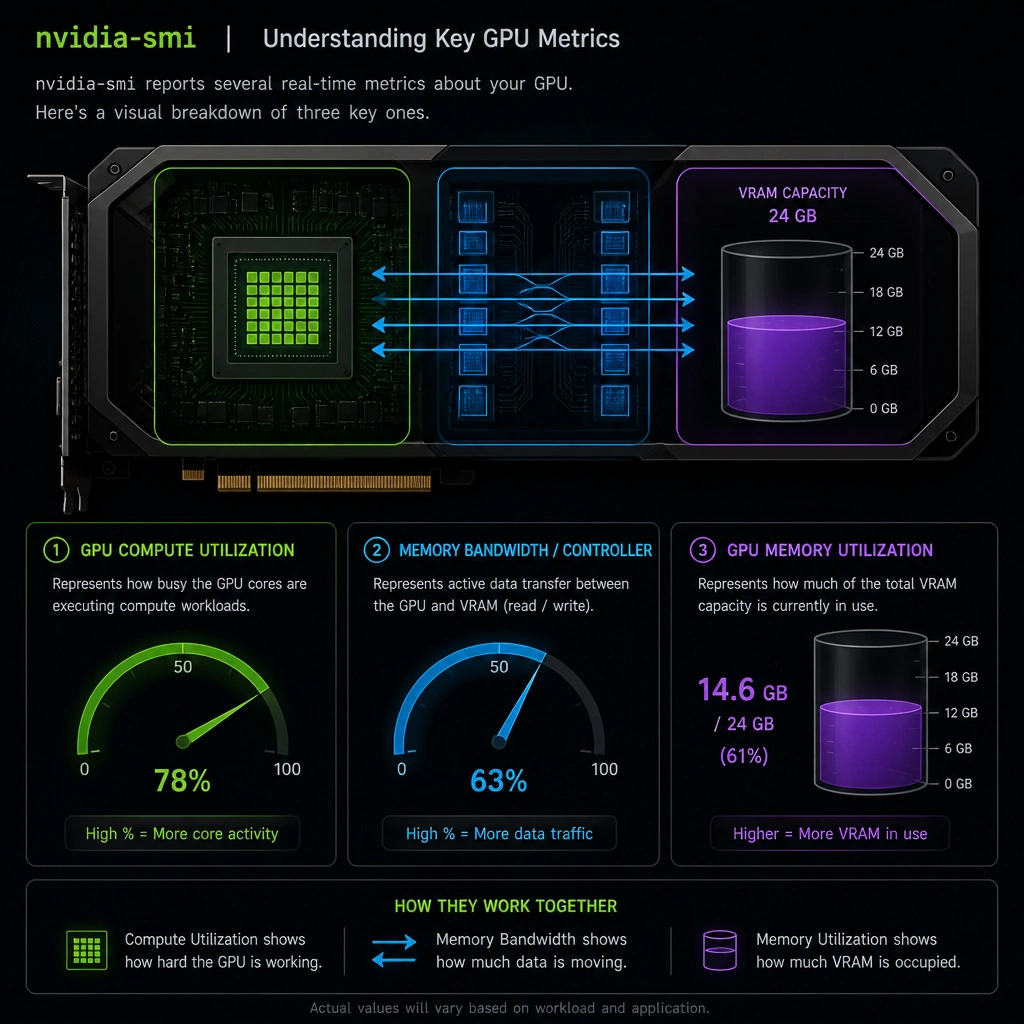
Let's dive in. If you're managing GPU infrastructure, nvidia-smi is going to be your best friend. But you've got to understand what the metrics are actually telling you, because it's easy to get confused. A common pitfall is mixing up GPU utilization with GPU memory utilization. Think of it like this: your GPU memory (VRAM) is like a workbench. If you have a 32GB GPU, and your training process allocates 16GB of weights and batch data, your GPU memory utilization is 50%. It simply measures the ratio of allocated memory to the total memory available. It tells you if you have room to scale up your batch size or if you're about to hit an 'Out of Memory' (OOM) error. But here's where people get tripped up on the exam: they think memory utilization means how hard the memory controllers are working. Nope! The percentage of time the memory controllers are reading and writing data is a completely different metric (often called memory controller utilization). Also, look at the other options. Option A describes GPU core utilization (how busy the compute engines are), and Option D is your PCIe bandwidth. Remember, GPU memory utilization is strictly about space—how much VRAM is currently holding data. Keep that distinction clear and you'll ace this topic on the test!
Full explanation below image
Full Explanation
When monitoring and optimizing machine learning workloads, understanding GPU telemetry is critical. The metric 'GPU memory utilization' (commonly queried via nvidia-smi or NVML) measures the proportion of the physical onboard GPU memory (Video RAM or VRAM, such as HBM or GDDR) that is currently reserved or allocated by active GPU processes relative to the total physical memory capacity of the card. For instance, if an A100 GPU with 80 GB of memory has 40 GB of model weights, cache, and active batch tensors loaded, the memory utilization is 50%.
Analyzing the incorrect options: - Option A describes GPU utilization (often called graphics or compute utilization), which represents the percentage of time over the sampling interval during which one or more kernels were executing on the GPU cores. - Option C refers to memory controller utilization (or bus usage), which measures the percentage of time during the sampling window that the onboard memory interface/controllers were actively reading from or writing to the VRAM. A system can have 100% memory utilization (all VRAM allocated) but 0% memory controller utilization if the GPU is idle and no active read/write operations are happening. - Option D describes PCIe throughput or bus bandwidth utilization, which measures the rate of data transfers between host system memory (RAM) and GPU memory over the PCI Express lanes.
Distinguishing between memory capacity allocation and active memory bus bandwidth is crucial for diagnosing whether a workload is bottlenecked by compute capacity, memory access speeds, or memory capacity limits.