
In an AI compute cluster managed by the Slurm workload manager, a large training job requiring 64 GPUs is queued and waiting for nodes to free up. How does Slurm's 'backfill' scheduling algorithm improve overall cluster utilization while this high-priority job is waiting?
Select an answer to reveal the explanation.
Short Explanation and Infographic
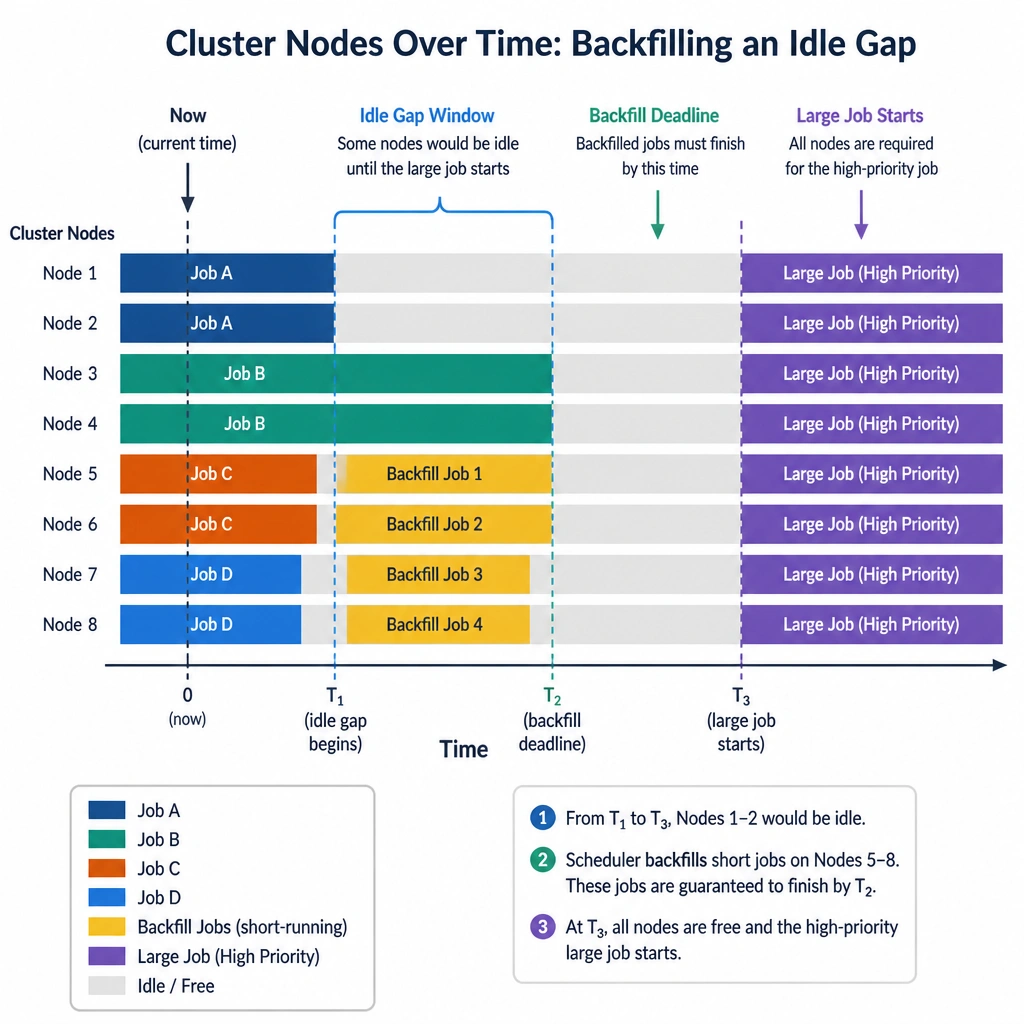
Okay, let's talk about scheduling. Imagine you have a massive AI cluster, and there's a huge training job in the queue that needs 64 GPUs. Since those 64 GPUs aren't all free right now, that big job has to sit there and wait. But while it's waiting, some nodes are sitting completely idle. That's a massive waste of expensive hardware! So, how does Slurm handle this? It uses a super cool feature called backfill scheduling. Think of it like booking a table at a busy restaurant. If a party of ten is waiting for three tables to clear, and a party of two walks in, the host might seat the party of two at an idle table as long as they promise to finish eating before the rest of the tables for the party of ten are ready. Slurm does the exact same thing. It looks at the smaller, shorter jobs in the queue and starts them on those idle nodes. The key rule here is that these backfill jobs must be scheduled to finish before the big job's resources are fully ready. This keeps cluster utilization high and keeps the queue moving. Let's flag the traps in the other options. Slurm doesn't duplicate jobs (Option A) because that would waste resources. It doesn't prioritize CPU-only jobs over GPUs just to clear them (Option C), and it definitely doesn't dynamically change memory allocations on running jobs (Option D)—that would crash your workloads! Remember: backfill is all about sliding smaller jobs into idle slots without delaying the big ones.
Full explanation below image
Full Explanation
Slurm (Simple Linux Utility for Resource Management) is a widely used open-source cluster management and job scheduling system for high-performance computing (HPC) and AI training environments. In large clusters, scheduling large parallel jobs (such as LLM training jobs requiring multiple GPU nodes) can lead to fragmentation. While the scheduler reserves nodes and waits for enough resources to accumulate to launch a high-priority, large job, several compute nodes may sit idle.
To prevent this underutilization, Slurm employs backfill scheduling. The backfill scheduler works by simulating the future start times of all high-priority queued jobs. It then scans the queue for lower-priority, smaller, or shorter jobs. If a smaller job can start and complete on the currently idle resources before the predicted start time of any higher-priority job, Slurm will execute the smaller job immediately. This process maximizes cluster throughput and hardware utilization (GPU/CPU duty cycles) without delaying the scheduled start time of the primary workloads.
Let's address the incorrect options: - Option A is incorrect because replicating jobs across nodes is not a scheduling optimization and would result in redundant resource utilization. - Option C is incorrect because backfill scheduling does not arbitrarily prioritize CPU workloads over GPU workloads; it relies strictly on resource requirements, requested time limits, and priority calculations. - Option D is incorrect because Slurm does not dynamically scale the memory or resource allocation of running jobs; job resource boundaries (defined via sbatch or srun parameters) are static during execution to maintain process stability.
For backfill scheduling to function effectively, users must specify accurate wall-time limits (--time) for their jobs, allowing the scheduler to plan the backfill windows accurately.