
Your organization wants to deploy a large language model (LLM) into production using NVIDIA NIM (NVIDIA Inference Microservice). What is packaged inside an NVIDIA NIM container that allows developers to immediately run inference via standard APIs without manual setup?
Select an answer to reveal the explanation.
Short Explanation and Infographic
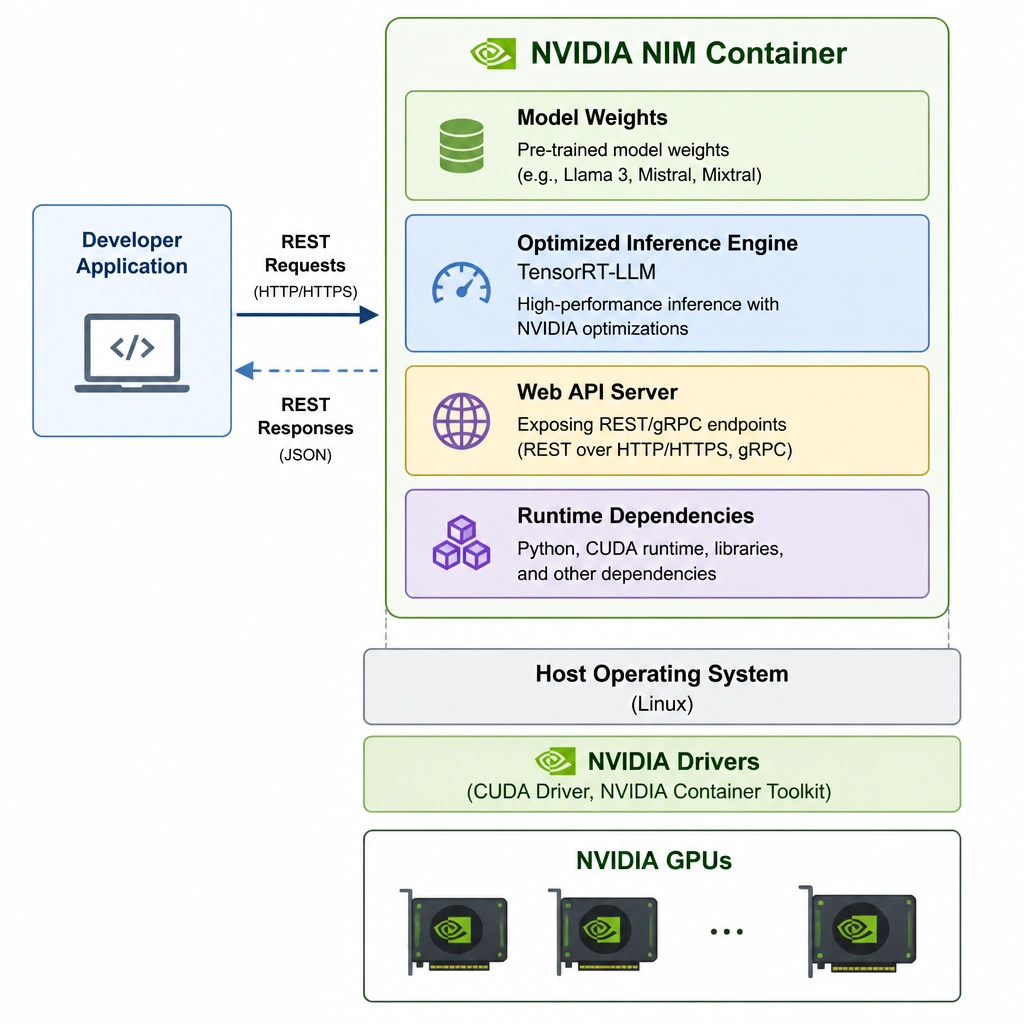
Check this out: in the past, getting a massive AI foundation model into production was a massive pain. You had to download the weights, figure out which inference engine (like TensorRT-LLM) worked best, set up an API server like FastAPI, manage all your Python dependencies, and hope nothing broke along the way. It took days, sometimes weeks, to get it right. NVIDIA realized this and came up with NIM, which stands for NVIDIA Inference Microservice. Think of a NIM container as a complete, ready-to-rock microservice in a box. When you pull a NIM container, you get the AI foundation model, the optimized inference engine (tuned specifically for NVIDIA GPUs), standard APIs (like OpenAI-compatible HTTP/gRPC endpoints), and all the system runtime dependencies packaged together. You run the container, and boom—your developers can start sending API requests to the model immediately. Now, let's look at why the other options are wrong. Option A says you only get the model weights. If that were true, NIM wouldn't be a microservice; you'd still have to write the API and configuration code yourself. Option B mentions GPU drivers and host OS kernels. Remember: containers run in user space and share the host kernel. They never package physical GPU drivers or OS kernels. And Option C? If you wanted manual configuration scripts and documents, you wouldn't be using a modern containerized microservice! Trust me on this: NIM is all about out-of-the-box, optimized inference.
Full explanation below image
Full Explanation
NVIDIA Inference Microservices (NIM) are designed to streamline and accelerate the deployment of generative AI models across cloud, data center, and workstation environments. A NIM container is a fully integrated, self-contained microservice that packages several critical layers to ensure out-of-the-box operation and maximum performance: 1. AI Foundation Models: The container either bundles or dynamically downloads pre-trained, optimized weights for specific models (such as Llama, Mistral, or Nemotron). 2. Optimized Inference Engines: It includes runtime engines like NVIDIA TensorRT, TensorRT-LLM, or vLLM, which are tailored to compile and run the models with peak performance on NVIDIA architecture. 3. Industry-Standard APIs: It exposes standard, secure API endpoints (such as OpenAI-compliant REST APIs or gRPC interfaces) allowing developers to integrate model inference into applications with minimal code changes. 4. Runtime Dependencies: It packages all required system libraries, Python packages, and runtime environments, eliminating version mismatches.
Review of the incorrect options: - Option A describes a raw model repository (like Hugging Face weights) which lacks the integrated server and optimization layers. - Option B is incorrect because containers do not package low-level hardware drivers (like the NVIDIA GPU driver) or host operating system kernels; these must reside on the host system infrastructure. - Option C describes legacy manual deployment methods, which contradict the containerized microservice architecture of NIM.
By containerizing these components together, NIM allows enterprises to achieve predictable, low-latency inference scaling without requiring deep expertise in deep learning compiler optimization.