
InfiniBand is the industry-standard network fabric for high-performance computing (HPC) and distributed AI training clusters. Which of the following core technical features and architectural designs define InfiniBand networking? (Select all that apply)
Select all correct answers, then click Submit.
Short Explanation and Infographic
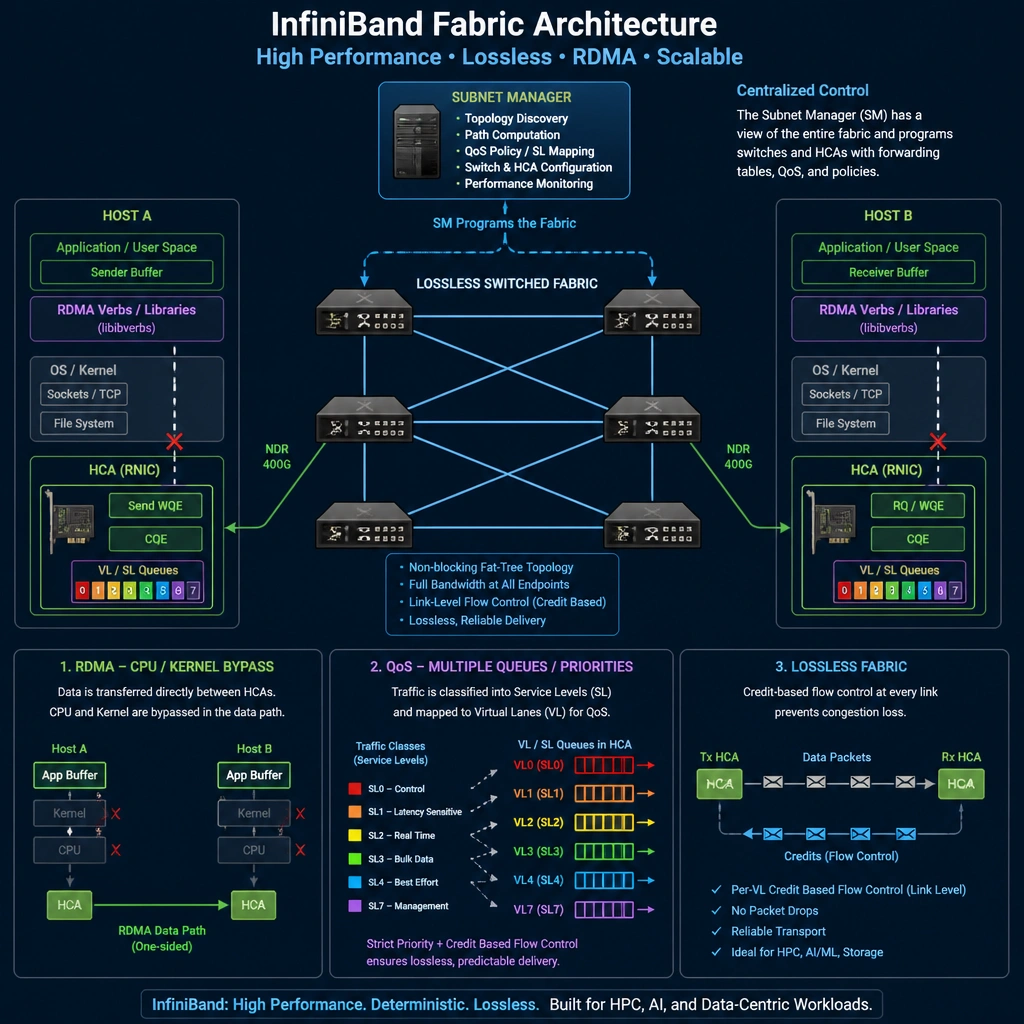
Pay close attention here: InfiniBand is not just fast Ethernet. It's a completely different architecture. First off, it's a lossless fabric—meaning packets don't get dropped, which is crucial when you're transferring gigabytes of model weights. Second, it uses a switched fabric design with point-to-point connections, not a shared bus. The secret sauce is RDMA (Remote Direct Memory Access), which lets one server copy data straight into another server's memory without bothering either CPU. To keep the whole thing running, a centralized Subnet Manager configures the paths and routing, while Quality of Service (QoS) keeps traffic organized. Remember these four components and you'll ace this topic on the exam!
Full explanation below image
Full Explanation
InfiniBand is designed from the ground up to support high-throughput, low-latency communication in clustering environments. Its architecture differs fundamentally from traditional Ethernet in several key ways:
1. Native RDMA Support: Remote Direct Memory Access allows a host adapter to transfer data directly from its local application memory to the memory of a remote host. This bypasses the operating system kernel and CPU on both ends, reducing latency and freeing host compute resources for training workloads.
2. Switched Fabric Topology: InfiniBand does not use shared buses. Instead, it utilizes a switched fabric structure where devices connect via point-to-point serial links through switches. This allows for concurrent, non-blocking communication between multiple nodes.
3. Centralized Subnet Management: InfiniBand networks rely on a Subnet Manager (SM) to manage the subnet. The SM discovers physical connections, assigns Local Identifiers (LIDs), calculates optimal routing paths, and programs the switch routing tables.
4. Quality of Service (QoS): InfiniBand supports QoS by mapping traffic to different Virtual Lanes (VLs) and Service Levels (SLs), ensuring high-priority traffic (like synchronization barriers) is not blocked by bulk data transfers.
Let's contrast the incorrect options: - Option A is incorrect because InfiniBand is a lossless fabric, using credit-based flow control to prevent buffer overflows and packet drops, unlike the lossy design of standard Ethernet. - Option D is incorrect because InfiniBand uses point-to-point switched fabric networks, not obsolete shared-bus topologies.