
You need to deploy two separate AI inference models on a single GPU-enabled bare-metal host. Model A requires Python 3.8 and PyTorch 1.12, while Model B requires Python 3.10 and PyTorch 2.1. Which technology should you use to isolate these conflicting runtime dependencies and run both models concurrently without interference?
Select an answer to reveal the explanation.
Short Explanation and Infographic
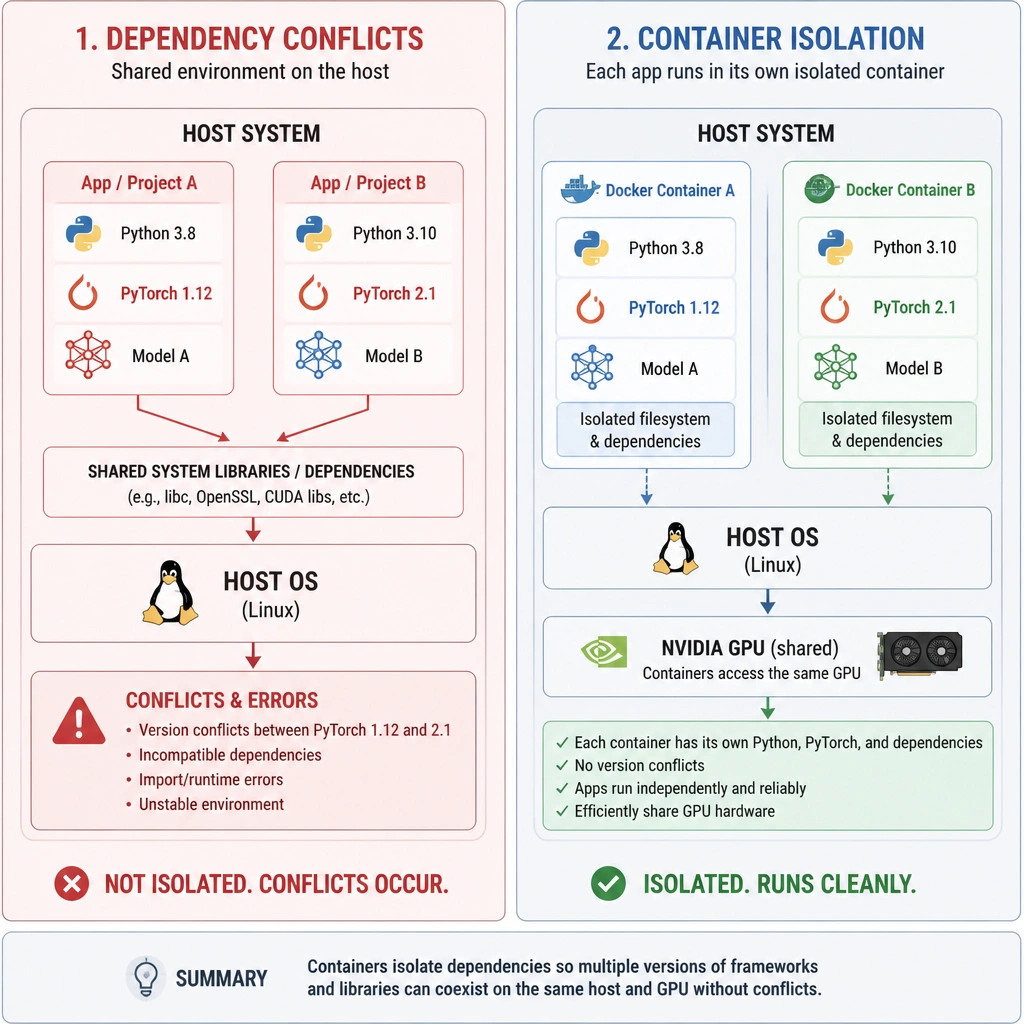
Here's the deal: when you're deploying AI models in production, software dependency hell is very real. You've got one model screaming for PyTorch 1.12 on Python 3.8, and another model that won't run on anything older than PyTorch 2.1 and Python 3.10. If you try to install all of this directly on the same bare-metal operating system, you'll end up with a broken mess of conflicting libraries. So, how do we solve this? We use Docker containers. Think of a Docker container as a self-contained cargo box. Inside that box, you pack everything your model needs to run—the exact version of Python, PyTorch, libraries, and custom code. Because the container is isolated from the host OS and other containers, you can run both models on the exact same GPU host at the same time without them stepping on each other's toes. Trust me on this, trying to manage dependency conflicts manually on bare metal is a recipe for office riots. Now, don't get tripped up by Kubernetes namespaces here. A namespace is great for separating teams or projects inside a cluster, but it does absolutely nothing to package or isolate local software versions. Triton is a killer tool for serving models, but it relies on containers to keep things clean. And NCCL? That's your multi-GPU communication library, which has zero to do with package management. Got it? Sweet. Docker containers are the key to clean, conflict-free deployments.
Full explanation below image
Full Explanation
Containerization is a foundational practice in modern AI operations and DevOps, specifically designed to address software dependency conflicts. A Docker container packages an application along with all of its binaries, libraries, configuration files, and specific language runtimes (such as Python and PyTorch versions) into a single, immutable image. This image runs in an isolated user space on the host operating system, sharing the host kernel but maintaining separate file systems, process trees, and network interfaces. This isolation ensures that even if two models have entirely incompatible software requirements, they can execute simultaneously on the same physical infrastructure without library conflicts or path pollution.
To understand why the other options are incorrect: - Kubernetes namespaces (Option A) are virtual clusters within a physical Kubernetes cluster. They provide isolation for resource naming, authorization, and network policies, but they do not isolate container-level software dependencies. Multiple pods running in different namespaces still run their respective container images, which rely on containerization to resolve software dependencies. - NVIDIA Triton Inference Server (Option C) is an open-source inference serving software that optimizes model deployment across GPUs and CPUs. While Triton can run multiple models concurrently, it does not inherently package the OS-level dependencies or resolve Python environment conflicts unless it is itself run within a containerized environment. - NVIDIA Collective Communications Library (NCCL) (Option D) provides multi-GPU and multi-node collective communication primitives (like AllReduce and AllGather) optimized for NVIDIA GPUs. It is used to accelerate training and inference scaling, not to manage software packaging or dependency isolation.
In production environments, deploying models within Docker containers ensures reproducibility, scalability, and seamless integration with orchestration systems like Kubernetes.