
A clinical hospital group is implementing deep learning models for real-time surgical computer vision guidance and automated medical image screening. Due to strict HIPAA requirements and the critical need to avoid WAN latency issues during operations, which factor most strongly warrants choosing a dedicated on-premises GPU cluster over cloud infrastructure?
Select an answer to reveal the explanation.
Short Explanation and Infographic
Here's a real-world scenario for you: a surgeon is performing a delicate procedure, and an AI is analyzing a video feed to identify critical structures in real-time. If the internet connection drops or gets congested, that delay could be disastrous. In this situation, you need two things: zero-delay local processing (ultra-low latency) and absolute data security to keep patient records safe. Going with an on-premises GPU cluster keeps the data local and ensures your network doesn't have to hop across the WAN to the cloud. If you answered C, you've got this down. If you need dynamic scaling or want to avoid buying hardware upfront, that's when you look at the cloud.
Full explanation below image
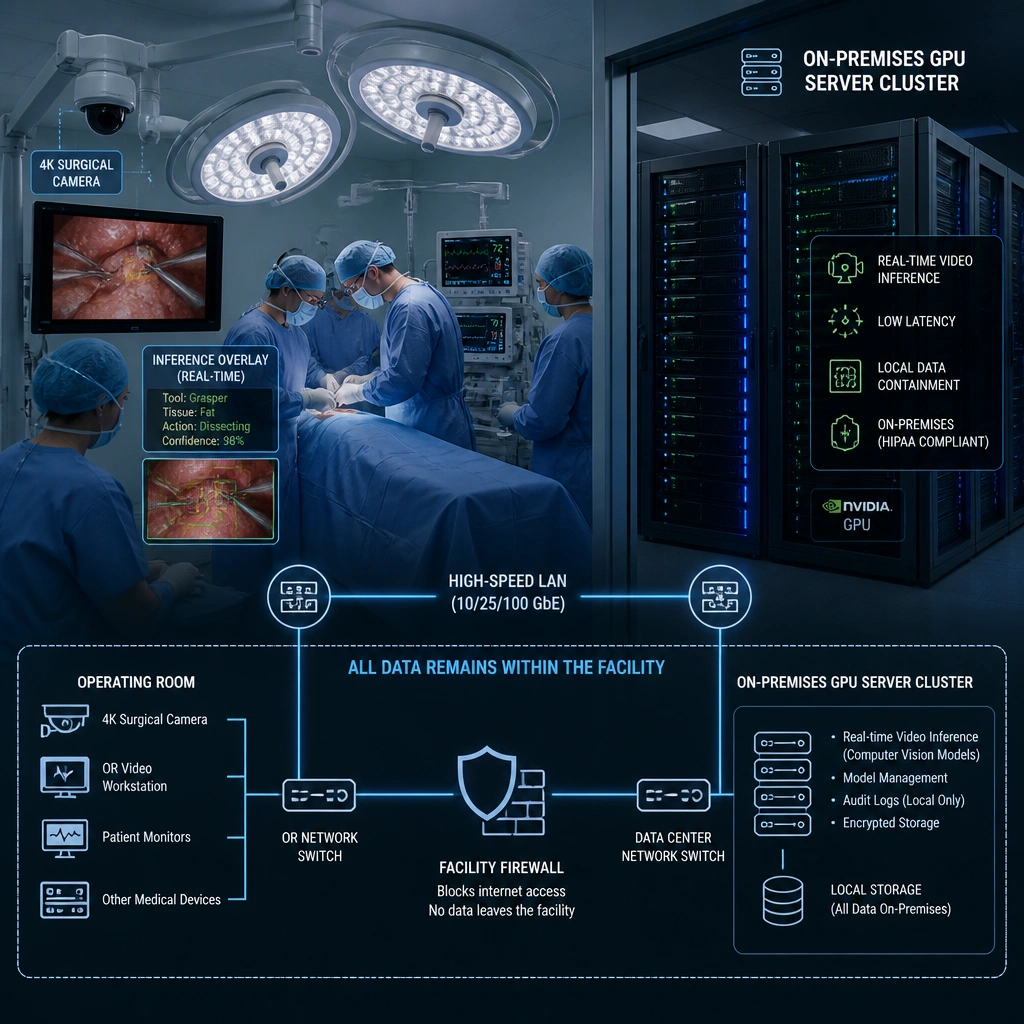
Full Explanation
Choosing between on-premises and cloud-based AI infrastructure requires balancing cost, operational flexibility, latency, and compliance.
For clinical healthcare applications (such as real-time surgical assistance or emergency diagnostics), on-premises infrastructure is strongly justified by two key factors: latency and data control.
1. Latency: Critical real-time diagnostic systems require sub-millisecond response times. Cloud solutions introduce WAN latency, routing hops, and potential internet outages, which can compromise patient safety. Local, on-premises GPU servers connected to the hospital's high-speed LAN ensure consistent, deterministic, ultra-low latency.
2. Data Security and Compliance: Under regulations like HIPAA, Protected Health Information (PHI) must be meticulously protected. Hosting AI infrastructure on-premises gives the organization physical and logical control over the entire data lifecycle, eliminating risks associated with public cloud data breaches or third-party storage compliance gaps.
Let's address the distractors: - Option A (dynamic scaling) and Option B (capital expenditure reduction/no maintenance) are classic benefits of cloud computing, not reasons to choose on-premises infrastructure. - Option D (global team collaboration) is also easier to implement in cloud environments where remote access and centralized cloud developer environments are native.