
An enterprise needs to deploy a large language model to process confidential customer data. Why would the engineering team choose to deploy NVIDIA NIM (NVIDIA Inference Microservice) containers locally or in their own private cloud rather than using external third-party model APIs?
Select an answer to reveal the explanation.
Short Explanation and Infographic
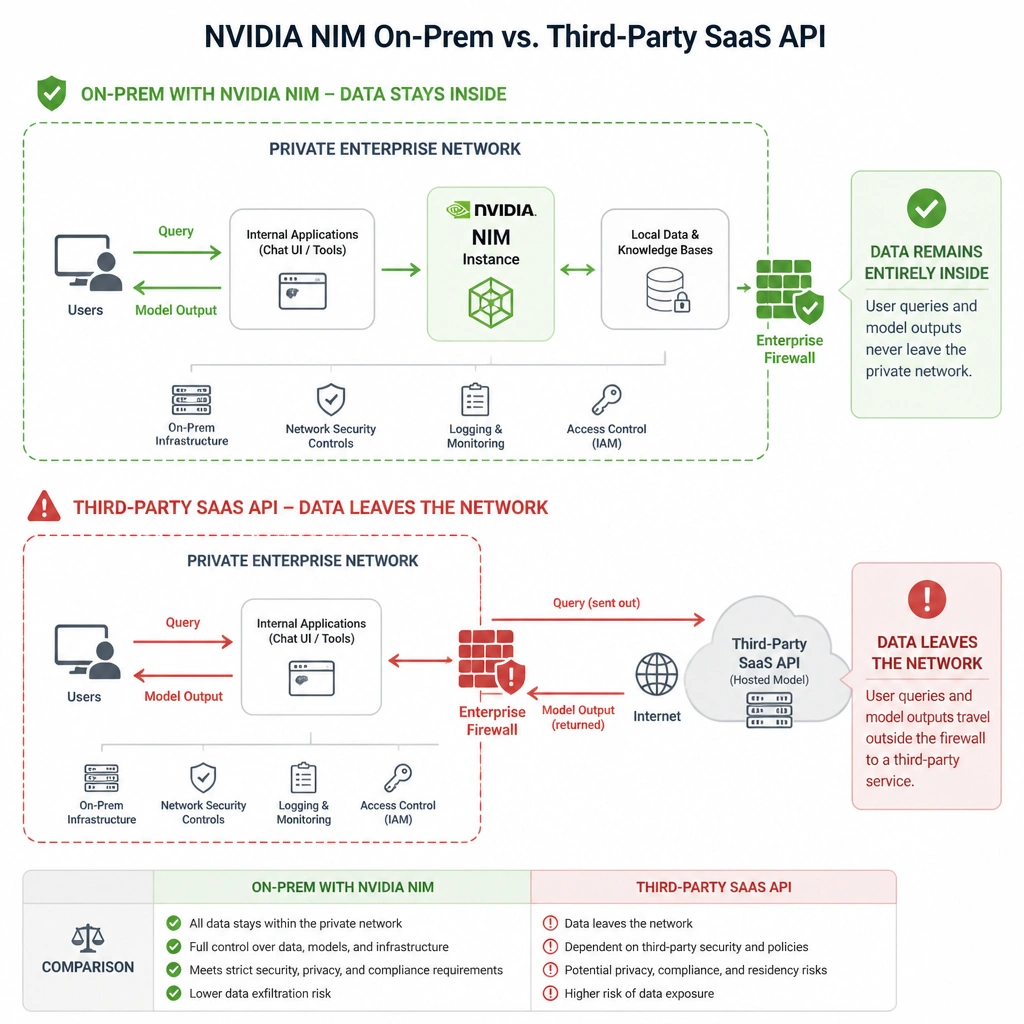
Think of it like this: if you're a bank or a hospital, you can't just send sensitive customer or patient data out to some public API on the internet. You'd get hit with massive regulatory fines! That's where NVIDIA NIM comes in. NIM packages up optimized models inside containers that you run inside your own data center or secure private cloud. Your data never leaves your network. That means you keep complete control and maintain your compliance. Keep in mind, NIM doesn't magically make models run on cheap CPU hardware or give you free cloud compute—it's designed to run on NVIDIA GPUs in your own secure space.
Full explanation below image
Full Explanation
NVIDIA NIM (NVIDIA Inference Microservice) is a set of easy-to-use microservices designed to accelerate the deployment of generative AI models across enterprise environments.
For enterprises with strict data privacy, security, or regulatory requirements (such as HIPAA in healthcare or GDPR/FINRA in finance), sending data to third-party SaaS APIs (where data is transmitted over the internet to external servers) is often unacceptable. NVIDIA NIM addresses this by delivering models as containerized microservices. Enterprises can download these containers and run them on-premises or within their private virtual private clouds (VPCs). This ensures that all data processing, prompt execution, and model inference occur entirely within the organization's secure infrastructure perimeter, maintaining total data sovereignty.
Let's look at why other options are incorrect: - Option A is incorrect because NIM is specifically optimized for NVIDIA GPUs (using TensorRT and TensorRT-LLM); it does not compile or port models to arbitrary hardware architectures. - Option C is incorrect because NIM requires NVIDIA-accelerated hardware to achieve the high-throughput, low-latency inference it is built for. - Option D is incorrect because NIM is a software deployment solution and does not supply free cloud computing resources; users must still provision and pay for the underlying GPU infrastructure.