
When architecting runtime environments for deep learning models, engineers often prefer containerization (like Docker or Apptainer) over traditional virtual machines (VMs). What is the architectural reason containers achieve superior resource efficiency and density on GPU hosts?
Select an answer to reveal the explanation.
Short Explanation and Infographic
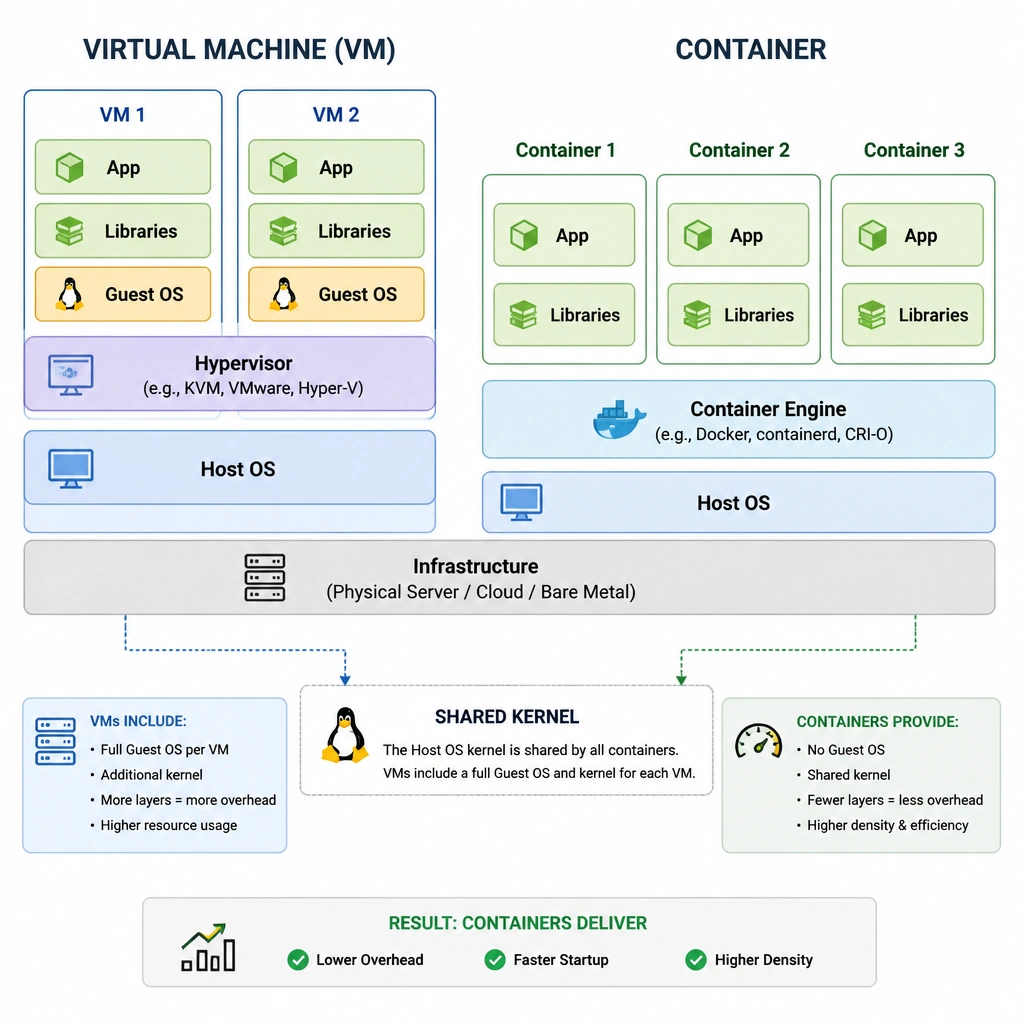
Here's the deal: virtual machines are heavy. When you spin up a VM, you're loading a complete guest operating system—with its own kernel, system libraries, and virtual devices. That consumes a ton of CPU and memory before you even start training your model! Containers are a completely different animal. They share the host system's kernel and just isolate the application space. Since you aren't running ten copies of Linux on a single machine, you save huge amounts of system memory and CPU overhead. This lets you pack way more workloads onto your expensive GPU hardware. Pretty cool, right?
Full explanation below image
Full Explanation
In modern AI/ML infrastructure, containerization is the standard method for packaging and deploying workloads due to its architectural efficiency compared to traditional hardware virtualization (Virtual Machines).
Virtual Machines rely on a hypervisor to partition physical hardware, requiring each VM to run a complete, independent guest operating system (OS). This guest OS consumes substantial system memory, disk space, and CPU cycles simply to maintain kernel operations and system daemons.
In contrast, containers isolate applications at the user-space level while sharing the host operating system's kernel. Because containers do not require a guest OS, they have a footprint that is orders of magnitude smaller than VMs. This shared-kernel architecture minimizes compute overhead (memory and CPU cycle waste), speeds up boot times to seconds, and allows administrators to achieve significantly higher deployment density (more container instances per physical GPU/CPU host).
Let's review the incorrect options: - Option A is incorrect because containers still require the host GPU driver (often exposed via tools like the NVIDIA Container Toolkit) to communicate with the hardware; they do not bypass the driver. - Option C is incorrect because containers are software packaging tools and have no mechanism or authority to modify hardware-level configurations like clock speeds or voltage. - Option D is incorrect because dataset compression and tensor deduplication are functions of the training framework or input pipeline (e.g., PyTorch DataLoader), not a feature inherent to the container runtime.