
A startup is developing an AI application where research activity spikes during the day, but requires minimal compute overnight. Which operational capability of cloud GPU infrastructure makes it the most cost-effective choice for this workload pattern?
Select an answer to reveal the explanation.
Short Explanation and Infographic
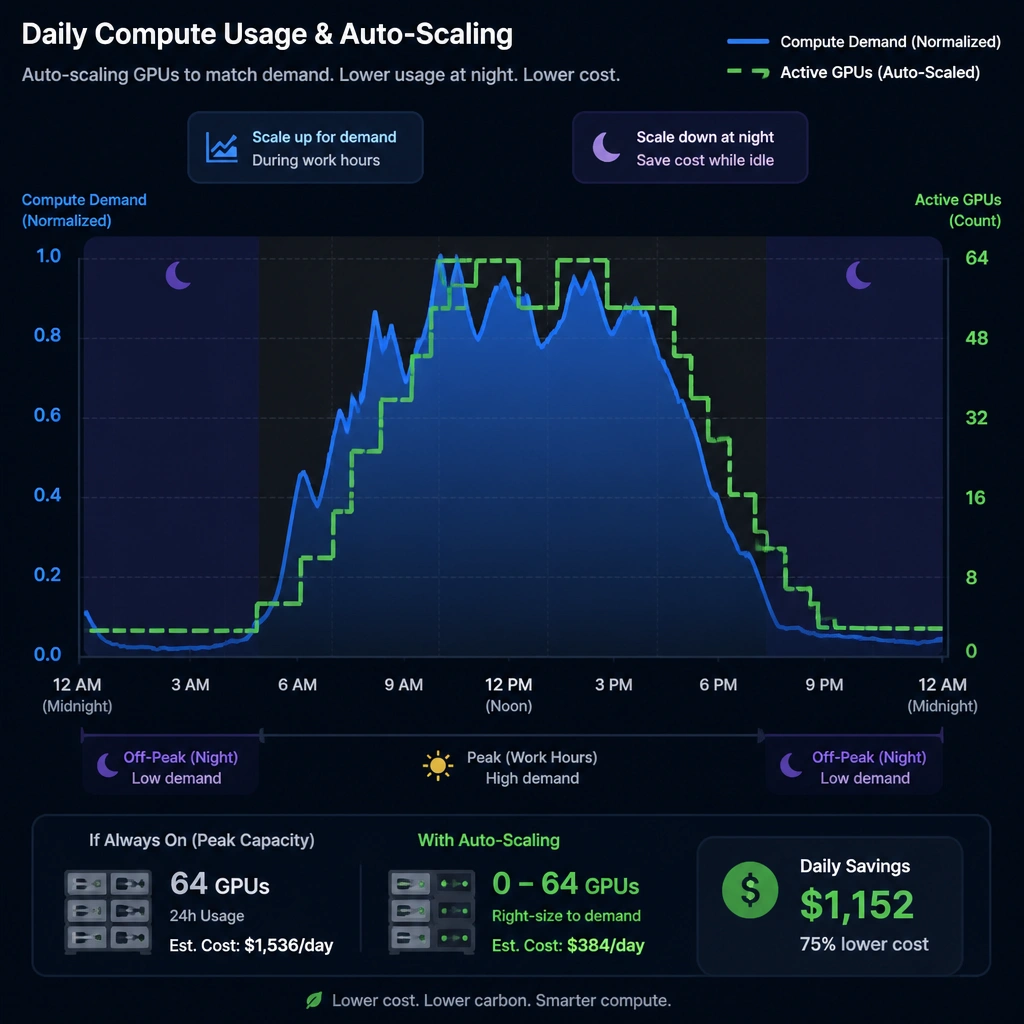
Think of it like this: why pay to heat an empty building at night? If your data science team goes home at 5 PM, your GPUs shouldn't be running hot and burning cash. With cloud GPUs, the killer feature for varying workloads is elastic provisioning. You can scale down your GPU footprint to next to nothing overnight, and then ramp it back up when the team logs back in. Try doing that with an on-premises cluster—those expensive servers are sitting in your rack depreciation-wise whether they are running jobs or not. Elasticity means you only pay for what you actually use!
Full explanation below image
Full Explanation
AI and machine learning development workflows are rarely constant. They are characterized by periods of high intensity (e.g., training a model, running large batch inference jobs) followed by periods of low usage (e.g., writing code, analyzing results, or overnight downtime).
For projects with highly variable computational demands, the most significant advantage of cloud GPU infrastructure is elasticity—the ability to dynamically provision and deprovision GPU instances (scale up or down) to align with immediate computing needs. This utility billing model allows companies to pay strictly for the compute seconds they consume, maximizing cost-effectiveness and avoiding capital lock-in for underutilized hardware.
Let's address the distractors: - Option A is incorrect because cloud infrastructure often introduces data transfer latency between remote object storage and cloud GPUs, which must be carefully managed (e.g., caching), rather than eliminating it. - Option B is incorrect because cloud providers deliver the underlying infrastructure (GPUs, VMs, networks); they do not automatically optimize or rewrite the user's AI training algorithms or model code. - Option C is incorrect because cloud networks are shared and subject to latency variance and congestion, meaning performance is not deterministic or immune to network conditions.