
An enterprise wants to quickly train and test multiple large-scale AI models without investing upfront in expensive physical data center build-outs. From an infrastructure scaling perspective, what is the primary benefit of selecting a cloud-based GPU platform over a traditional on-premises deployment?
Select an answer to reveal the explanation.
Short Explanation and Infographic
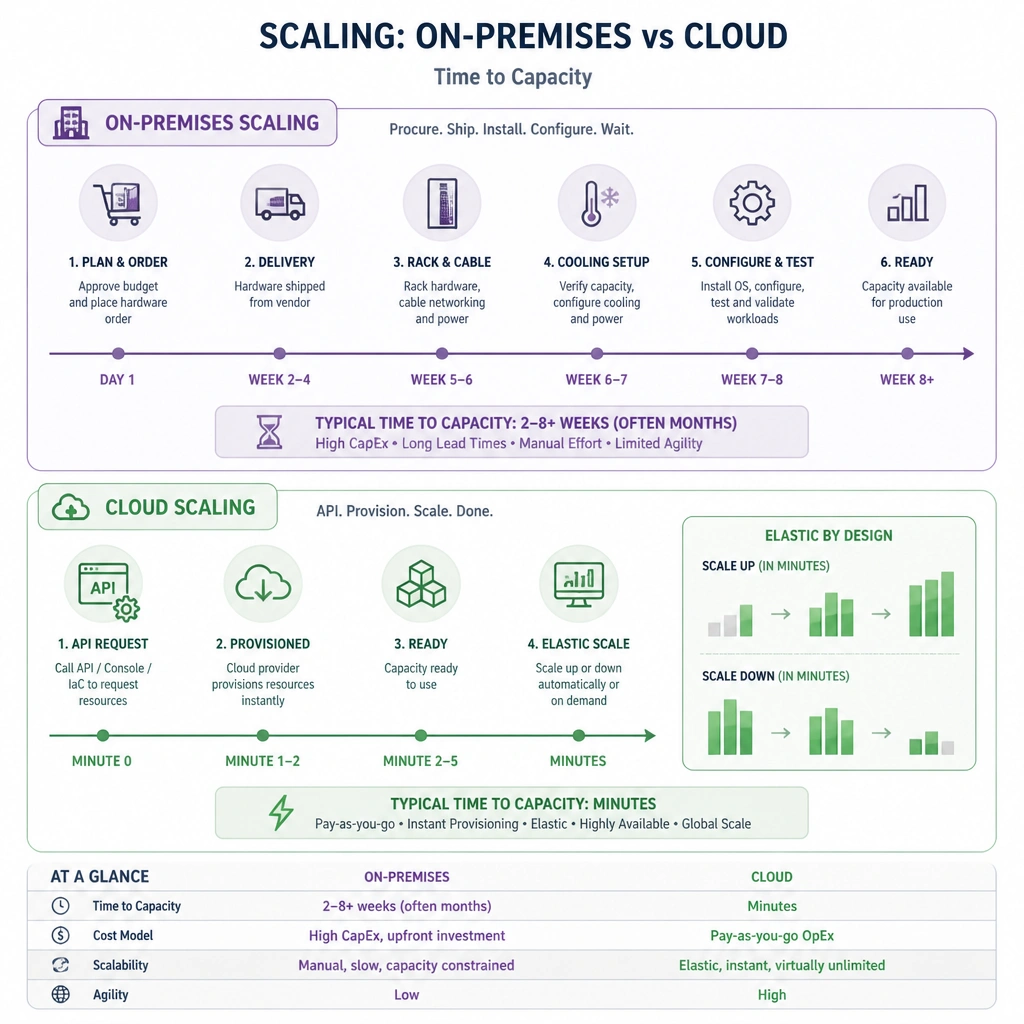
Here's the deal: if your boss walks in and says, 'We need to train a new model on 256 H100 GPUs by next Monday,' you can't just call up your vendor and expect that hardware to arrive tomorrow. Ordering servers, sorting out power, cooling, and racking takes months! But with cloud GPUs, you can spin up those nodes in minutes with a few API calls and spin them down when you're done. That on-demand scaling—without the hardware procurement delay—is the number one reason companies choose cloud GPU infrastructure. Yes, you pay a premium and have to watch out for shared-tenant performance issues, but the agility is unmatched.
Full explanation below image
Full Explanation
When deciding between on-premises and cloud-based AI infrastructure, scaling latency and capital deployment are crucial factors.
The primary scalability advantage of cloud GPU infrastructure is its elasticity and the elimination of hardware procurement cycles. In an on-premises deployment, scaling up computing resources requires physical supply chain operations (requesting quotes, ordering, shipping, customs), data center preparation (allocating rack space, provisioning adequate power and cooling capacity), and manual installation/integration. This process can take weeks or months. In contrast, cloud platforms allow organizations to instantiate clusters of virtual machines equipped with GPUs almost instantly through automation APIs, scaling up for intensive training phases and scaling down to reduce costs once the workload is complete.
Let's analyze the incorrect options: - Option B suggests that fixed resource allocation prevents cost overruns, but cloud computing is inherently variable-cost and prone to overruns if not monitored, unlike fixed-cap on-premises hardware. - Option C is incorrect because cloud platforms are typically multi-tenant and resources are shared. While some providers offer reserved instances, they do not guarantee exclusive access to the provider's entire fleet. - Option D is incorrect because cloud environments are susceptible to network fluctuations and 'noisy neighbor' effects in shared infrastructure, meaning performance is not unconditionally guaranteed compared to dedicated on-premises hardware.