
An operations engineer wants to feed real-time GPU metrics—such as thermal conditions, power usage, and memory utilization—into a Prometheus and Grafana observability stack. Which NVIDIA utility should be deployed on the cluster nodes to export this telemetry?
Select an answer to reveal the explanation.
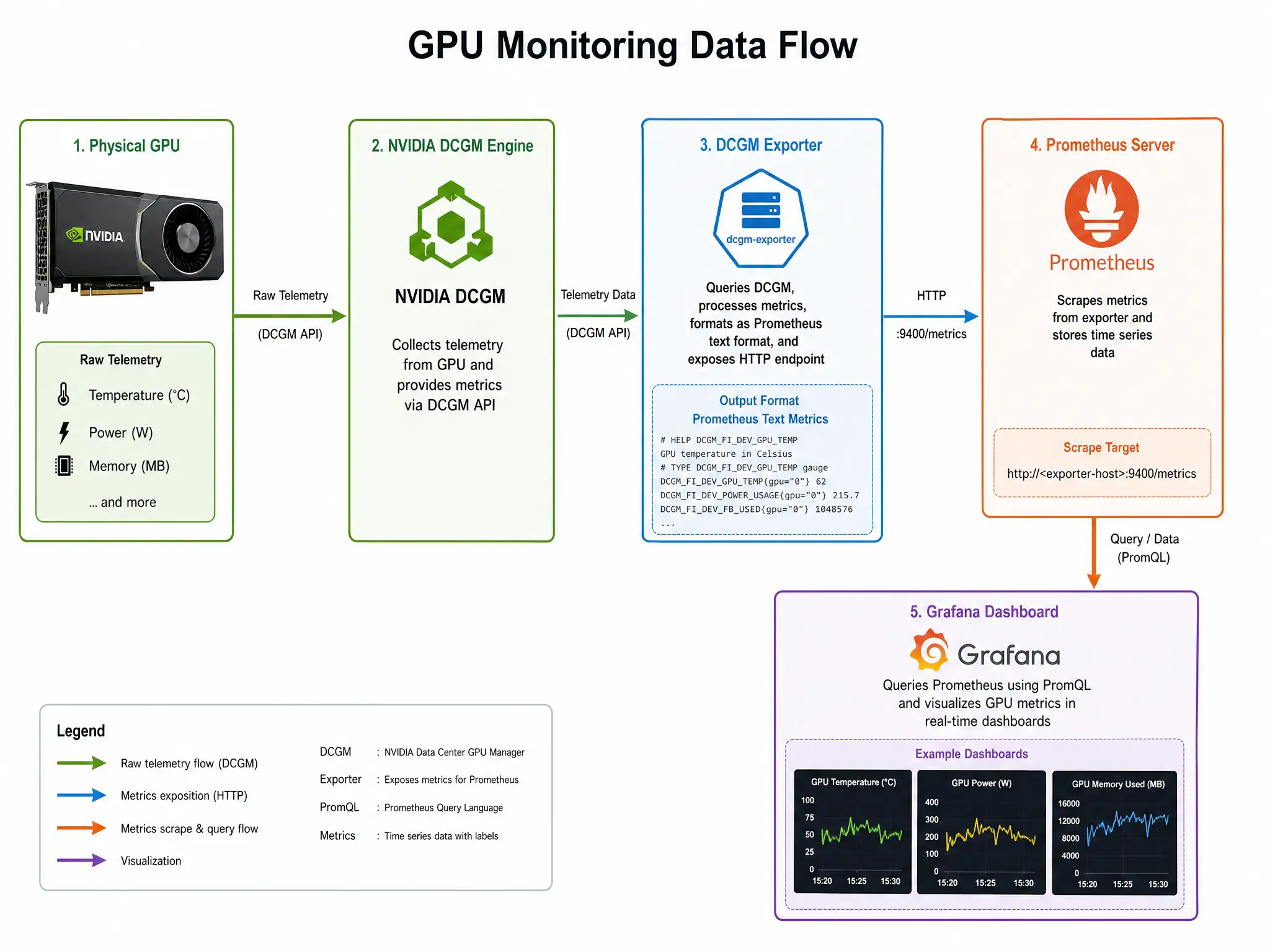
Short Explanation
Prometheus and Grafana don't talk to raw NVIDIA GPUs out of the box, so you need a translator. Deploy the NVIDIA Data Center GPU Manager (DCGM) Exporter on the nodes; it reads GPU telemetry like thermal conditions, power usage, and memory utilization, then exposes it in Prometheus format. Don't confuse it with profiling, GPU communication, or deep-learning libraries.
Full Explanation
The utility to deploy is the NVIDIA Data Center GPU Manager (DCGM) Exporter. Prometheus and Grafana are common observability tools, but Prometheus cannot scrape raw NVIDIA GPU telemetry directly, so you need a translator on each cluster node. DCGM is a suite of tools for managing and monitoring NVIDIA GPUs in clustered environments; it talks directly to the GPU drivers and tracks metrics such as GPU utilization, memory usage, temperature, fan speeds, power consumption, clock speeds, and hardware errors such as ECC memory errors. The DCGM Exporter hooks into the DCGM engine, reformats that telemetry into Prometheus-compliant text, and exposes an HTTP endpoint that Prometheus can scrape at regular intervals, after which Prometheus can forward the data to visualization tools like Grafana. Exam caveat: this is an exam favorite, so do not confuse telemetry export with profiling, GPU-to-GPU communication, or deep-learning math libraries. The NVIDIA Nsight Systems profiling tool is wrong because it is a system-wide profiling tool used by developers to analyze application performance, identify GPU bottlenecks, and optimize execution paths, not a continuous telemetry exporter. The NVIDIA Collective Communications Library (NCCL) is wrong because it provides multi-GPU and multi-node collective communication primitives such as All-Reduce, All-Gather, and Broadcast, and is not involved in system monitoring. The NVIDIA CUDA Deep Neural Network library (cuDNN) is wrong because it is a GPU-accelerated library of primitives for deep neural networks, providing implementations for routines such as convolution, pooling, normalization, and activation functions, rather than a system-level telemetry exporter.