
In addition to compute, networking, and storage, which two further foundational areas must an enterprise AI cluster design integrate to form a fully operational deep learning environment?
Select an answer to reveal the explanation.
Short Explanation
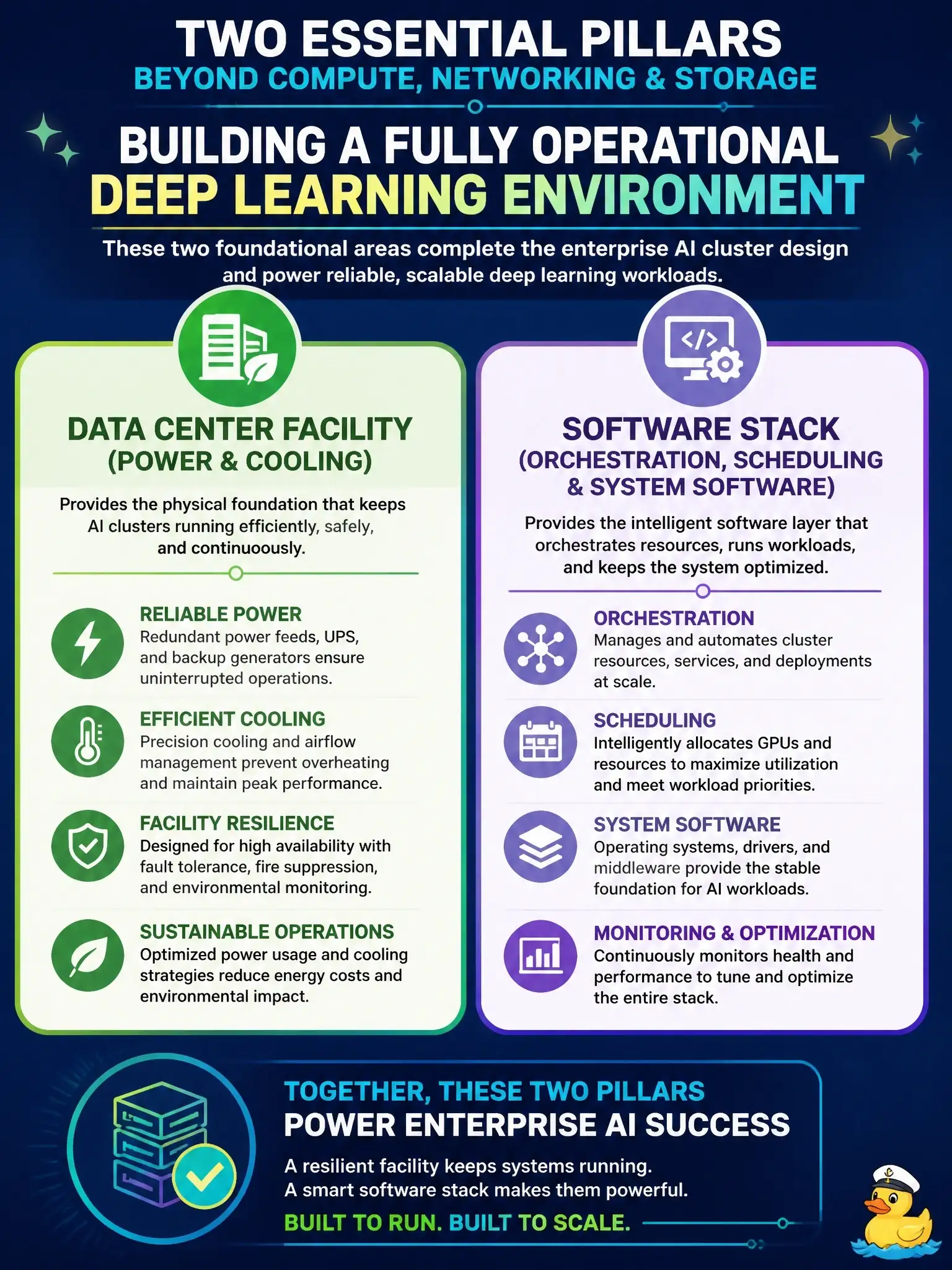
GPUs, switches and storage arrays are just expensive boxes until something powers, cools and runs them. That's why you also design the data center facility, with its power and cooling, and the software stack that schedules and orchestrates the work. Leave either one out and your cluster either overheats or sits idle.
Full Explanation
Reference designs such as the NVIDIA DGX SuperPOD architecture treat an AI cluster as more than servers and cables. Beyond compute, networking, and storage, they call out the data center requirements, with power above 40 kW per rack and rack layouts adjusted to local power and cooling distribution, and a dedicated software layer for managing the cluster. The facility matters because dense GPU systems draw far more power and produce far more heat than typical enterprise racks, so capacity, cooling method, and floor layout shape the whole design. The software stack matters because drivers, cluster management, container runtimes, and schedulers such as Slurm or Kubernetes are what turn hardware into a shared, usable environment for training jobs. A public-cloud burst account and a CI/CD pipeline are optional operating choices, not foundational to the on-premises cluster. A business-intelligence dashboard layer and a data-labeling contract support business workflows around AI, but the cluster runs without them. A standby GPU cluster and an offsite tape library are resilience extras that duplicate existing layers rather than completing the design. For the exam, think of five areas: facility, compute, networking, storage, and software. As a practical check, confirm the facility's per-rack power and cooling budget before finalizing node counts.