
In a dynamic AI cluster environment, what operational capability is unlocked by deploying a real-time scheduler that continuously monitors job queues and system health?
Select an answer to reveal the explanation.
Short Explanation
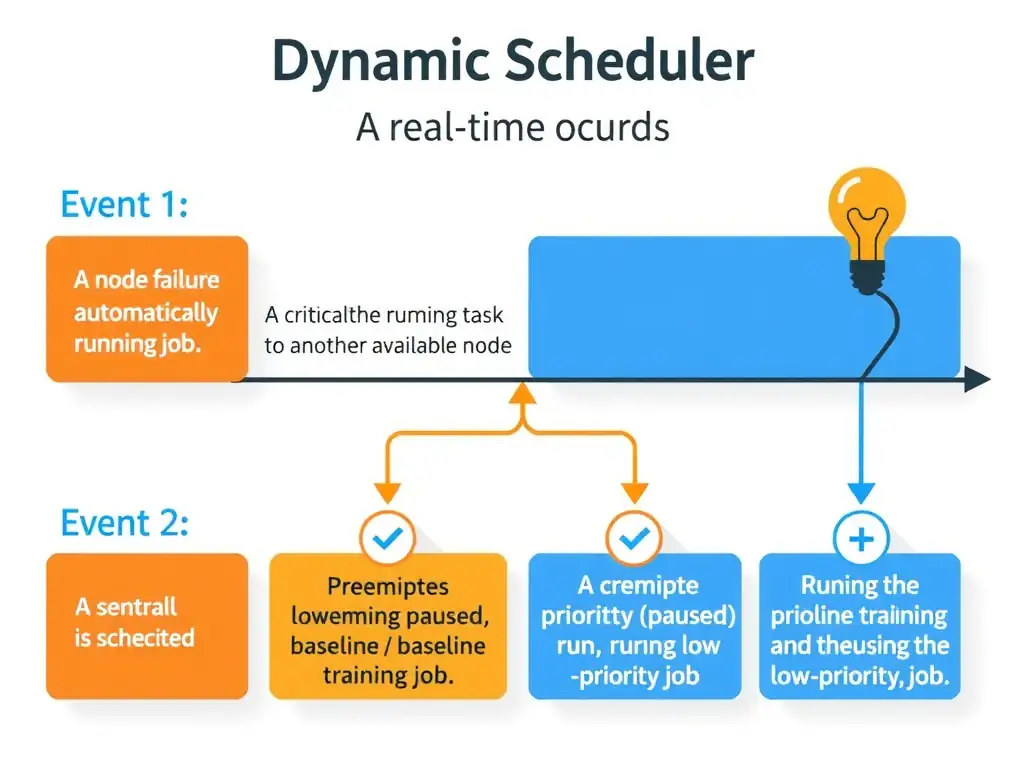
When priorities shift or hardware fails, you need your cluster to react. A real-time scheduler watches queues and health, then reassigns compute and adapts job placement on the fly. It doesn't guarantee deadlines or magically run everything at once, but it keeps critical work moving when real life happens.
Full Explanation
Real-time dynamic scheduling is essential for managing the unpredictable nature of enterprise AI workloads and cluster infrastructure. AI clusters are subject to frequent changes: new, high-priority training requests are submitted, active jobs are cancelled by users, and physical hardware components (like GPUs or network links) can fail. A real-time dynamic scheduler continually evaluates the state of the cluster and the job queue. It can automatically execute policies such as preemption (suspending a low-priority job to free up resources for a high-priority one), rescheduling (moving tasks from a failing node to a healthy one), and dynamic scaling (allocating idle resources to running jobs). This continuous orchestration ensures optimal alignment of resource consumption with business priorities.
The capability described by dynamically reassigning compute resources and adapting job placement on the fly in response to fluctuating task priorities and hardware health status is exactly what this scheduler provides. It reacts to changing priorities and hardware health rather than relying on a fixed plan. In operational terms, if a critical production bug needs immediate testing, the scheduler can preempt a low-priority training run, checkpoint its state, and resume it later; if a node's power supply fails, it can move affected tasks to healthy hardware.
The claim that it guarantees all deep learning jobs will finish within a strict, pre-negotiated timeframe regardless of the cluster's physical compute capacity is incorrect because schedulers cannot override the physical limitations of the hardware. They cannot guarantee that a job will finish within a specific timeframe if the compute requirements exceed the available cluster capacity.
The claim that it locks in hardware reservations in advance for every job submitted, completely eliminating the possibility of task preemption, is incorrect because dynamic schedulers do not prevent preemption; in fact, the ability to preempt jobs (suspend them) is a core feature used to ensure high-priority tasks can run immediately. Static reservation of resources for all jobs would lead to severe head-of-line blocking and underutilization.
The claim that it bypasses the need for job queuing and priority levels by executing all workloads concurrently without performance degradation is incorrect because finite hardware resources mean that running all workloads simultaneously without queueing or priority would cause severe resource contention, out-of-memory errors, and massive performance degradation for all tasks.