
In a dynamic AI cluster environment, what operational capability is unlocked by deploying a real-time scheduler that continuously monitors job queues and system health?
Select an answer to reveal the explanation.
Short Explanation and Infographic
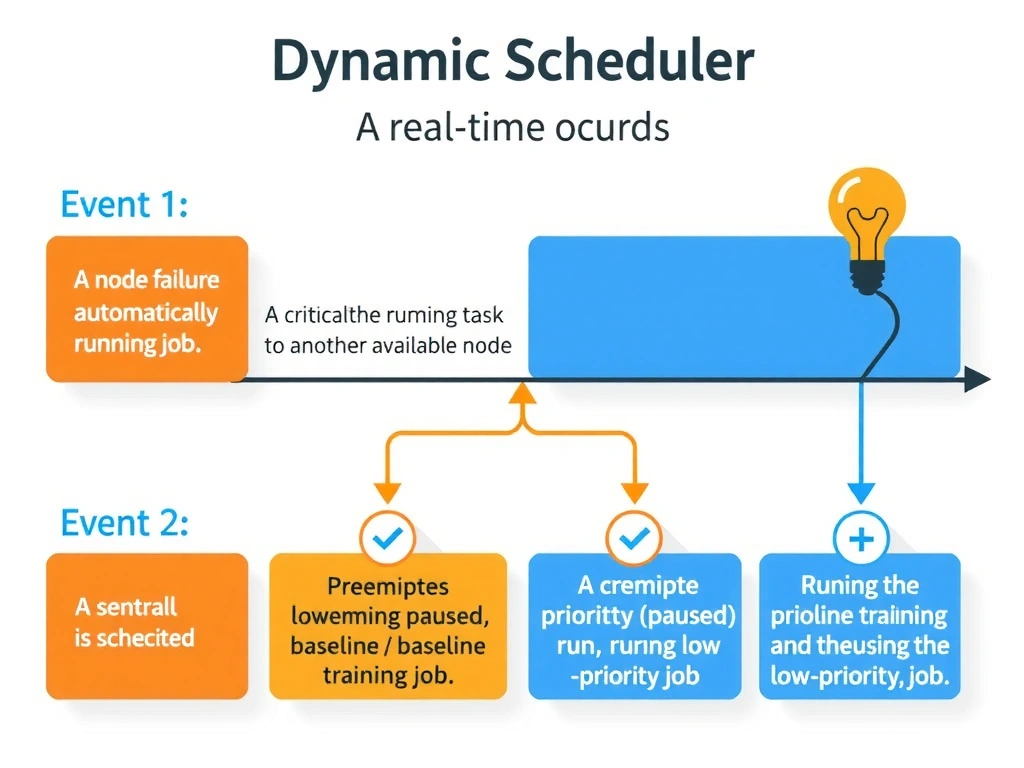
Let's say you're running a massive training job that's going to take three days. Suddenly, the lead AI researcher runs into the room and says, 'Stop everything, we have a critical production bug and I need to test this fix right now!' Or, even worse, one of your main compute nodes has a power supply failure and drops offline mid-run. What happens next? If you don't have a real-time dynamic scheduler, your system is stuck. But with dynamic scheduling, the cluster manager handles this in real-time. It sees the high-priority fix, gracefully pauses (preempts) your low-priority training run, saves its state (checkpoint), and boots it off the GPU to let the critical bug fix run. When that's done, or when the failed node is replaced, it automatically spins your training job back up from where it left off. That's real-time adaptability! It doesn't guarantee deadlines or magically run everything at once, but it ensures your cluster reactively bends instead of breaking when real life happens.
Full explanation below image
Full Explanation
Real-time dynamic scheduling is essential for managing the unpredictable nature of enterprise AI workloads and cluster infrastructure. AI clusters are subject to frequent changes: new, high-priority training requests are submitted, active jobs are cancelled by users, and physical hardware components (like GPUs or network links) can fail. A real-time dynamic scheduler continually evaluates the state of the cluster and the job queue. It can automatically execute policies such as preemption (suspending a low-priority job to free up resources for a high-priority one), rescheduling (moving tasks from a failing node to a healthy one), and dynamic scaling (allocating idle resources to running jobs). This continuous orchestration ensures optimal alignment of resource consumption with business priorities. Let's analyze the incorrect options: - Option B is incorrect because schedulers cannot override the physical limitations of the hardware. They cannot guarantee that a job will finish within a specific timeframe if the compute requirements exceed the available cluster capacity. - Option C is incorrect because dynamic schedulers do not prevent preemption; in fact, the ability to preempt jobs (suspend them) is a core feature used to ensure high-priority tasks can run immediately. Static reservation of resources for all jobs would lead to severe head-of-line blocking and underutilization. - Option D is incorrect because finite hardware resources mean that running all workloads simultaneously without queueing or priority would cause severe resource contention, out-of-memory errors, and massive performance degradation for all tasks.