
In a multi-tenant enterprise cluster where teams submit different workloads—ranging from small model debugging to large-scale training runs—which scheduling strategy maximizes resource efficiency and GPU utilization?
Select an answer to reveal the explanation.
Short Explanation and Infographic
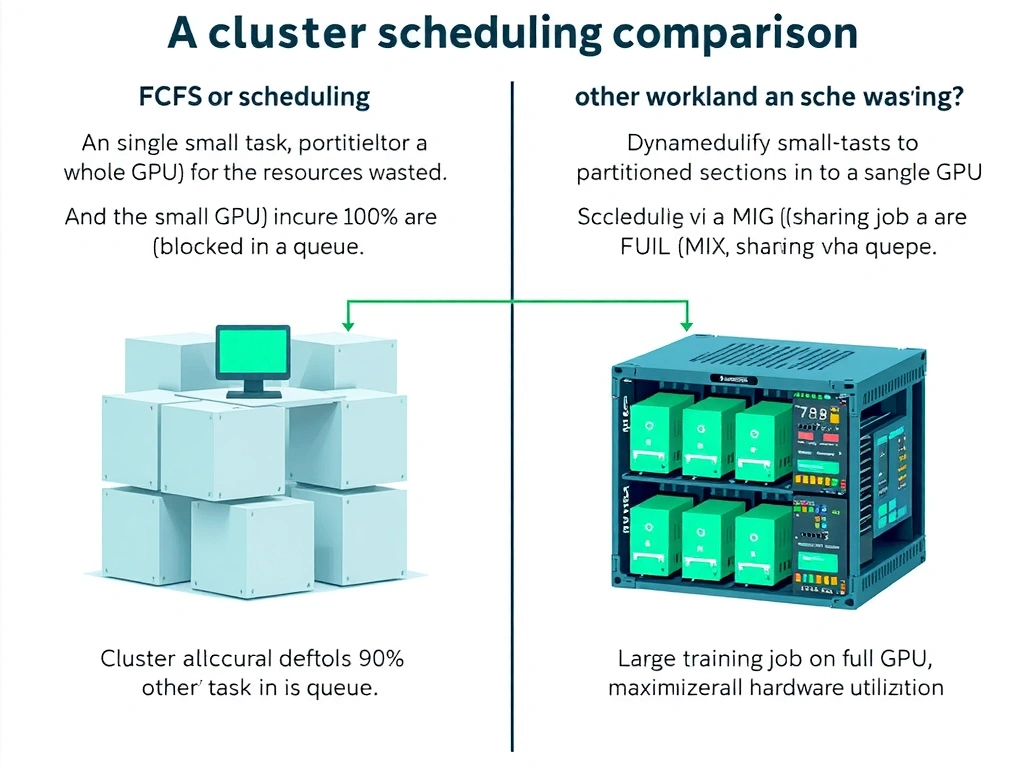
Here's the deal: GPUs are expensive, and leaving them sitting idle is a great way to get a friendly chat with the CFO. If you use static partitioning—where Team A gets two GPUs and Team B gets two—what happens when Team A is on vacation? Their GPUs sit there doing absolutely nothing while Team B's jobs are stuck in a queue. That's a waste of money! If you use First-Come, First-Served with exclusive access, a tiny debugging script that needs 5% of a GPU will lock down a whole physical card, blocking a massive training run. What we want is dynamic scheduling. A workload-aware scheduler looks at what each job actually needs. It might say, 'Hey, this job only needs a fraction of a GPU, so let's share this physical card using Multi-Instance GPU (MIG) or dynamic fractional sharing.' This keeps your overall utilization high and your queues short. Trust me, dynamic, workload-aware scheduling is the gold standard for enterprise clusters.
Full explanation below image
Full Explanation
In a shared AI/ML cluster environment, workloads vary significantly in their compute, memory, and duration requirements. A dynamic scheduler with workload-aware algorithms evaluates these specific requirements (such as requested GPU memory, compute intensity, and priority) and matches them to available physical resources. Techniques like NVIDIA Multi-Instance GPU (MIG) allow a physical GPU to be partitioned into separate hardware instances. A dynamic scheduler can assign small development or inference jobs to these smaller partitions while reserving full GPUs or multi-node configurations for large training tasks. This dynamic allocation prevents resource fragmentation and maximizes overall cluster utilization. Let's analyze the incorrect options: - Option A is incorrect because static partitioning leads to low cluster utilization because resources cannot be shared. If a team has no active workloads, their allocated GPUs remain idle while other teams' jobs queue up. - Option B is incorrect because round-robin scheduling is inefficient for ML tasks because it does not consider the resource profile of the workloads. Frequent preemption and context-switching of large neural network states are highly expensive and can degrade performance. - Option D is incorrect because FCFS scheduling with exclusive access leads to head-of-line blocking, where a small job blocks larger, high-priority workloads, or a long-running, low-priority training run prevents developers from running quick validation tests.