
When architecting an enterprise-grade AI cluster from scratch, how many foundational infrastructure pillars must be designed and integrated to form a fully operational deep learning environment?
Select an answer to reveal the explanation.
Short Explanation and Infographic
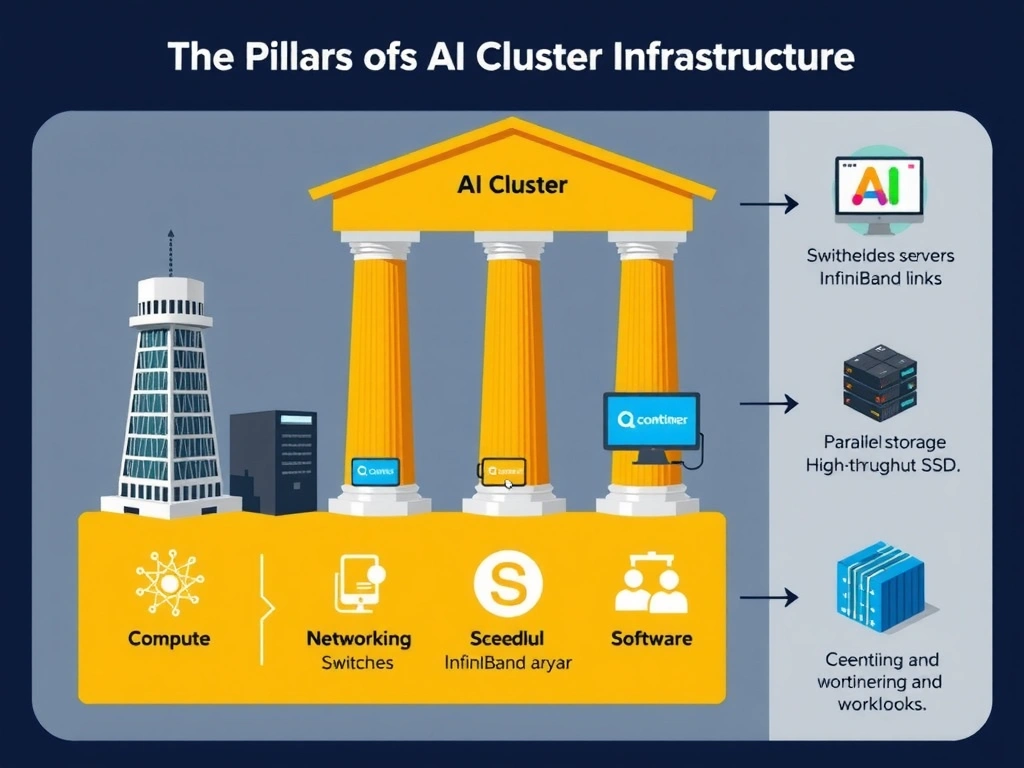
Okay, let's look at this from a high-level design perspective. If you are building an AI cluster, you can't just buy a bunch of GPUs and call it a day. You have to design a complete ecosystem. Industry best practices break this down into five core pillars. Think of them like the legs of a table—if you ignore any of them, the whole thing crashes. First, you have the physical Data Center—we're talking massive power delivery and specialized cooling to keep those hot GPUs running. Second is Compute—the physical servers, CPUs, and GPUs themselves. Third is Networking—which is massive in AI because you need separate, high-speed fabrics for compute synchronization and storage. Fourth is Storage—parallel file systems that can feed training data to the GPUs without choking. And fifth is the Software stack—things like Kubernetes, Slurm, and drivers that schedule jobs and manage the cluster. That's five key components you must plan for. Do not leave any of these out, or your AI project is going to fail before it even starts!
Full explanation below image
Full Explanation
According to industry standards and reference architectures (such as NVIDIA's DGX SuperPOD guidelines), a complete AI cluster infrastructure is built upon five essential architectural pillars. Each component is critical to sustaining high-performance training and inference: 1. Data Center Facility: The physical infrastructure providing the massive power density (often 30–100 kW per rack) and specialized cooling (air or liquid) required by high-density GPU servers. 2. Compute: The physical server nodes containing the accelerators (GPUs) and host processors (CPUs) that perform the mathematical calculations. 3. Networking: The communication fabric, which typically consists of three separate networks: a high-speed compute interconnect (e.g., InfiniBand or RoCE for inter-GPU communication), a storage network, and a management network. 4. Storage: High-throughput, low-latency parallel storage systems (such as GPFS or Lustre) capable of constantly streaming massive training datasets to the compute nodes. 5. Software Stack: The orchestration, scheduling, and system software (including cluster managers like Kubernetes or Slurm, GPU drivers, container registries, and AI frameworks) that manage workloads. Let's analyze the incorrect options: - Options A, C, and D represent incorrect counts. Designing an AI cluster with only 3 or 4 components would mean omitting vital layers (such as software orchestration or specialized networking fabrics), leading to an unmanageable or severely bottlenecked system. Six components is not the standard classification in these reference architectures.