
In a multi-tenant enterprise cluster where teams submit different workloads—ranging from small model debugging to large-scale training runs—which scheduling strategy maximizes resource efficiency and GPU utilization?
Select an answer to reveal the explanation.
Short Explanation
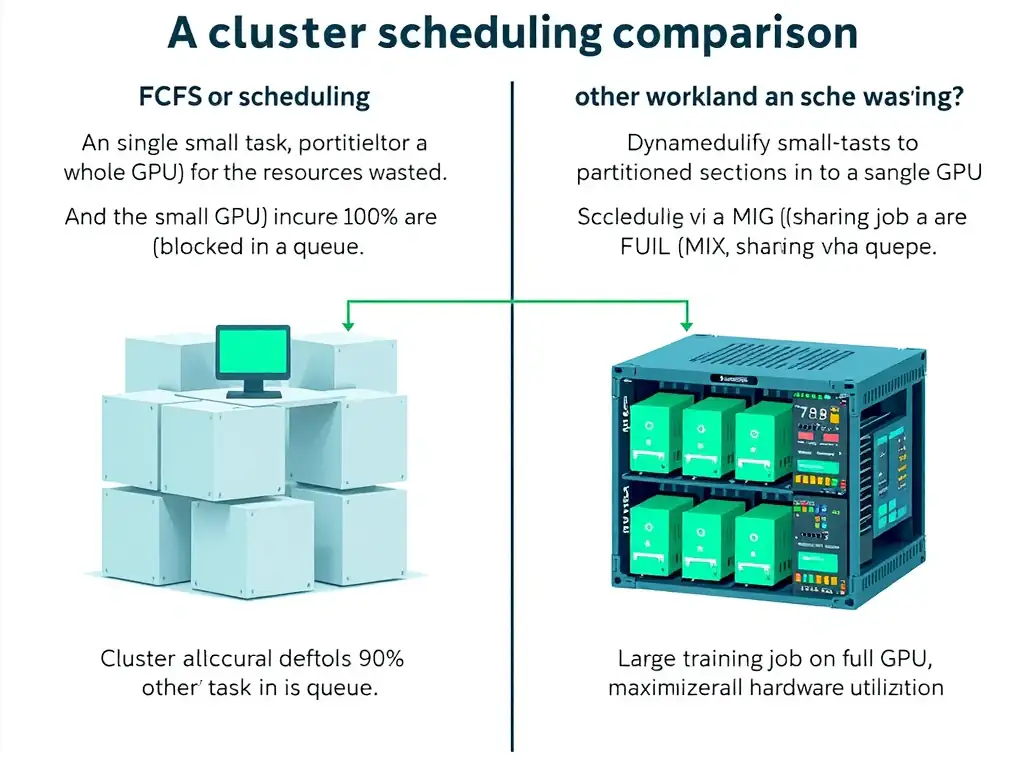
Here's the deal: GPUs are expensive, and idle cards cost money. Dynamic, workload-aware scheduling lets you match each job's actual needs to shared GPU capacity, keeping utilization high and queues short.
Full Explanation
Dynamic scheduling driven by workload-aware algorithms that evaluate job demands and coordinate multi-tenant GPU sharing is the best strategy.
In a shared artificial intelligence and machine learning cluster environment, workloads vary significantly in their compute, memory, and duration requirements. Workload-aware algorithms evaluate these specific requirements (such as requested GPU memory, compute intensity, and priority) and match them to available physical resources. Techniques like NVIDIA Multi-Instance GPU (MIG) allow a physical GPU to be partitioned into separate hardware instances. Dynamic scheduling can assign small development or inference jobs to these smaller partitions while reserving full GPUs or multi-node configurations for large training tasks. This dynamic allocation prevents resource fragmentation and maximizes overall cluster utilization.
Static partitioning, where specific GPUs are permanently assigned to designated teams or individuals regardless of active use, is incorrect because it leads to low cluster utilization because resources cannot be shared. If a team has no active workloads, their allocated GPUs remain idle while other teams' jobs queue up.
Standard round-robin scheduling, which distributes execution slices equally among all queued tasks without evaluating their resource needs, is inefficient for machine-learning tasks because it does not consider the resource profile of the workloads. Frequent preemption and context-switching of large neural network states are highly expensive and can degrade performance.
First-Come, First-Served (FCFS) queuing, which assigns exclusive, unshared GPU access to each job in the order of submission, is incorrect because it leads to head-of-line blocking, where a small job blocks larger, high-priority workloads, or a long-running, low-priority training run prevents developers from running quick validation tests.