
A startup AI company needs to train a custom computer vision model but expects their compute demands to fluctuate wildly over the next six months. Why would they choose cloud-based GPU instances rather than purchasing on-premises hardware?
Select an answer to reveal the explanation.
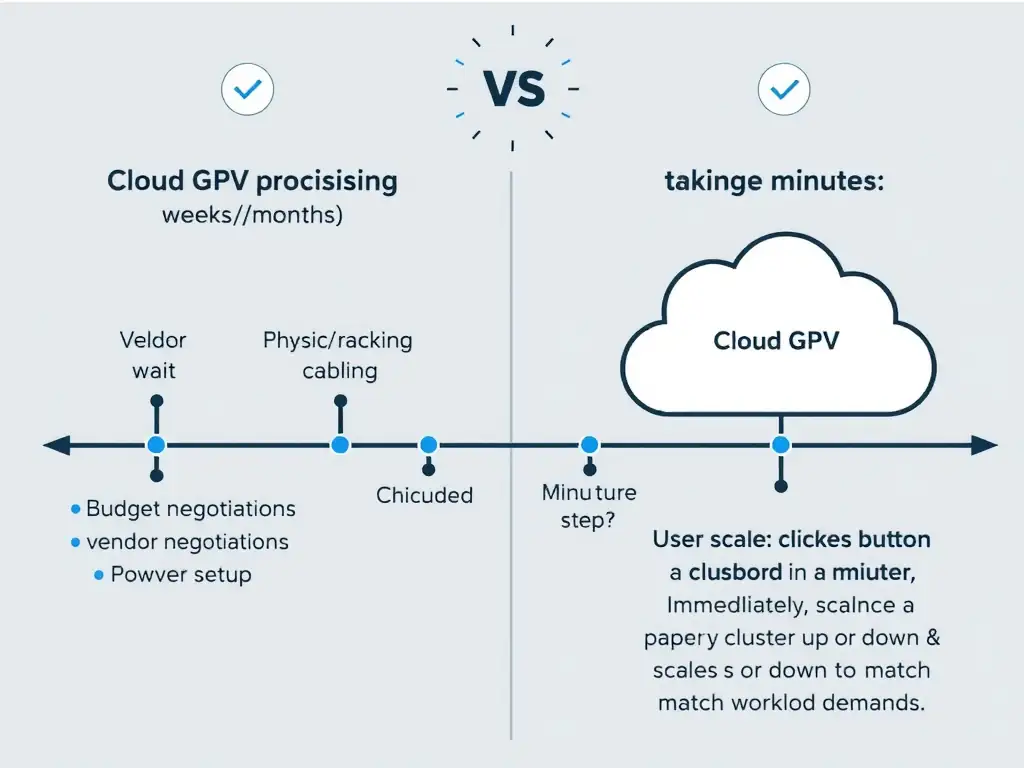
Short Explanation
You need GPUs that can appear and disappear with your workload. Cloud GPU instances let you provision and scale compute instantly, then tear it down when you're done, avoiding months of buying, shipping, racking, powering, and cooling physical hardware. That on-demand elasticity is the biggest reason to choose cloud for fluctuating AI compute demands.
Full Explanation
The primary operational benefit of cloud-hosted GPU services (such as AWS EC2, Google Cloud Vertex AI, Azure ML, or specialized bare-metal GPU clouds) is elastic scalability and speed-to-market. AI and ML development is characterized by highly variable resource demands—teams may need hundreds of GPUs for a short training run, and then only a few for inference or development. Acquiring physical GPUs on-premises involves major capital expenditure (CapEx), hardware supply chain delays, and significant engineering effort to design, power, cool, and network the infrastructure. Cloud GPUs convert these costs into operational expenditures (OpEx) and allow resources to be provisioned or de-provisioned programmatically in minutes, matching the hardware footprint directly to project demands. This is why the correct choice is the one describing on-demand elasticity, instant provisioning and scaling, and bypassing lengthy procurement and installation cycles for physical hardware.
The claim that cloud GPU instances automatically refactor ML models and optimize neural architectures without manual hyperparameter tuning or human engineering is incorrect. Cloud platforms do not automate the design and optimization of custom AI models without human intervention. While Auto-ML tools exist, they are software services and not an inherent feature or operational advantage of renting GPU compute instances.
The claim that cloud GPU instances completely resolve all data transfer latency issues and deliver faster communication speeds than physical networks located on-premises is incorrect. Cloud solutions do not eliminate network latency. In fact, moving large datasets to and from the cloud can introduce significant network latency and data egress fees, whereas on-premises setups often have lower latency for localized operations.
The claim that cloud GPU instances guarantee faster epoch training times for all deep learning tasks, regardless of model size, network architectures, or software settings, is incorrect. Cloud GPUs do not guarantee faster training times. The same GPU model in the cloud versus on-premises will perform similarly; software bottlenecks, poor data pipelines, or mismatched model sizes can still result in slow training times.
Exam caveat: cloud GPUs don't magically write your code or make latency disappear—in fact, on-premises is usually faster for local latency. For flexibility and fluctuating demand, cloud wins.