
An infrastructure architect is analyzing hardware requirements for training a trillion-parameter Large Language Model (LLM). Why does the architect specify high-end GPUs over high-core-count server CPUs regarding memory subsystem performance?
Select an answer to reveal the explanation.
Short Explanation
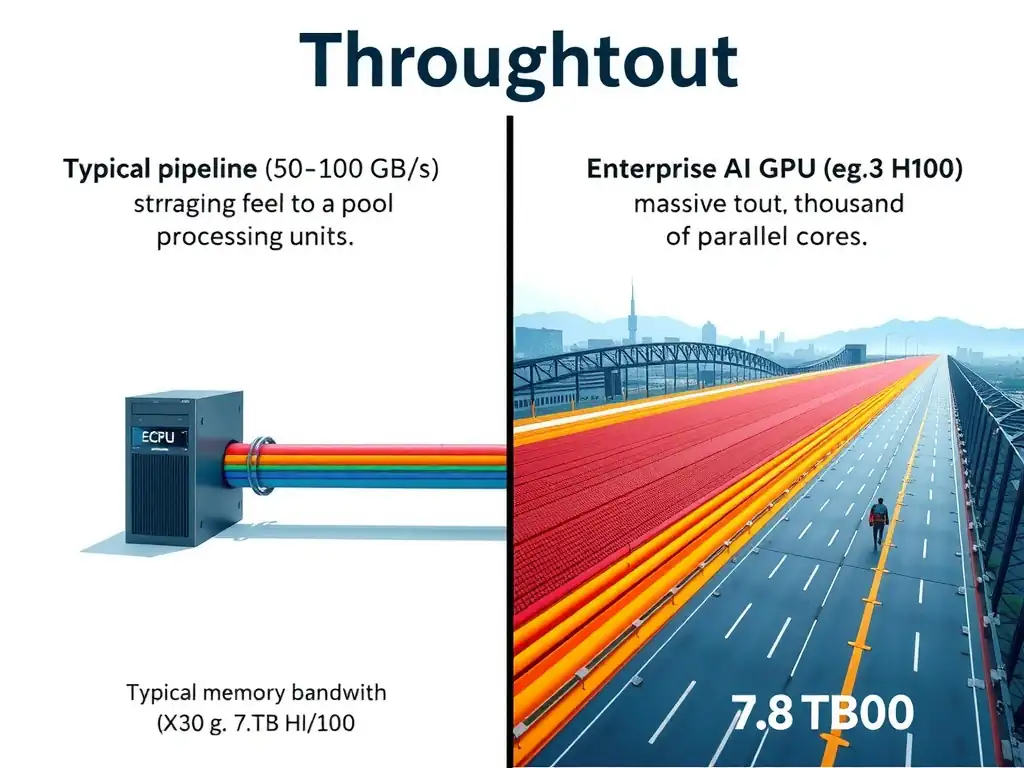
Deep learning is incredibly hungry for data, so you need to feed the compute units fast. A CPU's memory bandwidth is often only 50 to 100 GB/s, while modern high-end AI GPUs can reach up to 7.8 TB/s, removing a critical bottleneck for tensor calculations.
Full Explanation
Deep learning training workloads are highly memory-bound because massive volumes of weights, activations, and gradient data must be constantly transferred between processor registers and memory. A standard server CPU, even with multi-channel DDR5 memory, typically provides around 50 GB/s to 100 GB/s of bandwidth per socket. High-end AI accelerators like the NVIDIA H100 or H200 utilize advanced High Bandwidth Memory (HBM3/HBM3e), which stacks memory dies vertically and connects them via a wide silicon interposer. This design achieves memory bandwidths of up to 3.35 TB/s to 7.8 TB/s. That immense bandwidth delta is critical for preventing compute elements from stalling, making GPUs vastly superior for high-throughput, data-intensive deep learning tasks such as training trillion-parameter LLMs.
The statement that peak memory bandwidth is negligible and that CPU clock frequency and instruction-level parallelism are the main drivers of execution speed is incorrect because memory bandwidth is a primary performance bottleneck in AI workloads. High compute capacity is useless if data cannot be loaded into the compute units quickly enough.
The statement that the memory bandwidth of both architectures is virtually identical and that any observed performance gap is caused by software framework optimizations rather than hardware limitations is incorrect because the performance gap is a fundamental hardware architectural difference, namely DDR memory channels versus stacked High Bandwidth Memory interfaces, not a software optimization issue.
The statement that CPUs supply far greater memory bandwidth than GPUs due to their direct connection to system RAM and support for multi-channel DDR5 configurations is incorrect because CPUs do not supply greater memory bandwidth. While system RAM (DDR5) has high capacity, it has significantly lower bandwidth compared to the specialized on-package HBM used in high-end GPUs.