
In terms of memory subsystem design, how do the hardware architectures of modern enterprise GPUs and general-purpose CPUs differ when handling data-heavy workloads?
Select an answer to reveal the explanation.
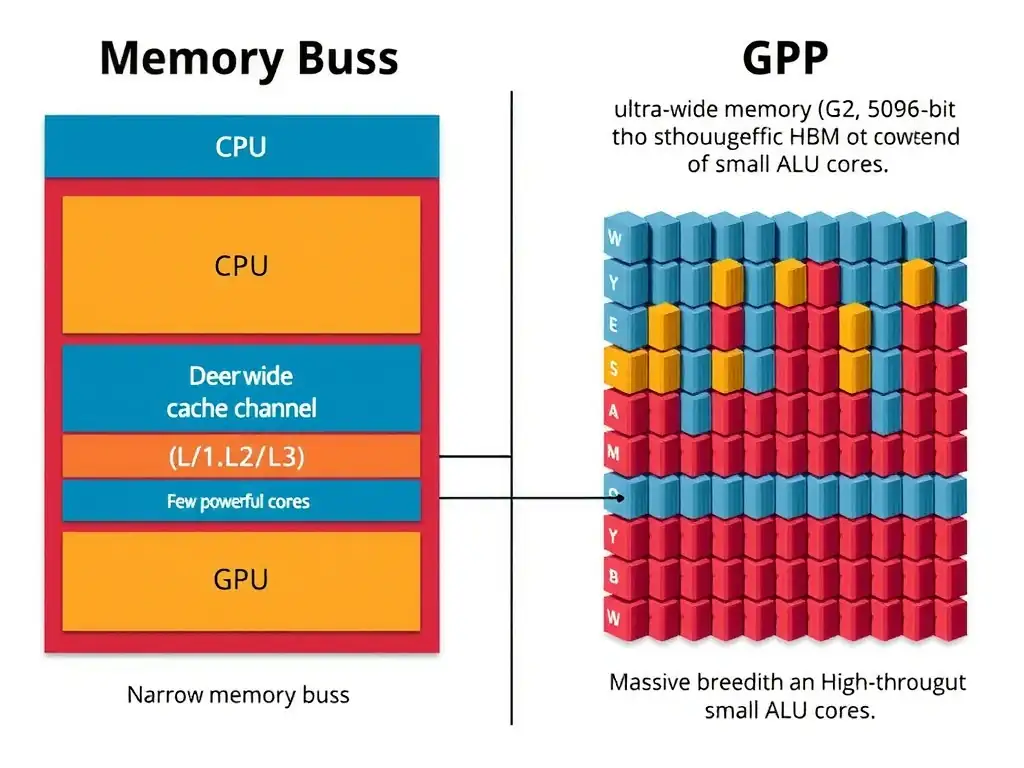
Short Explanation
Check this out: when you're moving data-heavy workloads, GPUs win on bandwidth because they use ultra-wide memory buses to feed thousands of cores at once. CPUs win on latency because they use narrower buses and deep cache hierarchies to get data to a core fast. So think wide and throughput for GPUs, narrow and low-latency for CPUs.
Full Explanation
GPUs are designed for data-parallel processing, requiring massive amounts of data to be fed to thousands of cores simultaneously. To achieve this, GPU architectures use extremely wide memory interfaces. For example, traditional GDDR6 memory on GPUs can use bus widths of 256-bit to 512-bit or more, and stacked high-bandwidth memory architectures use silicon interposers to achieve bus widths of 1024-bit to 4096-bit per stack. This wide path allows GPUs to achieve massive bandwidth, up to multiple terabytes per second. In contrast, CPU memory subsystems are optimized for sequential, single-threaded execution, prioritizing low latency. CPUs use narrower memory interfaces, typically 64-bit per DDR channel and up to a few hundred bits total for multi-channel configurations, and depend heavily on multi-tiered cache hierarchies, including first-level, second-level, and third-level caches, to reduce access latency. The claim that CPUs consistently deliver superior memory bandwidth and lower access latency across the entire memory subsystem due to integrated high-bandwidth memory modules is incorrect. CPUs do not consistently outperform GPUs in memory bandwidth; GPU memory bandwidth is typically one to two orders of magnitude higher than CPU memory bandwidth. Enterprise CPUs also do not generally use high-bandwidth memory as their primary memory. The claim that GPUs rely heavily on massive, multi-megabyte first-level, second-level, and third-level cache hierarchies to hide latency, whereas CPUs leverage large register files and bypass caching altogether, is also incorrect. The opposite is true. CPUs rely heavily on massive cache hierarchies to hide memory latency. GPUs have smaller caches relative to their core count and instead rely on large register files and hardware-based thread scheduling to hide memory latency by switching to active threads while waiting for memory fetches. The claim that both architectures use identical memory bus configurations and achieve comparable peak bandwidth, with the only hardware difference lying in cache controller logic, is incorrect. CPUs and GPUs do not share the same memory bus width design; GPUs have significantly wider memory buses to achieve the high bandwidth necessary for parallel processing.