
A DevOps team is transitioning a large-scale transformer model training run from a single multi-GPU node to a distributed cluster spanning multiple physical nodes. What technical challenges and performance bottlenecks should they expect during this transition? (Select all that apply)
Select all correct answers, then click Submit.
Short Explanation
Here's the deal: scaling out to multiple nodes isn't a free lunch. Your GPUs spend time waiting for gradient synchronization across the network, so utilization drops, and you hit network bandwidth limits and heavy communication overhead. Don't expect faster math convergence, easier debugging, or memory limits to disappear.
Full Explanation
Distributing large-scale transformer model training across multiple physical nodes introduces several architectural hurdles that do not exist within a single server chassis.
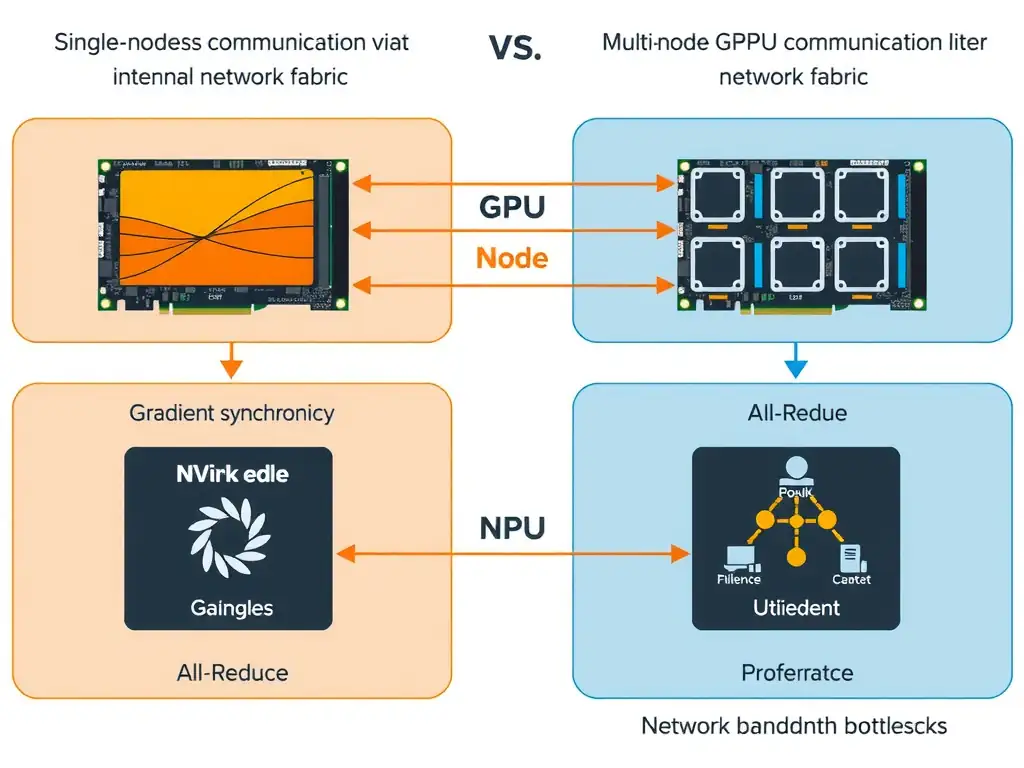
GPU utilization efficiency drops compared to single-node setups because GPUs spend time waiting for communication phases, such as All-Reduce operations for gradient synchronization, to complete before proceeding to the next step. This idle time reduces overall GPU utilization compared to single-node training, where high-speed NVLink interconnects are used.
Substantial communication overhead arises from constant synchronization of gradients across nodes because distributed training requires nodes to share parameter gradients calculated during the backward pass. The time taken to synchronize these gradients across multiple nodes introduces significant communication overhead, which can severely impact scaling efficiency.
Severe network bandwidth bottlenecks occur when transferring data between different physical nodes because node-to-node communication is limited by external network interfaces, such as standard Ethernet or high-speed InfiniBand. Unlike internal GPU-to-GPU communication within a single chassis, which leverages ultra-fast NVLink at up to 900 GB/s, network bandwidth constraints become the primary bottleneck when syncing massive amounts of model data.
The claim that distributed computation automatically increases the model's mathematical convergence speed per epoch is incorrect because distributing computation allows training to finish faster in terms of clock time if scaled efficiently, but it does not improve the mathematical convergence speed of the model itself. In fact, scaling the batch size can sometimes degrade convergence quality and require careful tuning of learning rates.
The claim that tracing, logging, and debugging of training processes across the cluster becomes simplified is incorrect because distributed systems are inherently more complex to monitor and debug. Issues like straggling nodes, network partitions, and desynchronization make debugging much harder, not simpler.
The claim that memory limitations for model states and activation parameters are absolutely eliminated is incorrect because while distributed training allows model states to be spread across multiple nodes using model or pipeline parallelism, it does not eliminate memory constraints. Developers must still carefully manage memory allocations, and improper setups will still result in out-of-memory errors.