
When building an enterprise AI infrastructure for deep learning, why do system architects select Graphics Processing Units (GPUs) rather than high-performance Central Processing Units (CPUs) to run the training workloads?
Select an answer to reveal the explanation.
Short Explanation
You choose GPUs because deep learning is massive matrix math, and GPUs throw thousands of parallel cores plus high-bandwidth memory at it all at once. A CPU is too focused on doing a few tasks sequentially, so it can't keep up with the parallel math and data flow.
Full Explanation
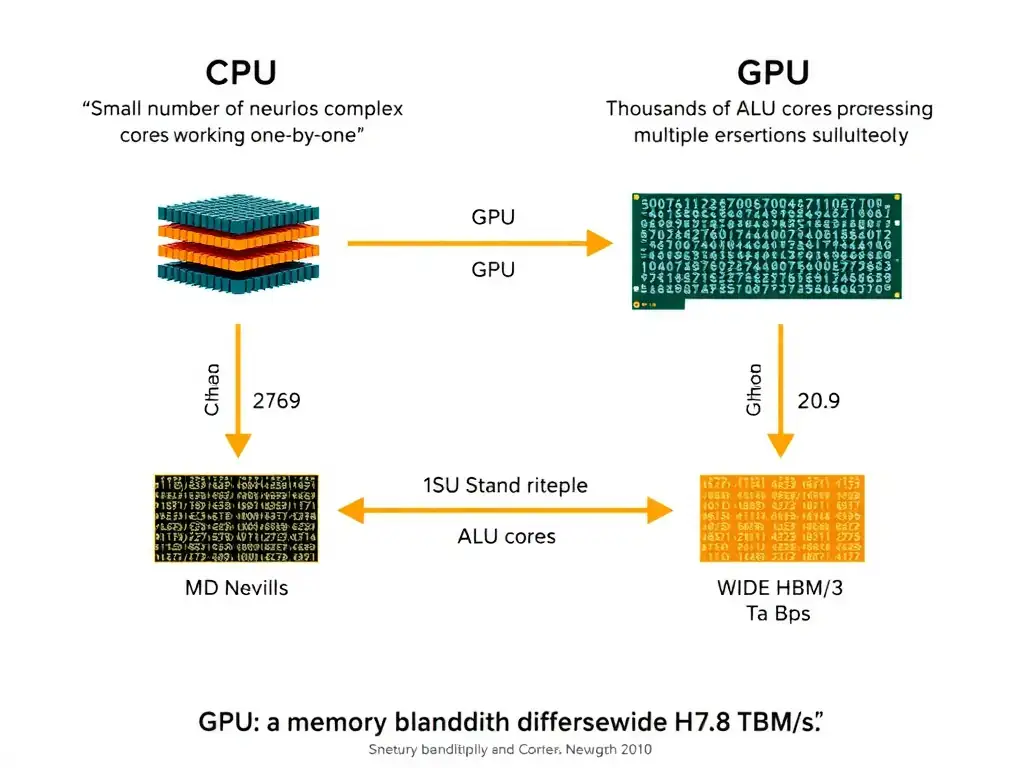
Training deep neural networks requires executing billions of matrix computations and linear algebra operations simultaneously. Central Processing Units (CPUs) are designed for general-purpose computing, prioritizing low-latency sequential execution. They feature a small number of sophisticated processing cores with large caches and high clock speeds, optimized for serial processing.
Conversely, Graphics Processing Units (GPUs) are designed from the ground up for massive parallelism. Instead of a few complex cores, a modern GPU contains thousands of simpler arithmetic-logic units (ALUs) working in parallel. This architecture is perfect for the layer-by-layer calculations in deep neural networks, where operations can be distributed across thousands of data points at the same time.
To sustain these thousands of cores, a GPU requires a memory architecture that can feed data at an extreme rate. GPUs leverage High Bandwidth Memory (HBM) and extremely wide memory interfaces, achieving memory bandwidths of up to 7.8 TB/s. In contrast, standard CPUs rely on narrower DDR memory channels, typically yielding only 50 GB/s to 100 GB/s. Without this high memory bandwidth, the GPU cores would starve, rendering the parallel compute capacity useless.
The choice claiming GPUs use a complex instruction set architecture (CISC) and large cache blocks to execute complex activation functions sequentially is incorrect because GPUs do not rely on complex instruction sets or large individual caches; they use simple cores designed for parallel execution of basic arithmetic. Complex instructions and large caches are CPU characteristics.
The choice claiming GPUs consume significantly less power and emit minimal thermal waste is incorrect because GPUs actually draw significant amounts of power, often 300W to 700W+ per GPU, and generate massive heat, requiring specialized cooling such as liquid cooling or high-airflow chassis and complex power infrastructure in AI data centers.
The choice claiming GPUs feature superior single-threaded latency and faster clock speeds to cycle through serial training layers rapidly is incorrect because CPUs, not GPUs, are optimized for single-threaded performance and low latency. GPUs have lower clock speeds per core compared to CPUs and are not designed for rapid sequential execution.