
Which of the following diagrams or descriptions correctly represents the hierarchical relationship and nesting of Artificial Intelligence (AI), Machine Learning (ML), Generative AI (GenAI), and Large Language Models (LLMs)?
Select an answer to reveal the explanation.
Short Explanation and Infographic
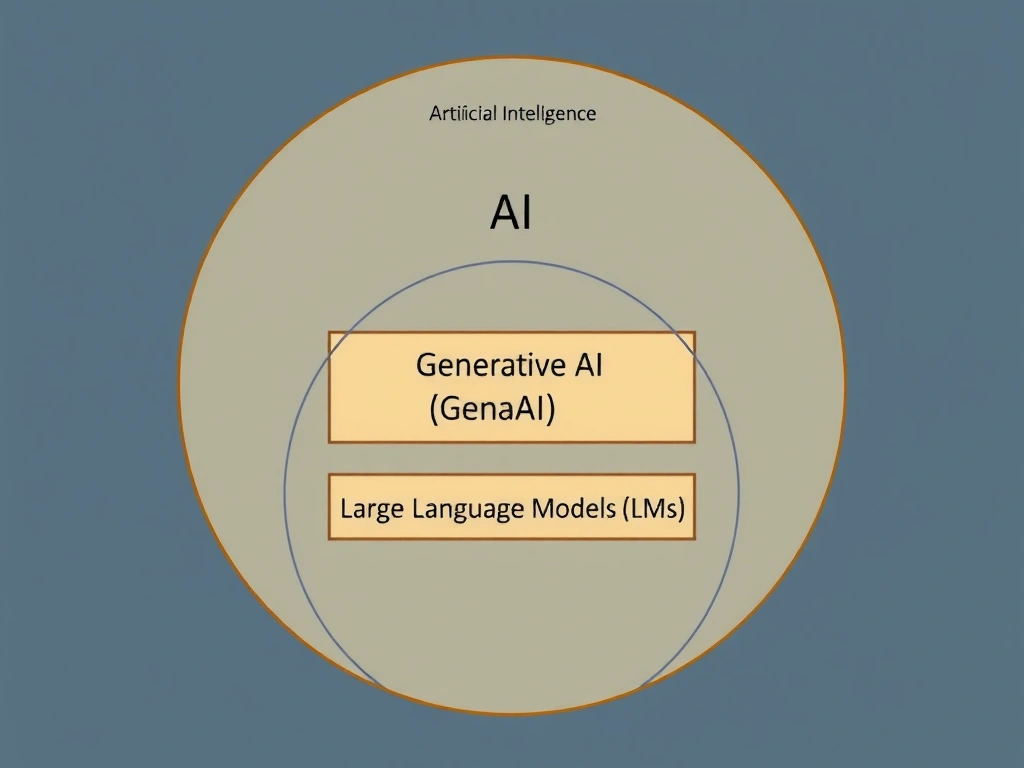
Let's clear up some marketing confusion here. You hear these buzzwords thrown around every single day on LinkedIn, but you need to know how they actually fit together. Think of it like Russian nesting dolls. The biggest doll is Artificial Intelligence (AI). That's any machine behaving smartly. Inside that is Machine Learning (ML), which is the subset where machines learn from data instead of being hard-coded. Inside ML, we have Generative AI (GenAI), which is all about creating new data—like images, audio, or text. And at the very center, the smallest doll is Large Language Models (LLMs), which are specific neural networks trained on massive amounts of text to write like humans. So, LLMs are inside GenAI, inside ML, inside AI. Got it? Sweet, remember this structure because it's guaranteed to be on the test!
Full explanation below image
Full Explanation
Understanding the taxonomy of artificial intelligence is critical for defining project scopes and architectures. The hierarchical relationships are defined as follows: 1. Artificial Intelligence (AI): The broadest classification. It refers to the overall field of computer science dedicated to creating systems capable of performing tasks that typically require human intelligence, such as reasoning, problem-solving, and planning. This includes rule-based systems and heuristics. 2. Machine Learning (ML): A major subset of AI. It involves algorithms and statistical models that allow computers to learn patterns directly from data without being explicitly programmed. 3. Generative AI (GenAI): A specialized subset of ML. While traditional ML models are often discriminative (used for classification, prediction, or regression), Generative AI focuses on generating new, original content (e.g., text, images, code, or synthetic data) based on patterns learned during training. 4. Large Language Models (LLMs): A highly specialized subset of Generative AI. These are deep learning architectures (typically based on the Transformer architecture) trained on massive textual datasets to understand, summarize, translate, and generate human-like text. Therefore, the nested structure is LLMs in GenAI in ML in AI. Let's check the distractors: Option A reverses the hierarchy, claiming AI is a subset of ML. Option C mistakenly places Generative AI inside LLMs, when in fact LLMs are just one type of GenAI. Option D is incorrect because AI and ML are not independent parallel domains; ML is a subfield of AI.