
An engineering team is scaling a deep learning model training run from a single system containing 8 GPUs to a distributed cluster of 32 GPUs spread across 4 server nodes. What are three critical technical requirements or considerations they must address to ensure effective multi-node performance? (Select three)
Select all correct answers, then click Submit.
Short Explanation and Infographic
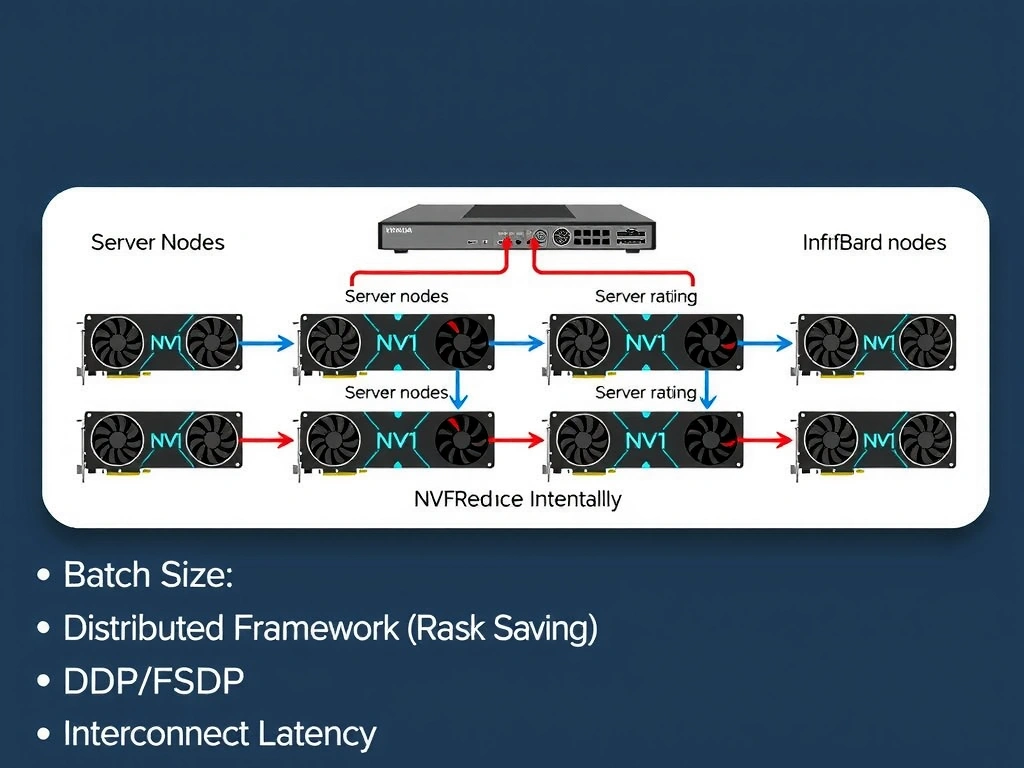
Okay, let's dive into scaling! Imagine your boss walks in and says, "We just bought four servers with 8 GPUs each—go make our models train four times faster!" If you just plug them into standard Gigabit Ethernet switches and hit 'run', you're going to have a bad day. The network will choke instantly! When you scale out to multiple nodes, you must address three major pillars: First, the network: you need super low-latency, high-bandwidth interconnects like InfiniBand or RoCE. Standard Ethernet just won't cut it when GPUs are trying to talk to each other. Second, software: you need distributed frameworks like PyTorch's DDP or DeepSpeed ZeRO to manage how the model weights are split and shared across nodes. Third, optimization: you have to tune your batch sizes and use gradient accumulation. If you don't, your GPUs will spend all their time waiting on the network instead of doing math. And trust me on this, you will never get perfectly linear scaling in the real world due to network overhead. Keep these three points in mind and you'll ace this!
Full explanation below image
Full Explanation
Scaling deep learning training from a single node to a multi-node cluster introduces significant distributed systems challenges, primarily centered around synchronization and communication bottlenecks. Let's look at the three correct considerations: 1. High-Speed Interconnects (Option C): In distributed training, GPUs must constantly share and synchronize their calculated gradients. This synchronization is extremely bandwidth-intensive. Standard networking creates a severe bottleneck. Technologies like InfiniBand or RDMA over Converged Ethernet (RoCE) are required to provide the high throughput (e.g., 200Gbps to 400Gbps per link) and sub-microsecond latency needed for efficient scaling. 2. Distributed Frameworks (Option D): Specialized software libraries like PyTorch Distributed Data Parallel (DDP), DeepSpeed (with ZeRO technology), or Fully Sharded Data Parallel (FSDP) are necessary to orchestrate the distributed run. These frameworks handle the splitting of data (Data Parallelism), the splitting of model layers (Pipeline Parallelism), or the sharding of model states (ZeRO) across the cluster. 3. Batch Size and Gradient Accumulation (Option A): Because communicating across nodes is slower than communicating within a single node, developers must tune the global batch size. If the batch size per step is too small, the GPUs finish computing quickly and spend most of their time idle, waiting on network synchronization. Implementing gradient accumulation allows GPUs to run multiple forward/backward passes locally before performing an expensive global synchronization step, effectively amortizing communication overhead. Now let's examine the incorrect options: Option B is incorrect because simply distributing a workload across nodes does not reduce the VRAM required per GPU unless a specialized sharding framework (like ZeRO) is explicitly implemented. Option E is incorrect because standard Ethernet and cabling are far too slow and will throttle GPU utilization, leading to poor scaling efficiency. Option F is incorrect because distributed training scales sublinearly due to network communication overhead; 32 GPUs will never achieve a perfect 4x speedup over 8 GPUs.