
An infrastructure architect is designing a resource scheduling policy for a cluster of GPUs that runs both large-scale deep learning model training jobs and real-time user inference APIs. What is the most operationally efficient strategy for allocating resources between these two workloads?
Select an answer to reveal the explanation.
Short Explanation and Infographic
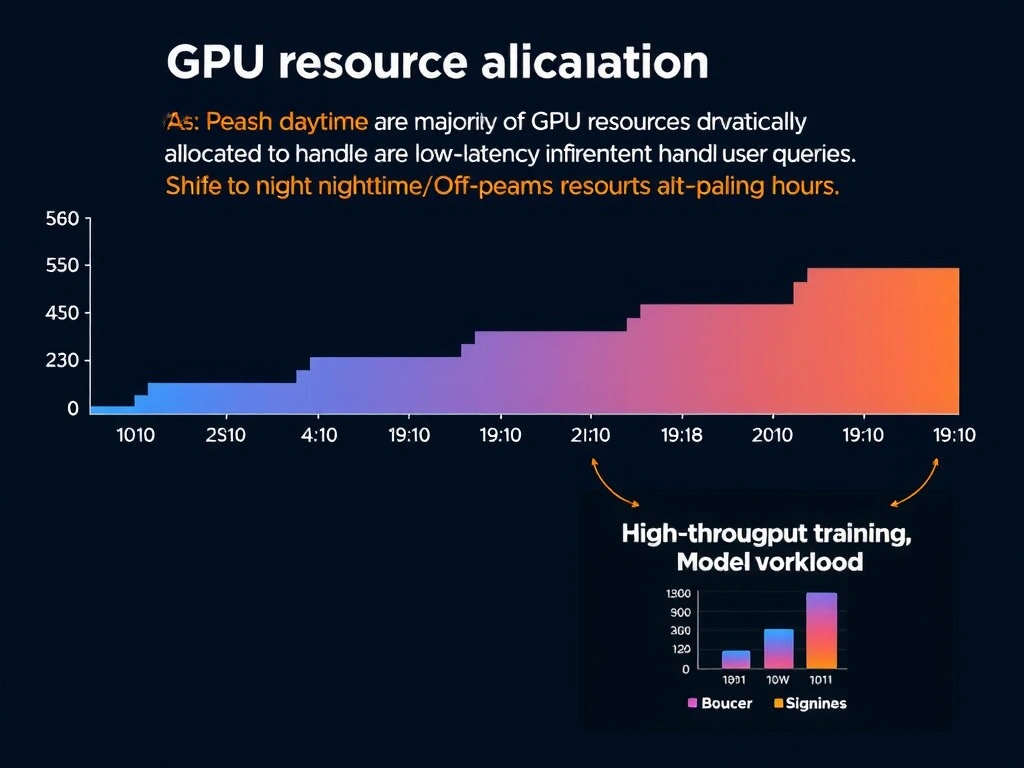
Alright, imagine your boss walks in and says, "Our customer-facing AI chat is lagging, but our model training is taking up all the GPUs! What do we do?" If you tell him you're running training and inference with equal sharing, or that you're waiting for training to finish completely before turning on inference, you'll be looking for a new job! Here's how this works in the real world: training is a batch process. It's hungry for throughput, but it doesn't care about a millisecond of latency. You can run training overnight or during off-peak hours when user traffic is dead. Inference, on the other hand, is all about low latency. Users expect a response now. You must dedicate optimized, low-latency GPU resources to inference during peak hours so users don't get frustrated. Dynamic scheduling and mixed workloads are how we keep data centers efficient.
Full explanation below image
Full Explanation
Deep learning training and inference have fundamentally different performance profiles and SLAs (Service Level Agreements). Training workloads are computationally heavy, throughput-oriented, and process massive datasets over hours, days, or weeks. They are typically run in batches and do not have strict real-time latency constraints, making them excellent candidates for scheduling during off-peak hours when general compute demand is low. Inference workloads are latency-sensitive and demand high availability. When a user requests a prediction, the model must process the query and respond in milliseconds. Because user traffic fluctuates throughout the day, the infrastructure must scale or dedicate resources to handle peak loads without introducing latency bottlenecks. The most efficient cluster resource management strategy combines these requirements. By reserving low-latency, highly available nodes for inference during peak hours and dynamically shifting resource allocations (or using job schedulers like Kubernetes/Slurm) to run large training runs during off-peak hours, organizations maximize GPU utilization and minimize costs. Let's analyze the incorrect options: Option A is inefficient because training and inference have highly asymmetric resource needs; equal partitioning leads to idle inference resources during low-traffic hours and starved training pipelines. Option C is unrealistic because enterprise models require continuous training, updating, and fine-tuning. You cannot shut down inference services to train a new model. Option D is incorrect because training actually requires the fastest available hardware and high-speed interconnects (like InfiniBand or NVLink) to coordinate weights across GPUs, whereas single-instance inference can often be run on smaller, mid-range GPUs or split-GPU profiles (MIG).