
When building an enterprise infrastructure to train deep neural networks, why do engineers deploy dedicated AI accelerators (such as GPUs, TPUs, or NPUs) rather than expanding their cluster using standard multi-core CPUs?
Select an answer to reveal the explanation.
Short Explanation
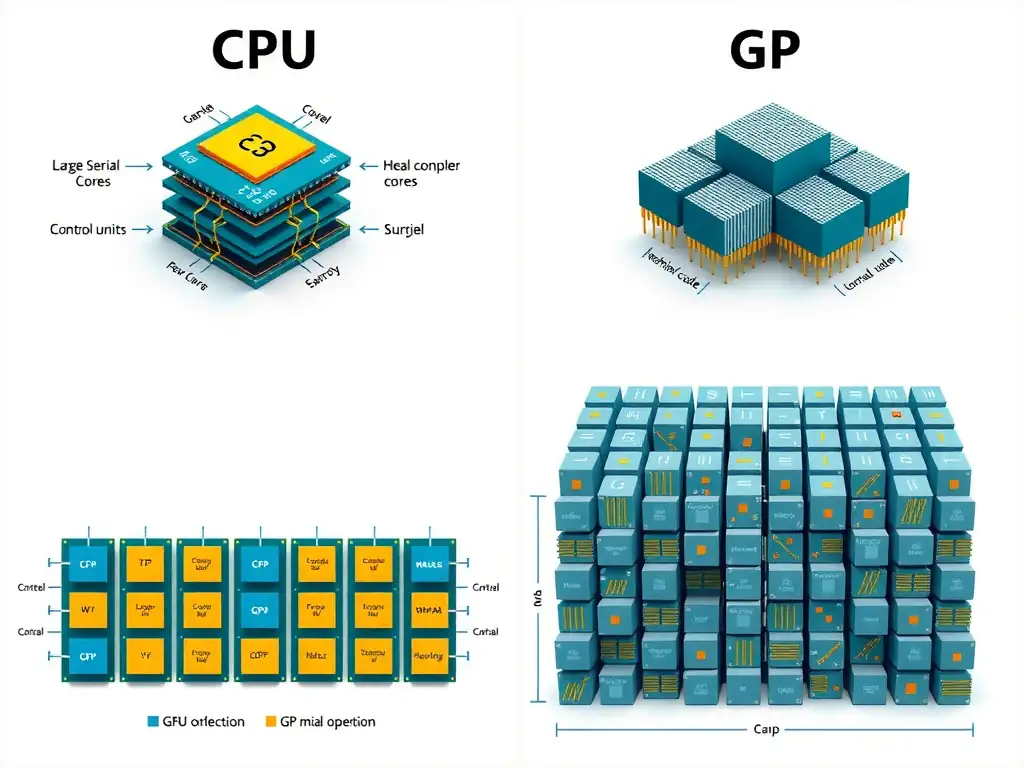
Here's the deal: deep learning is mostly huge matrix math, so you want thousands of simple cores doing calculations at once. AI accelerators give you that parallel horsepower, while CPUs are built to run sequential tasks one after another. Trying to train modern models on CPUs is like digging a pool with a teaspoon.
Full Explanation
Deep learning workloads, particularly the training and inference of large neural networks, are highly dependent on matrix multiplications and vector additions. These mathematical operations are inherently parallelizable, meaning they can be divided into thousands of independent, simultaneous calculations. Traditional central processing units are designed for general-purpose computing. They typically feature a small number of complex, highly optimized cores, such as 8 to 64 cores per socket, designed to execute sequential tasks as fast as possible, using sophisticated branch prediction and large cache hierarchies. AI accelerators, such as graphics processing units, tensor processing units, and neural processing units, are built with a completely different architecture. Instead of a few fast sequential cores, they contain thousands of smaller, simpler arithmetic logic units designed to perform parallel operations. This enables them to process large blocks of data simultaneously, leading to orders-of-magnitude improvements in throughput and energy efficiency for deep learning tasks. The claim that AI accelerators feature dedicated firmware that automatically regulates the data center's intelligent cooling loops and power distribution units is incorrect because facilities management systems and intelligent cooling controllers regulate cooling and power, not the AI accelerators themselves. The claim that AI accelerators act as primary network switches, offloading transport layer security encryption and routing protocols from the fabric is incorrect because network infrastructure and security protocols are handled by switches, firewalls, and SmartNICs or data processing units, not AI accelerators like graphics or tensor processing units. The claim that AI accelerators integrate built-in non-volatile storage arrays designed specifically for hot-standby replication and system-level backup is incorrect because backup and disaster recovery are software-defined storage management functions, not hardware features built into compute accelerators.