
An enterprise has just migrated several petabytes of unstructured training datasets to an object storage bucket in the cloud. Which of the following validation methods provides the most robust assurance that no data corruption or loss occurred during the transfer?
Select an answer to reveal the explanation.
Short Explanation
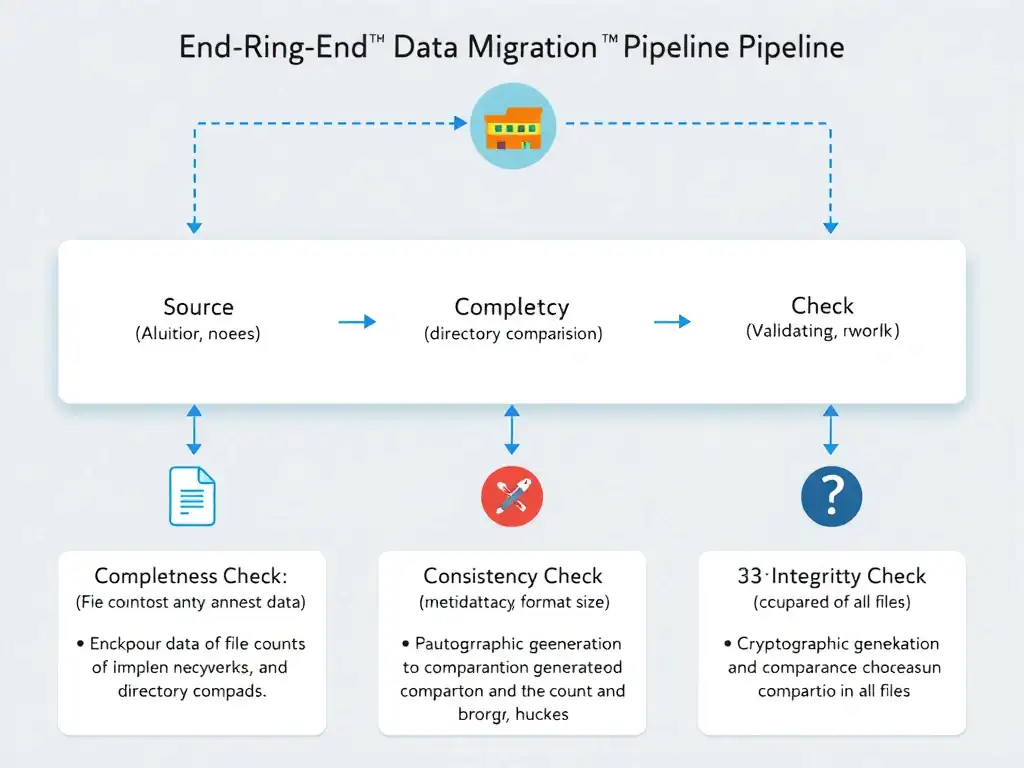
You can't just count files or sample a few and hope for the best. You need a validation pipeline that checks checksums, metadata, and automated consistency across every migrated file, because silent corruption can wreck your training data.
Full Explanation
During large-scale data migrations, data can be corrupted or lost due to network packet drops, storage block errors, file system incompatibilities, or transfer interruptions. Validating the integrity of migrated data is critical, especially for AI workloads where corrupted files, such as corrupt images or truncated text files, can crash training pipelines or introduce silent biases. A complete data validation strategy must address three pillars: completeness, ensuring all files from the source are present at the destination; consistency, verifying that file metadata, permissions, and directory structures match; and integrity, confirming that the exact byte sequence of every file is unchanged, usually verified through cryptographic hashing, such as comparing source and destination MD5 or SHA-256 checksums. The correct approach is the validation pipeline that performs checksum matching, metadata verification, and automated consistency testing across all migrated files, because it automates those checks across the entire migrated dataset. The file-count matching method only checks completeness at a very high level. It does not check if files were corrupted, truncated, or if metadata was lost. The random sampling method that calculates MD5 checksums on a random sample of 5% to 10% of the files leaves 90% of the dataset unverified. In petabyte-scale data, even a 1% corruption rate can mean thousands of corrupt training files, which is unacceptable. The cloud provider API transfer success logs and webhook event success metrics method is helpful for initial troubleshooting but is not a substitute for end-to-end user-side cryptographic verification. It only tells you that the cloud platform's transfer service didn't throw an error, not that the files are logically intact and matching.