
What is the primary advantage of deploying a dedicated Out-of-Band Management (OOBM) network in a large-scale AI cluster?
Select an answer to reveal the explanation.
Short Explanation and Infographic
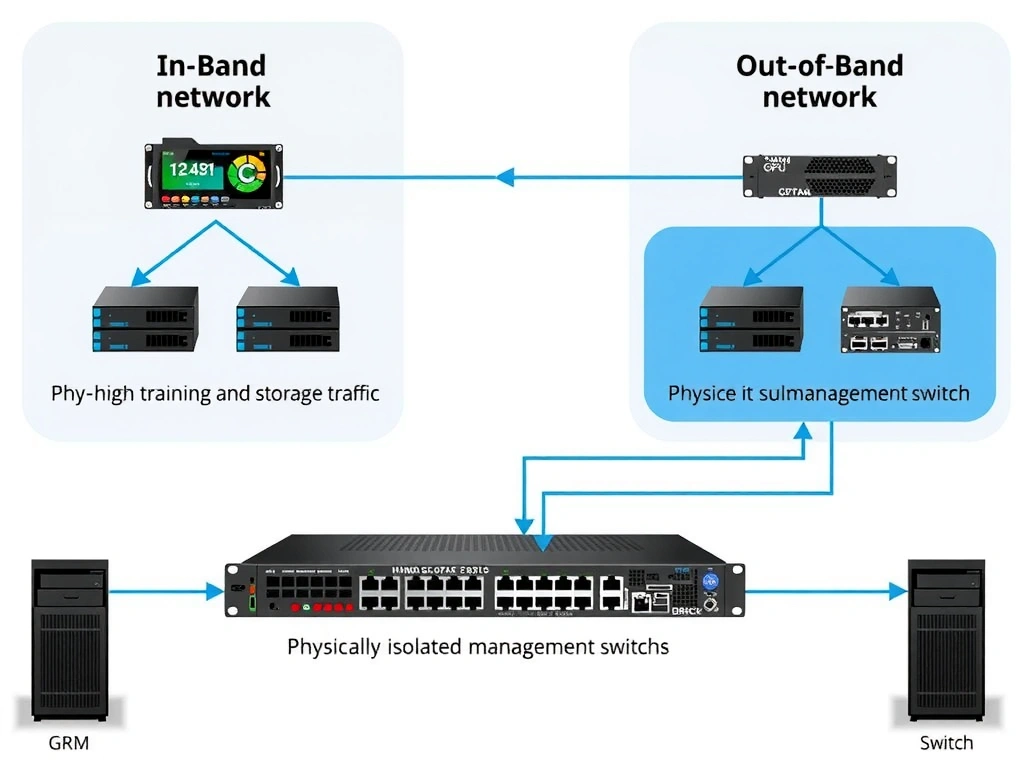
Think of it like this: if the main highway to your datacenter is completely blocked, you need a back road to get in and fix the problem. That's what Out-of-Band Management (OOBM) is. It's a physically separate, low-bandwidth network that connects to the management ports of your servers (like the BMC or iDRAC) and your switches. If a software update crashes the main operating system or a configuration error takes down the main data network, you can still log in via OOBM, see the console, reboot the hardware, and save the day.
Full explanation below image
Full Explanation
Out-of-Band Management (OOBM) involves setting up a dedicated, physically isolated network specifically for the management and control of cluster infrastructure (servers, network switches, power distribution units). This network connects to dedicated management interfaces, such as the Baseboard Management Controller (BMC) on servers (e.g., Dell iDRAC, HPE iLO) or the console/management ports on switches. The primary advantage of OOBM is that it operates independently of the primary "in-band" data network and the host operating systems. If a server experiences a kernel panic, or if a routing loop takes down the main data network, network administrators can still access the hardware console, monitor diagnostics, power cycle the systems, or reflash firmware remotely. - OOBM is not used for data transfers or storage throughput (D), nor is it involved in GPU compute optimization (A) or container orchestration autoscaling (B).