
An organization is deploying a cluster of microservices for natural language processing and wants to maximize GPU and memory utilization. Why does deploying these models in containers yield higher resource efficiency than deploying them inside traditional virtual machines?
Select an answer to reveal the explanation.
Short Explanation and Infographic
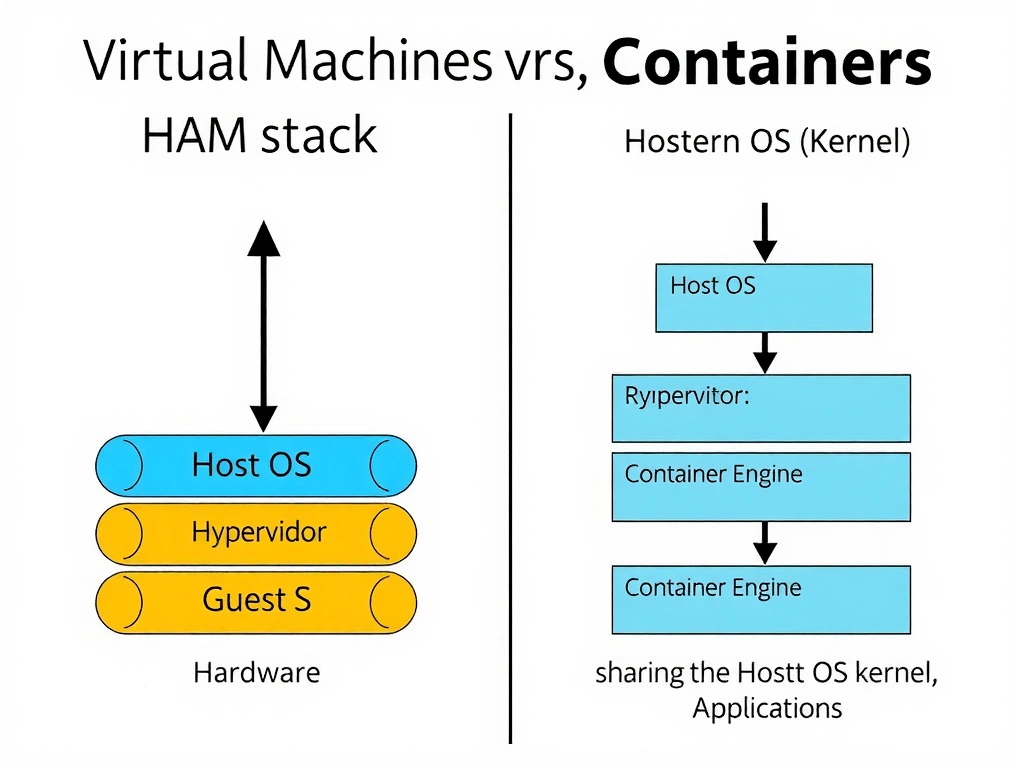
Alright, let's dive into this. Think of a virtual machine like a big, detached suburban house. It's got its own plumbing, its own roof, its own foundation—that's the guest operating system. If you want ten of them, you have to build ten houses. That is a massive waste of resources! Now, think of containers like apartments in a single building. They share the same foundation and plumbing—the host kernel—but they're still separate inside. When you're running AI/ML workloads, you want every scrap of RAM and CPU going to your models, not to booting up ten copies of Windows or Linux. Trust me on this, sharing the host OS kernel is what gives containers that lightweight, super-fast startup edge. If your boss asks you how to cram more NLP instances onto a single server, this is your answer!
Full explanation below image
Full Explanation
Containers and Virtual Machines (VMs) provide virtualization but at different layers of the software stack. A Virtual Machine virtualizes the underlying physical hardware. Each VM includes a complete copy of a guest operating system, a virtual copy of the hardware, and the application itself. Running multiple VMs on a host requires running multiple independent operating systems, which introduces significant overhead in terms of CPU, memory, and storage footprints. Conversely, containers virtualize the operating system. They run directly on the host operating system's kernel (typically Linux) and share its resources. A container engine (like Docker or containerd) isolates namespaces and control groups (cgroups), ensuring that applications run in their own environments without the overhead of booting a full guest OS. This shared-kernel architecture dramatically reduces the boot time and memory footprint of each instance, freeing up critical system memory (RAM) and processor cycles for memory-intensive AI/ML models. Let's break down the distractors: Option A is incorrect because containers do not feature hardware-level or runtime weight compression of models; model compression (like quantization or pruning) is done at the software framework level (e.g., PyTorch, TensorRT). Option B is incorrect because containers still use standard networking protocols (though virtualized/namespaced) and do not bypass the network stack to optimize GPU memory caching. Option D is incorrect because GPU virtualization and isolation (such as NVIDIA MIG or vGPU) are handled by the GPU drivers and hypervisors/container runtimes, not by hardware-enforced CPU partitioning inside the container itself.