
You are designing the storage architecture for an enterprise LLM training pipeline. During the initial stages of data ingestion, preprocessing, and curation—where petabytes of raw text and web scrapes must be stored—which storage tier offers the most cost-efficient solution?
Select an answer to reveal the explanation.
Short Explanation and Infographic
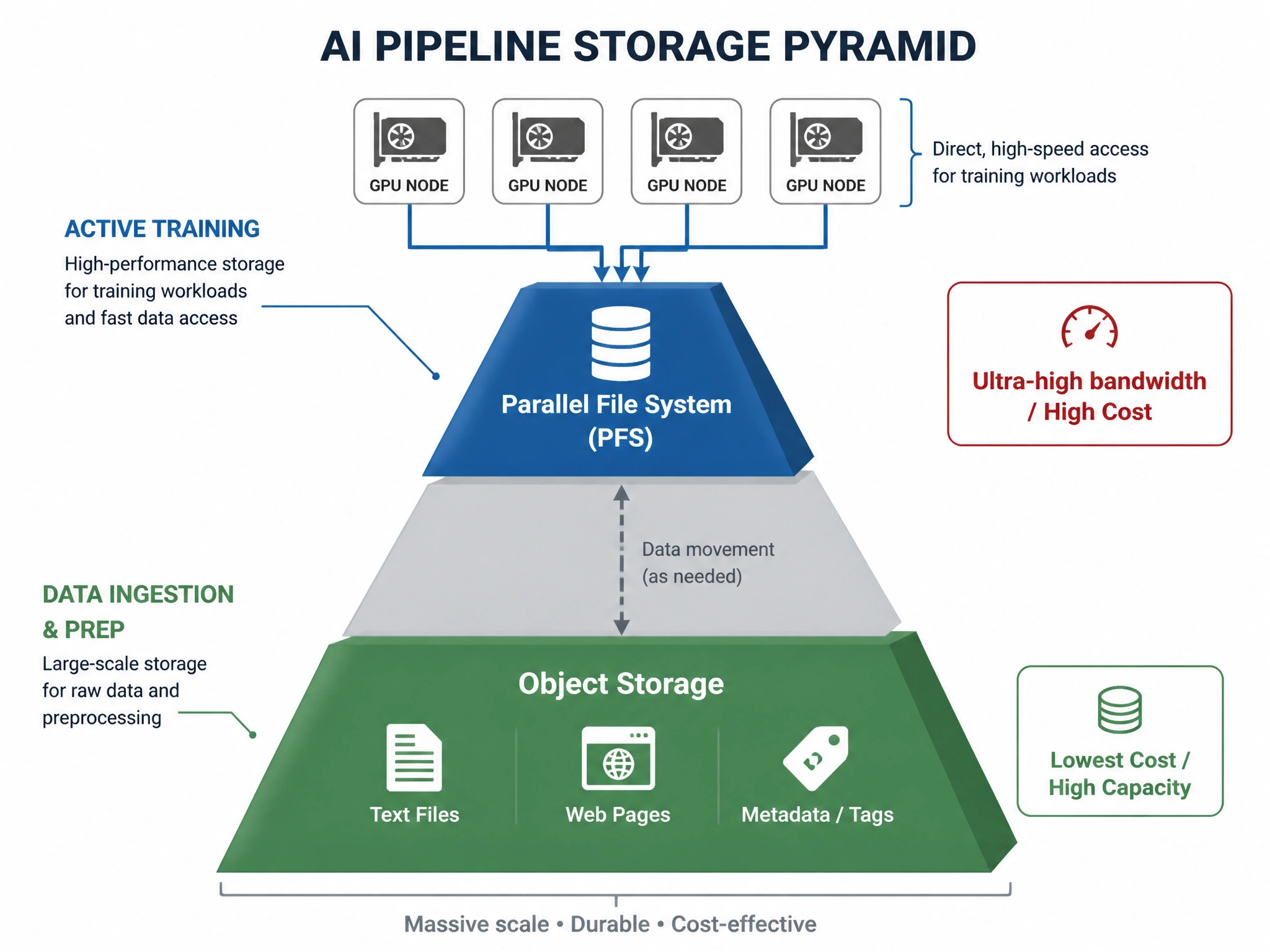
Think of it like this: if you're storing petabytes of raw training data (we're talking text files, web scrapes, images), you don't need the lightning-fast, ultra-expensive storage that the GPUs write checkpoints to. You need a massive, reliable digital warehouse. Object storage (like AWS S3 or on-prem MinIO) is perfect for this. It lets you store billions of files in flat, immutable buckets, and it uses key-value metadata to find them. If you try to dump all that raw ingestion data onto a high-performance parallel file system or high-IOPS block storage, your budget will be blown before you even start training your first epoch. Trust me, use object storage for ingestion, and save the expensive parallel file systems for the active training runs!
Full explanation below image
Full Explanation
AI model training workflows generally consist of distinct phases, each with different storage requirements. The data ingestion, cleansing, and preparation phase involves collecting, processing, and storing massive volumes of raw, unstructured data (often petabytes of text, code, or images).
For this phase, Object Storage is the most cost-effective solution. Here's why: 1. Scalability and Cost: Object storage scales horizontally to petabytes and exabytes at a fraction of the cost of block storage or high-performance parallel file systems. 2. Immutability: Raw training datasets are typically 'write-once, read-many' (WORM). Object storage natively supports immutability, ensuring that raw training data cannot be accidentally overwritten or corrupted. 3. Metadata Management: Object storage uses a flat namespace and permits custom key-value metadata tagging, making it easy to catalog, search, and filter datasets during preprocessing.
Let's look at the other options: - Parallel File Systems (PFS): While PFS (like Lustre or WekaIO) is critical during the active training phase to feed data to GPUs at maximum speed, using it to store raw, inactive, or preprocessed datasets is cost-prohibitive. - Block Storage: High-IOPS block storage is expensive and lacks the flat scale required for massive raw data lakes. - Network File System (NFS): NFS struggles to scale to petabytes of unstructured data and does not handle the concurrent access demands of distributed processing teams as efficiently as object storage.