
You are using monitoring tools like nvidia-smi or DCGM to analyze a training cluster, and you notice a metric called 'GPU Power Draw' expressed as a percentage of the total limit. What does this power utilization percentage specifically represent?
Select an answer to reveal the explanation.
Short Explanation and Infographic
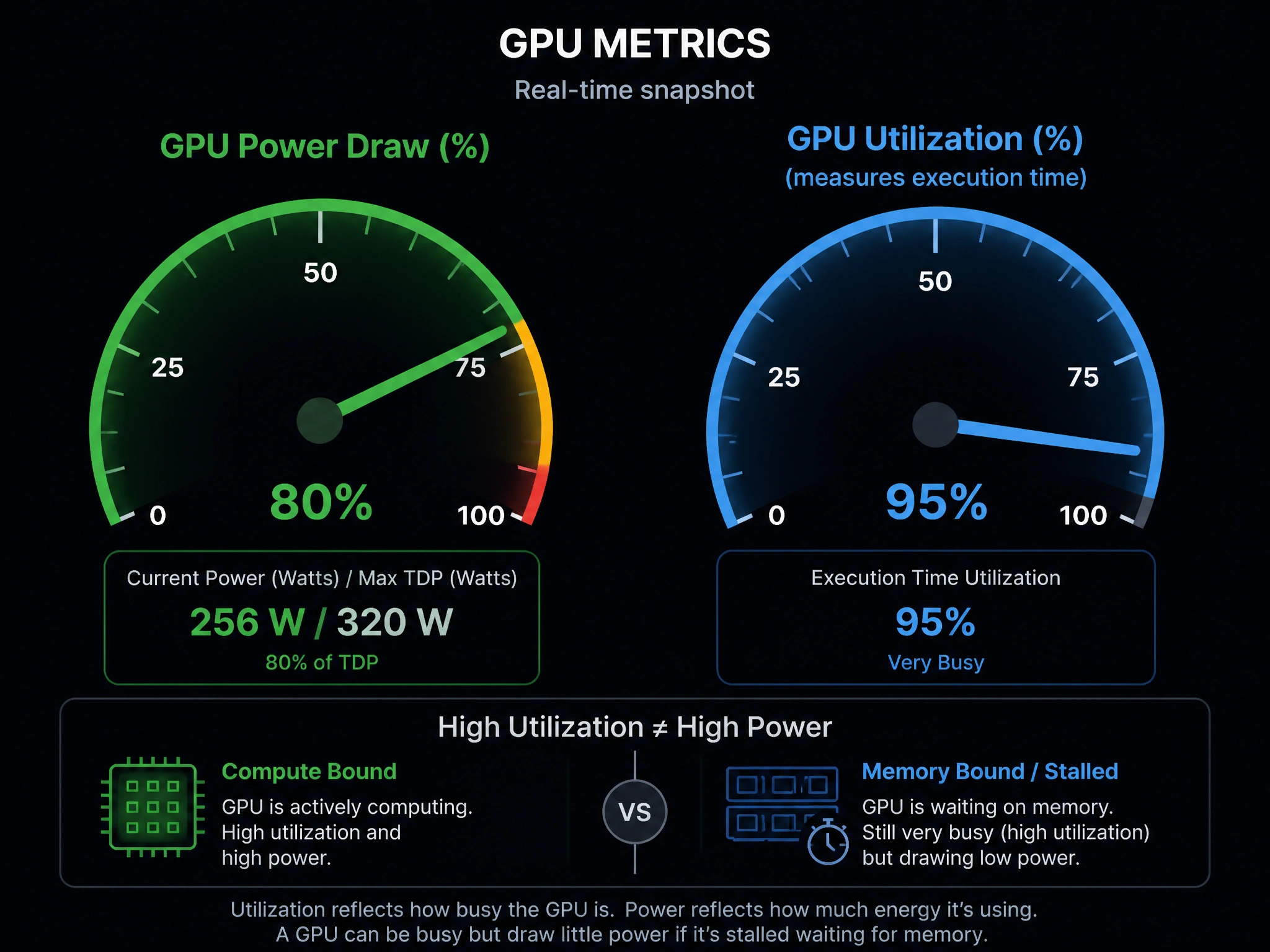
Here's the deal: when you look at GPU power utilization, you're literally looking at the electric meter for that specific card. If you have a GPU rated for a maximum of 400 watts, and your tool says it's running at 50% power utilization, that means it's drawing about 200 watts of power right now. It's one of the best indicators of how hard your hardware is actually working. Why? Because high-performance GPUs are power-limited. When they run massive matrix multiplications, they hit their power limit long before they run out of cores. Don't confuse this with GPU utilization (which is a time-based metric of whether the GPU was busy) or memory bandwidth!
Full explanation below image
Full Explanation
In GPU monitoring and performance analysis, it is critical to distinguish between different utilization metrics. GPU Power Utilization represents the current power draw of the GPU device expressed as a percentage of its maximum configured power limit (thermal design power or TDP).
For example, if an NVIDIA A100 GPU has a TDP of 400 watts and is currently drawing 300 watts, its power utilization is 75%.
This metric is highly useful for several reasons: - Computational Intensity: Power draw is a strong proxy for the actual computational intensity of a workload. Tensor Core-heavy operations (like FP16/BF16 matrix multiplication) draw significantly more power than simple memory transfers or control-flow operations, even if both keep the GPU 'busy' (utilization at 100%). - Power and Thermal Budgeting: Data center managers use this metric to ensure power delivery and cooling systems are not overloaded.
Let's look at why the other options are incorrect: - Memory Bandwidth: Measures the rate at which data is read from or written to the GPU's device memory (HBM/GDDR), not electrical power. - GPU Utilization (Time-based): Measures the percentage of time during which one or more kernels were executing on the GPU scheduler. A GPU can be at 100% time-based utilization but only 40% power utilization if it is waiting on memory. - SM Occupancy / Active SMs: Measures how many streaming multiprocessors are executing instructions, representing execution efficiency rather than electrical power draw.